
11th Battalion, Suffolk Regiment; Northamptonshire Regiment
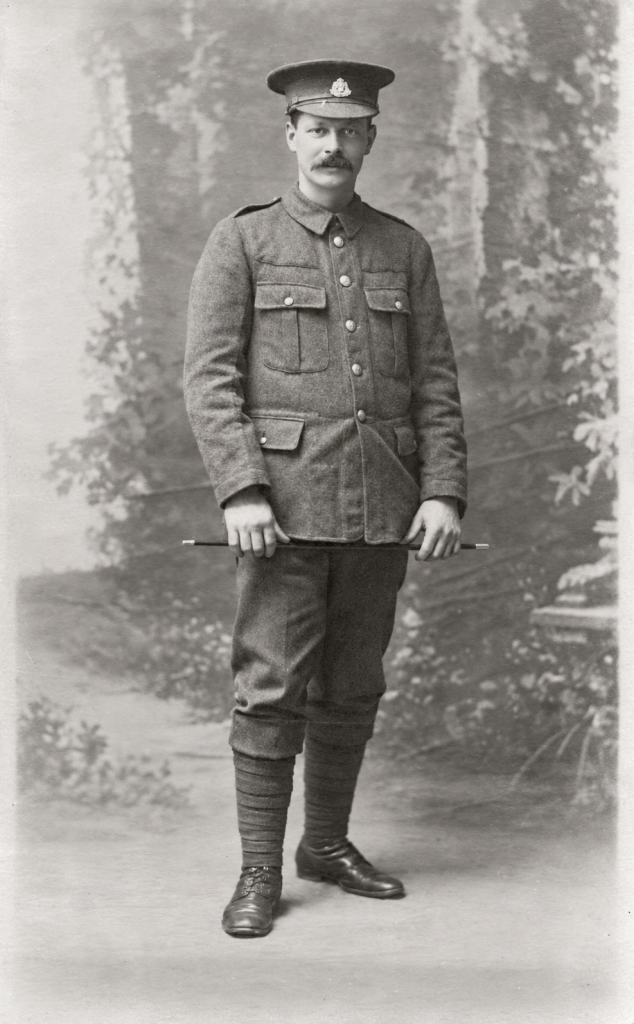
William Custerson was born on 12 June 1887, the first child of David Custerson and Emma Eliza Custerson, née Allen. In the 1901 census, the family was living on Field Road in Kingston. By 1911, William was working as a hurdle maker, like his father.
Hurdle making was skilled rural work. Hurdles were portable sections of fencing, usually made from split and woven wood, used for managing livestock. It was practical, physical and traditional work, demanding strength, hand skill and a close knowledge of timber. William’s later return to thatching and hurdle making suggests that this was not simply a youthful occupation but the working pattern of much of his life.
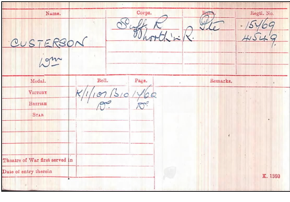
William began his Army service as a private in the Suffolk Regiment, with the service number 15769. This number places him in the same close group as several other Kingston men who joined the Suffolks in the October of 1914. Frank Allgood was 15763, Joseph Chapman was 15768, and Charles Thomas Custance was 15770. William’s number, sitting directly between Joseph Chapman and Charles Custance, strongly suggests they enlisted on the same day.
William first went to France in early 1916. Almost immediately, he developed a debilitating foot condition. This was very likely brought on, not by enemy action, but by the ordinary conditions of front-line service: marching, exposure, wet boots, cold, mud, standing water and trench life. Such conditions could disable a man very quickly. Feet were not a minor matter in an infantry army. A soldier who could not march could not fight, move up to the line, carry equipment, or withdraw safely.
On 18 March 1916, William was admitted to 104th Field Ambulance. Despite the modern sound of the phrase, a Field Ambulance was not just a vehicle. It was a Royal Army Medical Corps unit operating relatively close to the front, responsible for collecting, treating and moving sick and wounded men back through the evacuation chain. The fact that William was treated by 104th Field Ambulance, part of 34th Division, suggests that his condition was first dealt with close to the line rather than in a base hospital.
However, he was then moved further back, eventually passing through the 13th General Hospital at Boulogne. From there he was sent back to England on the hospital ship St Andrew. His first period in France was therefore cut short almost at once, not by a wound, but by the physical damage that the conditions of the Western Front could inflict even before a man entered a major battle.
William returned to France in July 1916 and rejoined his battalion and B Company on 11 July. This was just after the opening of the Battle of the Somme, a time when battalions were consuming reinforcements at a terrible rate.
He remained in the field until 9 April 1917, when he was wounded. He was evacuated on No 12 Ambulance Train to No 42 Casualty Clearing Station in Arras. This time the injuries were sever gunshot wounds to his right arm and to his legs. He spent 16 days in hospital; the pictures show his medical notes.
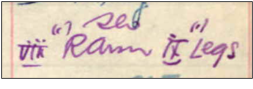
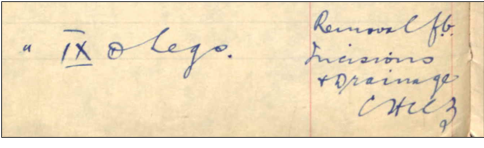
He was first admitted to hospital on 11 April. On 19 April 1917, he was admitted to 102 Field Ambulance and then moved back to the hospital area at Dannes-Camiers. Dannes-Camiers, on the Channel coast, was a major base hospital and convalescent area, with several hospitals operating there during the war. This was part of the normal rearward movement of a wounded soldier: from the front, through field medical units, then to a larger hospital area away from the fighting.
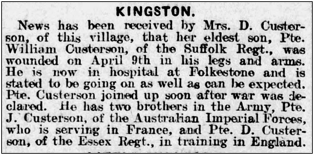
After treatment in France, William was evacuated from 18 General Hospital and sent back to England on the Hospital Ship St Andrew. He then joined the 3rd Suffolks at Folkestone. In practice, this means he was no longer with a fighting battalion. The 3rd Battalion was a reserve and training battalion, used to receive men, train them, hold them while they recovered, and assess whether they were fit for further service.
There was then a long gap before William was marked fit by a medical board on 14 December 1917. He seems to have spent roughly eight months in hospital, recovery and reclassification before being judged fit enough for overseas service again. That is a substantial interruption. It suggests either wounds of some severity, a slow recovery, or both. The medical records suggest that his right leg, particularly his ankle were the problem areas.
William embarked again in March 1918 and was posted to the 12th Battalion, Suffolk Regiment. He arrived in the field on 5 April 1918. This was a hard moment to return to the war. The German Spring Offensive had begun on 21 March 1918, and British formations were being driven back, reorganised and reinforced under intense pressure. The 12th Suffolks were part of the 40th Division, which had already suffered heavily in the German attacks. Sir Douglas Haig’s despatch later specifically mentioned the 12th Suffolks for their stand at Fleurbaix during the March fighting. William was therefore returning to a battalion that had already been badly tested.
On 7 June 1918, William was posted to the 2nd Battalion, Northamptonshire Regiment and given the service number 41549. This move fits the wider pattern of the Army in 1918. The 12th Suffolks left the 40th Division in May 1918, as part of the breaking up and redistribution of battalions after the spring crisis. The 2nd Northamptonshire’s, by contrast, were a regular battalion serving on the Western Front with the 3rd Division. William’s transfer therefore looks like a manpower move: a recovered and experienced soldier being sent into a regular front-line battalion that needed men.
William survived the war. He remained overseas after the Armistice and was eventually returned through Dunkirk for demobilisation. He was placed in the Class Z Reserve, the standard post-war reserve category for many men released from the Army in 1919. This meant that he had returned to civilian life but could technically be recalled if fighting resumed.
By 1939, when the national register was compiled during the Second World War, William was again living on Field Road in Kingston. He was working as a thatcher and hurdle maker. After the long interruption of war, illness, wounds, recovery and re-posting, he had returned to the same rural craft world in which he had begun.
William died in 1946 at Mills Villa on Field Road (Charlie and Linda’s house in 2026) and is buried in Kingston churchyard.
William Custerson’s story is one of repeated return. He went to France in 1916 and was almost immediately sent back sick. He returned to France and was wounded in 1917. He spent months recovering, was passed fit again, returned once more in the crisis of 1918, and was then transferred into the Northamptonshire Regiment. He survived the war and came back to Field Road, to thatching and hurdle making, and eventually to burial in the village churchyard. His record reminds us that survival was not a simple category. Some men came home only after the Army had used them, damaged them, repaired them, reclassified them and sent them back again.