
Bedfordshire Yeomanry; 8th (King’s Royal Irish) Hussars
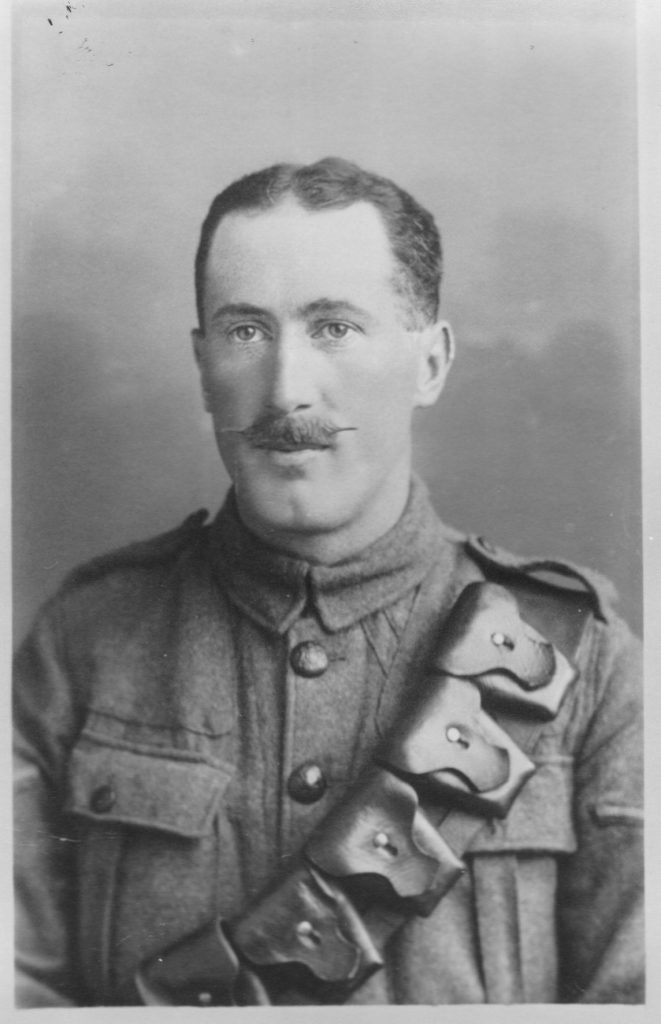
Samuel Clear was born on 2 March 1886 and baptised in Kingston on 21 September 1893. His sister Sarah, born on 14 October 1883, was baptised on the same day. Their parents were Samuel and Jane Clear.
The family can be traced through the census returns. In 1891, the household consisted of Samuel Clear senior, aged 53; Jane, aged 39; Clara, aged 11; Sarah, aged 7; Samuel, aged 5; and John, aged 3.
By 1901, their circumstances seem to have changed. The family was then at Library Farm, with Jane listed as head of the household. Living with her were Clara, Sarah, Samuel, John and Kate, together with John Carter, aged 65, recorded as a servant.
By 1911, the family had moved away from Kingston to 18 Ridgemount Street, Bedford. The household was Jane Clear, aged 59; Samuel, aged 25; Sarah, aged 27; John, recorded as 24; and Katie, aged 17. Samuel was working as a wood sawyer at Howard’s Agricultural Works. The move to Bedford was probably connected with a change in the family’s circumstances after the death of Samuel Clear senior.
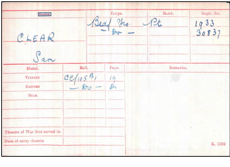
Samuel Clear served as a private in the Bedfordshire Yeomanry, with the service number 1933. He was later renumbered 30837 due to the Territorial Force renumbering scheme introduced in 1917.
The Bedfordshire Yeomanry had earlier roots, but in its modern form it was raised again during the Boer War. In 1908 it became part of the Territorial Force. This meant that it was made up of part-time soldiers who trained alongside civilian work, rather than regular full-time soldiers. The regiment was trained and equipped as lancers. Its headquarters were at Ashburnham Road in Bedford, and given Samuel’s Bedford address it seems likely that he was attached to A Squadron in Bedford, rather than to B Squadron at Biggleswade, C Squadron at Dunstable or D Squadron at Godmanchester.
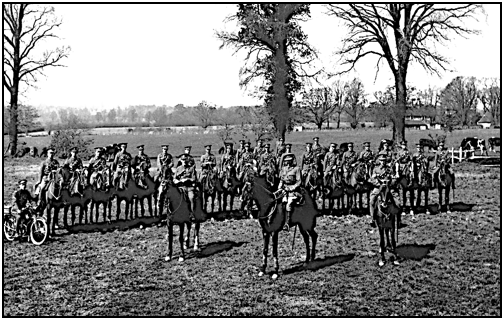
At the outbreak of war in August 1914, Territorial Force units were divided according to availability for service. Men in the 1st Line were liable for overseas service. The 2nd Line was for home service, including men who could not or would not serve abroad. A 3rd Line was later formed to train men and supply drafts to the other two lines.
The 1/1st Bedfordshire Yeomanry was assessed as a 1st Line unit and was mobilised on 4 August 1914. For men like Samuel, this marked a decisive shift. Territorial soldiers who had previously combined evening and weekend soldiering with ordinary civilian jobs were now taken into full-time military service. The 2/1st Bedfordshire Yeomanry remained in Britain, though it appears to have served at the Curragh in Ireland in 1917.
Samuel’s first service number, 1933, suggests that he joined in early 1915, after the regiment had already been mobilised. He would therefore have entered a unit already preparing for overseas service. The later number, 30837, fits the Bedfordshire Yeomanry block used during the Territorial Force renumbering programme from 1 April 1917.
Samuel may have left Southampton with the regiment on 9 June 1915 and landed at Le Havre on 10 June. However, if he was in that troop movement, he would have qualified for the 1915 Star, and his medal record does not show he served in France before the end of 1915. He may therefore have been in a second wave of reinforcements joining the unit in 1916.
Two days after they first arrived in France, the Bedfordshire Yeomanry joined the 9th Cavalry Brigade in the 1st Cavalry Division. For a modern reader, “cavalry” in the First World War can sound almost anachronistic, as if horsemen had somehow strayed into an industrial war of machine guns, barbed wire and artillery. Cavalry still had important uses, especially for reconnaissance, movement, traffic control, mounted patrols and exploiting gaps when the front became mobile. The old cavalry charge was becoming increasingly difficult against modern firepower, but horses remained central to the Army’s mobility and communication, particularly away from the most heavily entrenched parts of the line.
Samuel’s service with the Bedfordshire Yeomanry therefore placed him in a world that was both old and new: trained as a mounted soldier, but serving in a war increasingly shaped by artillery, machine guns, trenches and later tanks. Men in yeomanry units needed to manage horses, equipment, weapons and movement under conditions very different from pre-war training on English roads and fields.
In March 1918, the Bedfordshire Yeomanry was intended to be converted first into cyclists and then into part of a machine-gun battalion with the Essex Yeomanry. The German Spring Offensive disrupted that plan. Instead, the regiment was remounted and then split up in April 1918, with one squadron going to each of the 8th, 15th and 19th Hussars. This was typical of the later stages of the war, when units were reorganised, absorbed or broken up according to the urgent needs of the Army. It is not evidenced administratively where Sam went, in the Register of Absent Voters list of 1918 he is still recorded as belonging to 1/1st Bedfordshire Yeomanry, but the Absent Voters list often lagged the reality of unit transfers. However, James Clear recalled that Samuel said that he joined the Irish Hussars, which would be the 8th (King’s Royal Irish) Hussars.
In May 1918, in the War Office Daily List No 5563 it was reported that Lance Corporal Clear, S 30837 was entitled to wear a Wound stripe. No further details of the circumstances or nature of the injury could be found.
Samuel survived the war. He was awarded the British War Medal and the Victory Medal. The Victory Medal was awarded only to those who served in a theatre of war overseas, so this confirms that Samuel served abroad. It also supports the conclusion that he served with the 1/1st Bedfordshire Yeomanry, rather than the 2/1st, which remained on home service and would not have qualified for the Victory Medal.
In 1920, Samuel Clear married Gladys Marion Wyncote. The marriage certificate appears to give Samuel’s age incorrectly as 32, when he was 33 or 34, but the Bedford address helps tie the record to the same man. The marriage did not take place after the usual calling of banns in a parish church. Instead, Samuel and Gladys married by certificate at St Pancras in London. That does not necessarily imply anything clandestine; marrying by certificate was often simply a quicker route to marriage.
Speed may well have mattered, because in 1920 Samuel and Gladys emigrated to Saskatchewan, Canada. Their son, Samuel Edward Clear, was born on 10 April 1922, and their daughter, Marion Jane Clear, on 2 December 1925. Samuel Edward was the father of James Clear, and the grandfather of Sam Clear 2026, of South Sea Farm in Kingston.
The Clears lived in South Battleford, Saskatchewan, where they were farmers, certainly through the 1930s. At some point they returned to England, perhaps during the Second World War, as both children married in Bedford in the 1940s. Samuel died in Bedford on 19 July 1974.
Samuel Clear’s story begins in Kingston, passes through Bedford and the Bedfordshire Yeomanry, crosses to France with a mounted role through the war, and then carries on across the Atlantic to the Canadian prairies. He was not one of the village men killed in the war, nor one whose service record gives us dramatic wounds or captivity. His surviving story is steadier and more migratory: a Kingston-born man who became a yeomanry soldier, served overseas, survived the war, married in London, farmed in Saskatchewan, and eventually returned to Bedford. It is a reminder that the war did not produce only graves and memorial names. It also scattered lives into new geographies, and then, sometimes, brought them home again a couple of generations later, and for the Clears, right back to Kingston.