
5th (Royal Irish) Lancers; 7th Battalion, The Queen’s (Royal West Surrey Regiment)
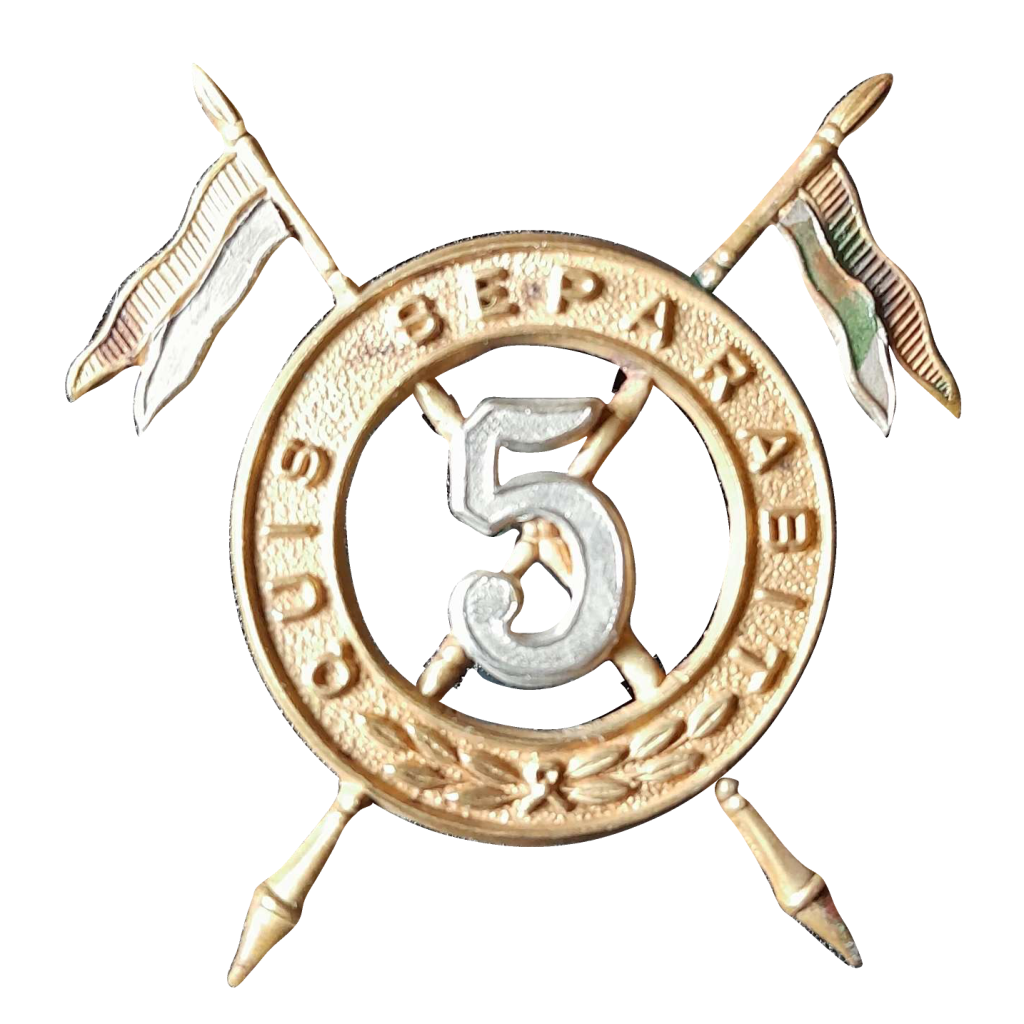
Frederick Charles Driver was born on 23 March 1895 at Great Shelford, the eldest child of Charles Henry and Sophia Driver. He was baptised at Melbourn on 12 July 1896, when his father was recorded as a publican. When in Kingston though, Charles Henry was recorded as a farmer, it seems he was one of the itinerant farm managers that seemed to move around farms every 3-5 years.
The Driver family moved frequently during Frederick’s childhood. By the time of the 1901 Census they were living in Green Lane, Kingston. Frederick was six years old and living with his parents and younger siblings Jack, Charles, Elsie and the recently born Thomas Edward. The family remained in Kingston long enough for two of Frederick’s younger brothers, Thomas Edward in 1901 and Frank in 1902, to be born here. This gives Frederick a clear childhood connection with Kingston.
The family subsequently moved away, first into Essex and eventually to Suffolk. By 1911 they were living at Bird Street Farm, Hitcham, near Ipswich. Charles Henry had by then left the farming and was working as a gamekeeper, while sixteen-year-old Frederick was employed as a farm labourer. The family’s later connection with Ipswich became a lasting one: Frederick would eventually settle there after the war.
Frederick’s record is a rare one where we have a basic set of military records and the usual Births, Marriages and Deaths, but also a parallel account from a website that gives no formal references but seems to come from a family account of his life. Because the informal account ties in very closely with the administrative records, we have used it as a credible account here.
Frederick enlisted in the Army on 22 November 1915, aged twenty. His surviving discharge records refer both to the 5th Lancers and to the Royal West Surrey Regiment, and the family account says that he went to Ireland in January 1916 to join the 5th Lancers.
This places Frederick in Dublin at an extraordinary moment. When the Easter Rising began on 24 April 1916, men of the 5th (Royal Irish) Lancers formed part of the cavalry reserve in the city. Lancers from Marlborough Barracks were among the first British troops to encounter the rebels on Easter Monday, and men of the 5th Lancers were killed during the fighting. We do not know exactly what part Frederick himself played, but he was serving in a unit which was directly involved.
According to the same family account, in August 1916 Frederick was transferred to The Queen’s (Royal West Surrey Regiment) and sent to France. His medal roll confirms that his active overseas infantry service was with the 7th Battalion, The Queen’s, service number G/22012, but gives no date of transfer. The 7th Battalion belonged to 55th Brigade of the 18th (Eastern) Division and had already suffered devastating casualties on the first day of the Somme before Frederick arrived.
Frederick therefore joined a battalion which was being rebuilt while the Somme fighting was still in progress. If the August 1916 transfer date is correct, he was almost certainly with the 7th Queen’s for its later Somme operations.
On 28 September 1916, during the Battle of Thiepval Ridge, the 7th Queen’s attacked the formidable Schwaben Redoubt. Advancing on the left of 55th Brigade, the battalion fought its way into the southern face of the redoubt, captured part of the position and took about fifty German prisoners. The battalion was subsequently engaged around Regina and Hessian Trenches during the fighting on the Ancre Heights. Frederick would have fought at the Battle of the Ancre, which began on 13 November 1916. He had therefore gone from a cavalry unit in Dublin to some of the hardest infantry fighting of the latter stages of the Somme within a matter of months.
During the winter the 7th Queen’s remained on the Somme. By February 1917 it was operating north of the Ancre in the area of Miraumont and Irles, just as the German Army began withdrawing from its exposed positions towards the newly prepared Hindenburg Line.
It was during these operations that Frederick’s war changed completely.
He was wounded while on patrol at Irles and captured on 23 February 1917, one report says the German patrol which captured him treated his wounds and thereby saved his life. His prisoner-of-war records independently confirm his identity, service number 22012, the 7th Queen’s and a place of capture recorded as “Merimont” or “Merrimont”, almost certainly a rendering of Miraumont. Later records place him in the prisoner-of-war camps at Dülmen and Parchim.
Frederick survived his wounds and entered the German prisoner-of-war system. A hospital list records him on 11 May 1917, while subsequent records place Private 22012 Frederick Driver at Dülmen on 3 July 1917 and at Parchim by 27 September. One of these later records identifies him as belonging to Headquarters Company, 7th Queen’s. The surviving records therefore give us glimpses rather than a continuous account of his captivity, but they confirm that he spent the remainder of the war as a prisoner in Germany.
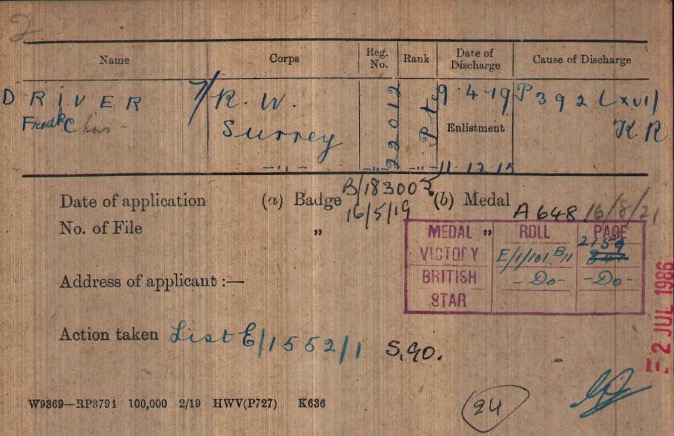
Frederick remained a prisoner until 1919. He would in practice have been released following the Armistice and repatriated to Britain, although he remained formally in the Army for some months afterwards. His discharge documents record his discharge on 9 April 1919 under King’s Regulations paragraph 392 (xvi), meaning that he was no longer physically fit for war service. He was awarded Silver War Badge B183005, as well as the British War Medal and Victory Medal. The fact that he qualified for the Silver War Badge is consistent with his wartime wounds and subsequent state of health, although the surviving paperwork does not allow us to say exactly what lasting disability he suffered.
After the war Frederick returned to Suffolk. In 1922 he married Dorothy Evelyn Rause Hall in Ipswich. They established their home there and had a family, including sons Ernest Charles, born in 1922, and Bryan Edward, born in 1933. Frederick was still living in Ipswich at the time of the 1939 Register. Records indicate that Dorothy died in 1978 and that Frederick died in Ipswich in January 1984, aged 88.
Frederick Driver’s connection with Kingston belonged to his childhood rather than his adult life. He spent part of his early childhood in Green Lane while his father managed one of the village farms, and two of his younger brothers were born in the village. His subsequent life took him from agricultural work in rural Suffolk to the cavalry in Ireland, the streets of Dublin during the Easter Rising, the infantry battlefields of the Somme and finally captivity in Germany.
Finally, adding an intriguing modern note to Frederick’s story – he is the only Kingston man we have found who definitely served in the Queen’s (Royal West Surrey) Regiment, the regiment our unidentified soldier served in.
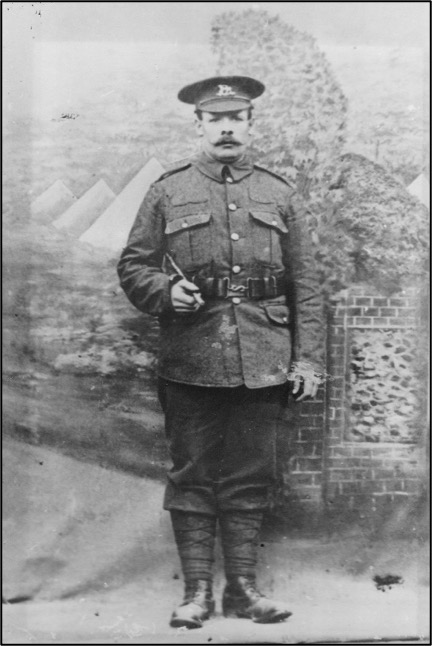
The question is, can we see the man in the picture as a 20-24 year old – Frederick Driver’s age through the war?
Also, given the Driver family moved out of Kingston somewhere between 3 and 12 years before the war, how would someone in the village have had his photograph and given it to the village when the picture was first put together but not remembered his name?
So, we make the connection here for the sake of future researchers being able to start from this point and prove or disprove this conjecture. We are not confident enough to claim the unknown soldier is Frederick Driver just yet.