We can never know exactly what the people of Kingston experienced during the First World War, unless this research prompts the recovery of family memories that have not previously been recorded. The emotional strain is easier to imagine than to measure: long absences, limited communication, uncertainty about where men were serving, and the continuing risk of death, wounds or illness. The depth of that experience is now largely lost to us.
These notes bring the individual stories together. They look at the village from which the men left, the lives they entered as soldiers, the ways in which the war affected those who remained at home, and the very different Kingston that emerged afterwards.
The pre-war population of Kingston
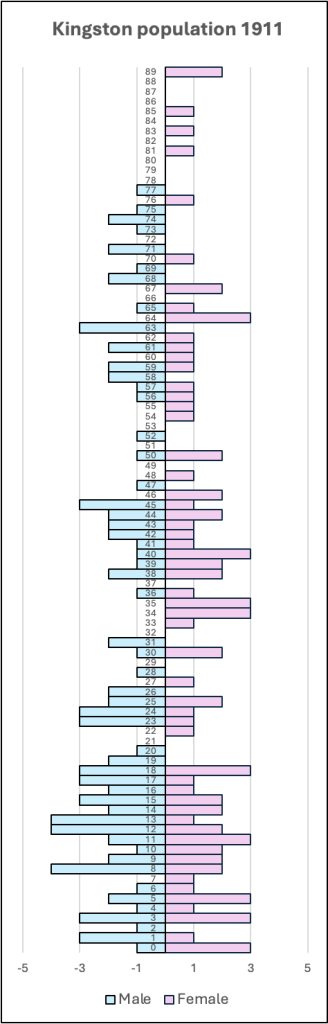
In numerical terms, Kingston in 1911 was not very different from the village today. The census recorded 188 people: 89 females and 99 males. Of those, 109—nearly 60 per cent—had been born in Kingston itself. Toft, Wimpole and Barton each accounted for about 5 per cent, and Kingston Wood for a further 3 per cent. Most of the remainder had also been born in Cambridgeshire, although there were individual residents from as far away as Pontefract, Liverpool, Sandbach and Sithney in Cornwall. Kingston was not immobile, but it was overwhelmingly local.
What was very different was the occupational structure of the village. Of roughly 100 occupations recorded in the census, almost all of the men were connected with agriculture and most of the women who worked outside the home were in domestic service. A shopkeeper/dealer, a person of private means, a printer/cabinet maker, the post mistress, the head teacher, a general dealer, an assurance agent and an assistant teacher—one of each—were almost the only exceptions to this pattern.
Farm management also appears to have operated rather differently from the pattern we might expect today. Families where the husband/father was described as a Farmer were often relatively mobile. The birthplaces of their children suggest that some moved from farm to farm every three to five years, filling a role that we might now think of as a farm manager rather than remaining attached to one holding for life.
We have identified 37 men who, at some point in their lives, had a connection with Kingston. The feedback we got was overwhelmingly that villagers felt that the project should include any reasonable connection, so any recorded period of residence (that was recorded in a census) has been treated as sufficient. A few men lived here only as children, moving as their fathers changed employment; a few were born in Kingston but left as young adults, for work or on marriage; and two had emigrated before the war and returned to enlist. Of the 37, about 28 were probably living in Kingston immediately before the war and were therefore removed from the day-to-day life of the village when they joined up. That was around 15 per cent of the entire population, but a much greater proportion of its young, adult men.
Recruitment
Of the Kingston men who were of, or reached, military age during the war, at least half served. Most of those that we can date with reasonable confidence—around 80 per cent—joined either soon after war broke out or as soon as they became old enough. The records can tell us when the men enlisted and indicate a certain patriotic fervour, joining as they did mostly as Kitchener volunteers, a few as Derby recruits and even fewer, perhaps only one being conscripted. What the records cannot tell us whether their wives, parents and children shared their same enthusiasm.
Agriculture, however, was increasingly protected because food production had to be maintained as military recruitment drained labour from the countryside. There is evidence that Phillip Hagger of Kingston Woods was active in trying to prevent farm workers from being called up. The demands of the Army and the demands of the land were in direct competition. He seems to have won an exemption from the local assessment board for his own son but failed to get a similar exemption for David Custerson.
A soldier’s life
For this project, one important distinction is between a man serving in an infantry regiment and one serving in one of the Army’s specialist corps. The corps—such as the Royal Engineers, Royal Field Artillery and Army Service Corps—were large organisations recruited nationally and providing services across the Army. A man might serve almost anywhere within them. Unless another record identifies his particular battery, company, section or other unit, it can therefore be extremely difficult to establish where he was at any given time. The surviving service record, where one exists, is often the only document capable of linking the man to a specific sub-unit; many such records were destroyed during the Second World War.
Infantry regiments present a slightly narrower research focus. A regiment contained a number of battalions, each normally of roughly 1,000 men at full strength, and traditionally drew much of its identity from a particular region or group of counties. If a man’s battalion can be identified, its war diary can usually establish where that battalion was serving from day to day. This is why the stories of Kingston men who served with the Suffolks or Essex Regiment can often be reconstructed in more detail than those of men in the artillery, Army Service Corps, Cycle Corps or Royal Engineers.
Rotations
Even when a battalion spent long periods in France or Flanders, its soldiers were not permanently in the front-line trench. Units moved in and out of the line as the fighting ebbed and flowed. After particularly costly actions they might be withdrawn to rest, rebuild and absorb reinforcements. New men also needed training in the unit’s routines before entering the line: the front was no place to learn basic orders, drills, procedures and self-care.
Within a front-line sector there was another cycle between different levels of risk and readiness. Battalion headquarters might be established in a farm or other group of buildings behind the line, providing space for officers, horses, stores, ammunition and the many support functions on which the fighting companies depended. The companies themselves were then rotated between positions.
Some men would be in the front-line trenches, holding the line or preparing for an ordered attack. Here the dangers were immediate: artillery and mortar fire, snipers, raids and gas, as well as the prospect of being among the first troops committed when an advance began.
Others would be in support or reserve, sometimes only a few hundred yards further back, ready to move forward if the front line needed reinforcing. They were less continuously exposed, but ‘safe’ was a relative description on an active battlefield.
Others again would be further back, resting and reorganising. Rest did not mean leisure. Men cleaned and repaired weapons and equipment, replaced clothing, practised drills, carried stores and prepared for their next spell forward. The exact pattern varied between units and circumstances, but short rotations of three to four days at each level were usual.
Leave
Soldiers were granted home leave, but when it could be taken was tightly controlled. As a broad guide, a soldier might receive about ten days leave in a year. Men with families in Britain commonly took their leave as one block. For a Kingston soldier serving in France, the journey itself consumed a significant part of it: travelling back to a Channel port, crossing to England, and then taking the train home, before repeating the journey in reverse. Ten days’ leave might therefore mean only five or six days actually in Kingston. Leave nevertheless explains how several of the Kingston men were able to marry, and in some cases father children, while still serving.
Pay
For a British infantry private in 1914, basic pay was strikingly low: 1 shilling a day, or 7 shillings a week. A farm labourer might typically earn something in the region of 14–22 shillings a week, depending on place and season, with a national average of around 18 shillings including allowances in kind. On cash pay alone, therefore, an infantry private earned substantially less than a civilian agricultural labourer.
That comparison is incomplete, however, because the Army fed, clothed, housed and equipped the soldier. His cash pay was consequently much closer to disposable income than a civilian wage from which rent, food and clothing all had to be met. Pre-war Regular soldiers could also qualify for additional proficiency pay, although this did not automatically apply to a newly enlisted wartime volunteer.
Farm wages in East Anglia were among the lowest in the country. That may help to explain why several Kingston men had supplemented their income through Territorial service before the war or had chosen the Army as a career. Regularity mattered as well as the headline amount. Agricultural earnings could fluctuate with season, weather and the availability of work; Army-linked payments were regular government income.
A married soldier did not normally have to receive all of his pay at the Front. The Army operated an allotment-of-pay system under which part of his pay could be assigned directly to his wife or other dependants. The government then added a separation allowance.
By October 1914, for an infantry private serving abroad, a common arrangement required 3s 6d a week from the soldier’s own pay to be allotted to his wife. Government separation allowance increased the amount received by the family. A wife without children received 12s 6d a week in total; with one child, 15s; two children, 17s 6d; three, 20s; and four, 22s. This income could be collected from the Post office in Church Lane.
Take, for example, a Kingston man who enlisted in late 1914 leaving a wife and two children, such as Simon Jacklin. Before enlistment he might have brought home around 15s a week, perhaps with a cottage or seasonal benefits as well.
Once he was serving abroad:
- his basic Army pay was 7s a week
- 3s 6d of that was allotted to his family
- the State added the separation allowance
- his wife and two children received 17s 6d a week in total and
- he retained roughly 3s 6d of his basic pay for personal expenditure while the Army met his food, accommodation and clothing.
In purely household cash terms, enlistment could therefore leave some poorly paid agricultural families with a more regular income than the man’s pre-war farm wage had provided. That does not mean that men enlisted principally for money, nor that the loss of a husband or father was financially simple. It does mean that volunteering did not necessarily imply immediate destitution for the family left behind.
Single men could also allot part of their pay to parents or other dependants. A soldier at the Front had relatively few opportunities for ordinary civilian spending, although canteens, tobacco, food and small comforts still absorbed money. Men could also accumulate money due to them through Army pay arrangements rather than carrying their entire earnings in cash. For agricultural labourers accustomed to low and irregular civilian wages, demobilisation could therefore bring access to a lump sum or savings on a scale they had rarely been able to build before the war.
Trades
A Battalion was a small, self-contained community. A battalion needed men who could build, wire, tailor, cobble, cook, read, write, lead, look after and fulfil all the day-to-day needs of a group that could not rely on external help from the Army, often for days at a time. Clearly a man coming into the Battalion with those skills from civilian life was first in line for these roles, but with injuries and deaths, men had to adapt. They learnt new skills they might never have had the opportunity to learn in their previous lives, especially coming from a small, agricultural village like Kingston.
The 11th (Cambridgeshire) Suffolk Regiment: a ‘Pals’ battalion
The idea behind the Pals battalions was simple and, in 1914, highly persuasive: men would be more willing to volunteer if they could enlist and serve alongside people they already knew. When Kitchener called for a huge volunteer army in August 1914, Britain needed to expand a relatively small Regular Army with extraordinary speed. Because enlistment remained voluntary until 1916, military service had to be made socially attractive as well as patriotic.
The Pals principle allowed men from the same town, workplace, school, profession, football club or neighbourhood to enlist together and, crucially, to expect to remain together. A young man did not have to imagine disappearing alone into an anonymous Army; he could join with friends, brothers, workmates and neighbours.
The approach had several obvious attractions. It was an exceptionally effective recruiting device. Collective enthusiasm—and sometimes peer pressure—could turn the decision to enlist into a group act rather than an individual one. It also reduced the psychological distance between civilian and military life. Recruits trained, ate and lived among familiar faces, making the Army less alien than it might otherwise have seemed. Existing social bonds were also expected to strengthen unit cohesion. Men who had grown up or worked together were thought more likely to support one another and less willing to let their companions down. Finally, the battalion itself could become a focus of local identity. Towns and districts could feel that they had raised ‘their’ unit, and newspapers, employers, mayors and other civic leaders threw themselves into recruitment. The Cambridge Independent Press reporting of autumn 1914 captures that mood vividly, albeit referring to the Cambridgeshire Regiment. Read with knowledge of what followed, its confidence, bravado and patriotism can be difficult to encounter without a sense of foreboding.
The system was not originally the product of a single War Office masterplan. It grew from local initiatives—Liverpool, under Lord Derby, became one of the best-known early examples—and spread rapidly once its recruiting power became clear. The War Office encouraged what had proved to be a remarkably successful means of raising the New Armies. Pals recruitment therefore belonged to a particular moment in the war: 1914 and 1915, when Britain was trying to create a mass army without conscription. It was much more than simply allowing friends to sign up together; it deliberately used existing social networks to generate recruits.
The 11th Battalion, Suffolk Regiment, was one of these locally raised units, recruiting heavily in Cambridgeshire and becoming known as the Cambridgeshire Battalion. It was formed only weeks after Kitchener’s appeal. Recruiting meetings were held in Cambridge and in surrounding villages including Bourn, Orwell and Barton, while recruiting parties moved between smaller communities—including Kingston—encouraging men to join.
In Kingston, it worked with remarkable force. The service numbers show that Arthur Jacklin, William Custance, Frank Allgood, Joseph Chapman, William Custerson and Charles Custance enlisted into the Suffolk Regiment together, probably on 19 October 1914. Their six numbers fall within a span of only thirteen: it is difficult to avoid the conclusion that they were standing in the same recruiting queue. Walter Rayner’s Suffolk number also belongs to the same mid-October period, although he served in a different battalion. A month later Motto Allgood, Frank Jacklin and John Wayman joined the 11th, Frank and John apparently on the same day and Motto perhaps a week earlier. Simon Jacklin followed in December. Fred Lindsay, William Allgood and Payne Custerson joined the Suffolks later in the war, probably through later recruitment schemes. In all, fourteen Kingston men served in the Suffolk Regiment, ten of them at some point in the 11th (Cambridgeshire) Battalion.
The strength of the Pals system also contained its terrible weakness. If men from the same community were concentrated in one battalion, catastrophic battalion losses were concentrated in the same community too. Battalions recruited from a particular town, district, workplace or social group could suffer hundreds of casualties in a single action. A military loss could therefore become, almost instantly, a local community disaster. The consequences became brutally clear on 1 July 1916, the first day of the Somme.
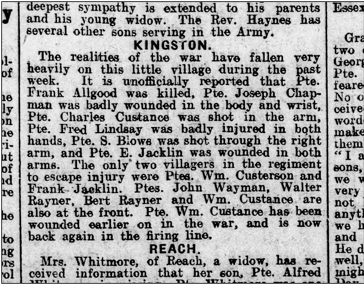
This news report in the Cambridge Daily news of 13 July 1916 sums up the impact for Kingston.
The 11th Suffolks suffered severely on the first day of the Somme, and the effect was visible even in a village as small as Kingston. The table below follows the fourteen Kingston men who served in the Suffolk Regiment, showing when they were training, in Britain or overseas and what happened to them as the war progressed. Seen separately, each service history is one man’s story. Placed alongside one another, they reveal the cumulative attrition of the war on a small group of neighbours and relatives.
Service histories of the Kingston men who joined the Suffolk Regiment

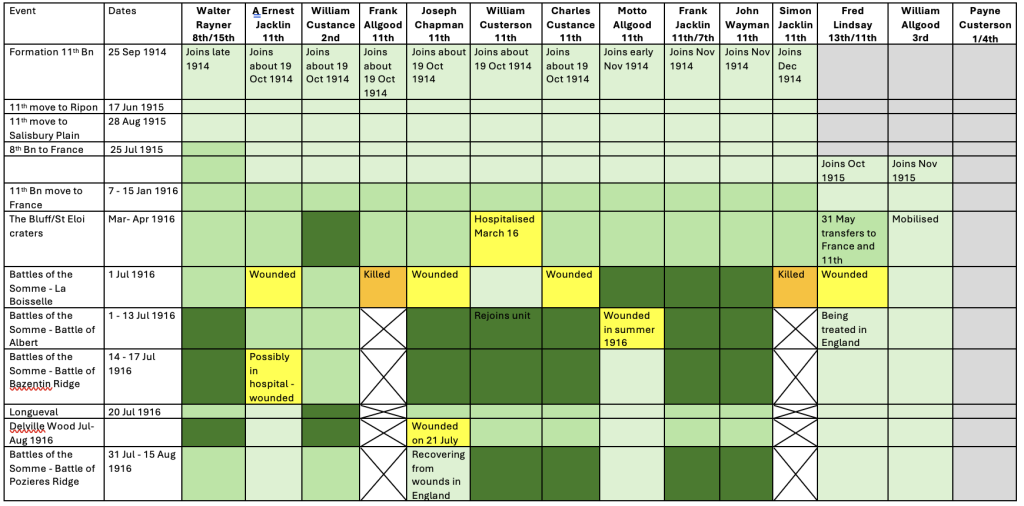
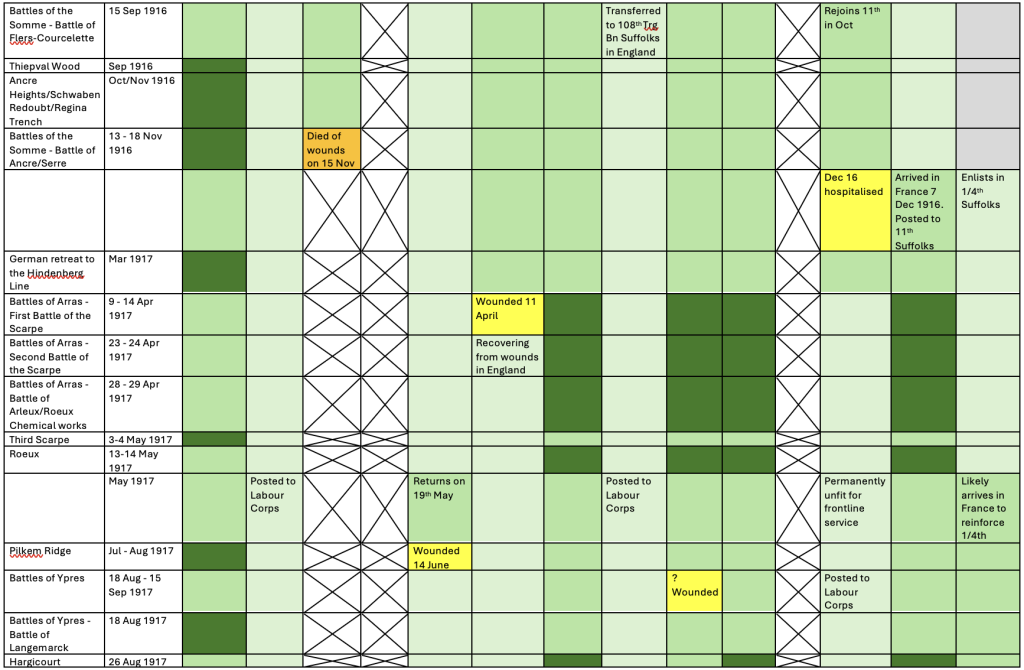
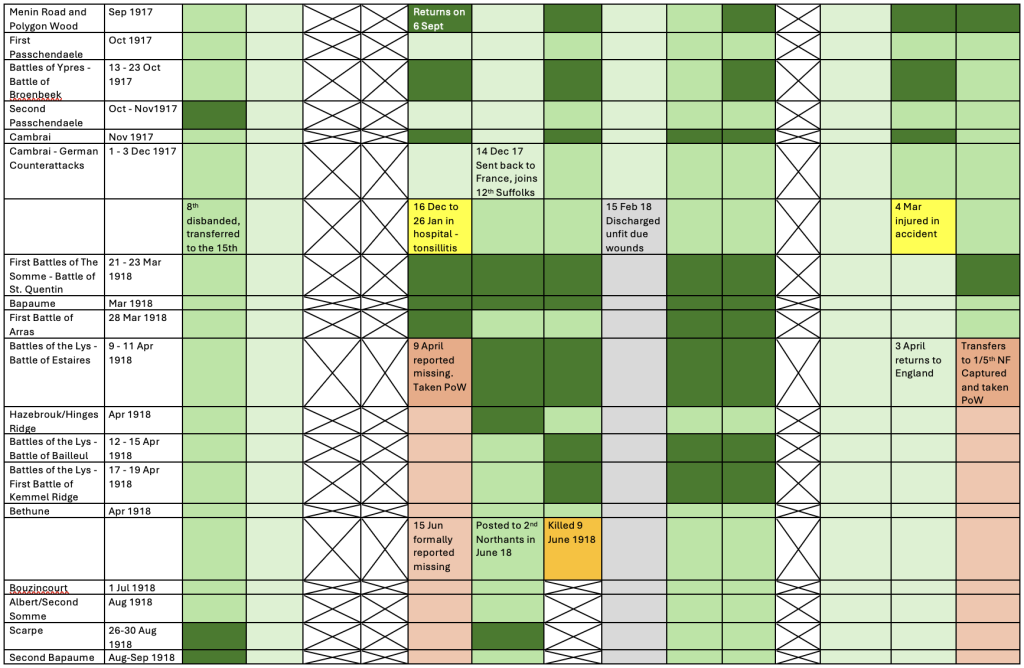
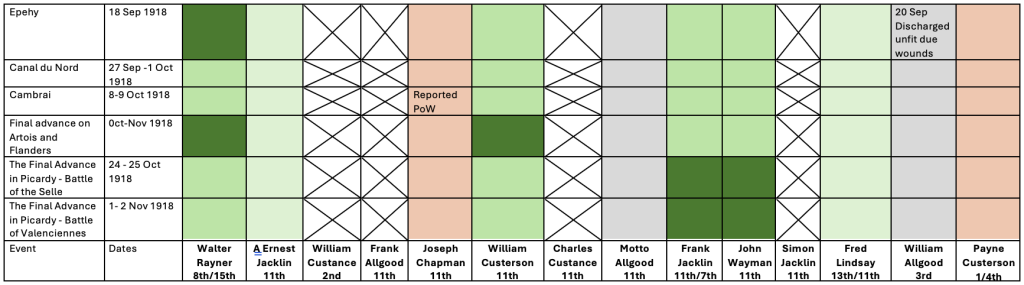
By the Armistice in November 1918, four of the fourteen men had been killed. Seven had been wounded or hospitalised, two of them on more than one occasion; two being eventually discharged from the Army; three had been transferred to agricultural work; and two had become prisoners of war, both after also being wounded. Only four were still serving in front-line infantry units:
- William Custerson, twice hospitalised, had been transferred to the Northamptonshire Regiment
- Frank Jacklin had been wounded in late 1917 but returned to the 11th Suffolks
- Walter Rayner had served continuously in France, first with the 8th and later the 15th Battalion of the Suffolks and
- John Wayman appears to have been the only Kingston man who joined the 11th (Cambridgeshire) Suffolks and remained serving throughout the war without any identified period of hospitalisation, capture or transfer. If the surviving record is complete, he may therefore have been present through an extraordinary proportion of the battalion’s major actions.
Women and the war
We searched all the women recorded in Kingston for any evidence of identifiable wartime service but have not found any. That does not mean that the war left their lives unchanged; much of women’s contribution was never recorded as ‘war service’ at all.
The war did not begin with a government plan for mass mobilisation of women. In August 1914 the expectation was largely that men would fight while civilian society continued as normally as possible. Women were encouraged to nurse, make comforts, raise money and volunteer, but there was considerable resistance to employing them in work regarded as male. Only as the shortage of men became acute did government and employers turn increasingly to female labour.
The major shift came in 1915–16. The shell crisis and the creation of the Ministry of Munitions generated an immense demand for industrial labour. Skilled jobs were divided into simpler operations through a process known as dilution, allowing less-skilled workers, many of them women, to undertake work previously reserved for trained men. The change was politically contentious and transformed employment in industrial towns. For women in Kingston, however, this sort of factory work was geographically out of reach.
The village had pressures of its own. In 1911 there were 49 children under twelve in Kingston—around a quarter of the population. Most children left school at about twelve and began contributing to the household economy: boys commonly entered agricultural work, while girls moved into the limited domestic-service opportunities available locally or helped at home.
Women had always contributed to farm work, particularly farmers’ wives and daughters and women employed casually at busy times, even where the census did not record that labour as a formal occupation. The first response to the loss of male workers was therefore not the arrival of an entirely new female workforce, but greater reliance on the work that rural women were already doing.
Private organisations began recruiting and training women for agricultural work earlier in the war, but the government did not establish the Women’s Land Army until 1917. Its creation came after more than two years of war, when the agricultural labour shortage and the growing threat to food supplies had become critical.
Cambridge had a substantial Women’s Land Army presence, and in 1918 Queen Mary visited to recognise the women’s work. Nationally though, only a minority of the women working in agriculture were formally placed through the WLA. The wider change was much larger but less clearly recognised, female employment in agriculture rose dramatically during the war. In Kingston, where so many men had left and agriculture dominated the local economy, women must have carried a greater share of both productive and domestic work, although this is unrecorded. Women were also keeping essential village institutions running: the school, the post office and both public houses in Kingston seem to be run by women.
However, the institutionalisation and national mobilisation of women was largely a response to the Second World War, and with those formal structures comes the administration and recording that build evidence, and recorded history. Without those records, while we can foresee the substantial increase in responsibility and workload that fell to the women of Kingston, we cannot give measure, example or evidence to it.
The Armistice
For the soldiers, 11 November 1918 did not necessarily mean an immediate return home. Demobilisation took time, and some units remained overseas; several were sent into Germany as part of the post-war occupation. The absence from Kingston therefore extended beyond the formal end of the fighting for some families.
Joseph Custance (Driver in the Royal Field Artillery), Robert Custerson (Gunner in the Royal Field Artillery) and Albert Wayman (Private in the Royal Sussex) were all still serving overseas in October 1919.
Kingston after the war
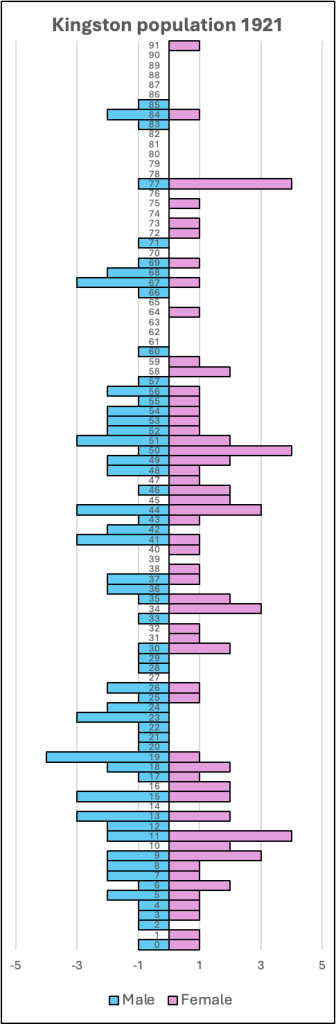
The 1921 census suggests that the war years generated a profound change in Kingston. The population had fallen only modestly, from 188 in 1911 to 173 in 1921—a reduction of about 8 per cent. The striking change is not the number of people, but who they were. Only 63 of the 188 people recorded in 1911 were still living in Kingston ten years later. In a village that had previously sustained multiple households of Waymans, Allgoods, Chapmans, Custersons and Custances across several decades, that degree of turnover needs explanation.
The war appears to have acted as a powerful accelerator of mobility that was already beginning to reshape rural England. Long-established families did not simply shrink: some collapsed from several Kingston households to one, while entirely new families arrived from much further afield. What we see looks less like straightforward depopulation than a restructuring of the village’s labour force, housing and family networks.
Before 1914 an agricultural village could be remarkably ‘sticky’. A family such as the Allgoods or Custances might have several sons working locally, marrying women from Toft or Bourn, daughters similarly marrying into local families, and relatives occupying cottages connected with particular farms. Over generations, employment, housing and kinship reinforced one another. People certainly moved, but there were strong practical reasons to remain within a small local world.
Military service broke that continuity. A very large proportion of Kingston’s young men spent four or five formative years away from the village. Those who survived had travelled across Britain, trained in unfamiliar places, served in France, Belgium, Salonika, Egypt or elsewhere, lived among men from Ireland, Durham, Northumberland, Norfolk, Suffolk, Surrey, London and more and, in many cases, learned skills far beyond agricultural labour.
For a man brought up expecting to work for a Kingston farmer because his father had done so, the imaginable geographical world had become much larger. That did not mean that demobilised soldiers automatically rejected village life, but it did remove one powerful barrier to leaving it: the fear that life elsewhere was unknown and inaccessible.
The economic calculation had changed too. Agricultural wages rose sharply during the war, although so did prices, and the post-war economy offered a wider range of employment. Former soldiers could look towards transport, building, engineering, factories and public services, while Cambridge itself provided a growing labour market within reach. A Kingston man who had learned to drive motor vehicles, lay cables, build roads, manage stores, cook, repair equipment and particularly to lead other men, possessed experience that could be valuable well beyond the farm gate.
The 1921 Census identified the same broad pattern nationally: young people commonly entered agricultural work and then moved away in their later teens and twenties, while agricultural counties showed marked losses of working-age men. Kingston’s experience was therefore distinctive in scale, but not isolated from wider rural change.
Housing was probably another important part of the explanation. Agricultural cottages were often owned by farmers or landowners and effectively tied to employment. Changing employer would therefore mean changing house and, sometimes, village. That relationship gave the rural labour market an unusual degree of geographical mobility: a new job could come with the accommodation needed to make a move possible.
Consider a plausible Kingston household in 1911: a 52-year-old agricultural labourer, three sons aged 24, 20 and 16 who also work on the land, and a family cottage connected with a farm in Kingston.
When the war intervenes all three sons enlist. One marries while serving; another learns to drive; the third is seriously wounded. When they are demobilised, there is no longer any obvious reason why all or any of the three should return to their father’s cottage and resume agricultural labour for a farm in Kingston. One may settle near his wife’s family, one take work in Cambridge as a driver for Marshalls, or the railways, and another might seek employment in a College, in a role better suited to the impact of his wounds.
Once those sons leave, their future households leave with them. Within a single census interval, a family that would have previously expanded to occupy several Kingston cottages can contract to one ageing household. The effect is cumulative: the village loses not only the young men themselves, but some of the next generation they might otherwise have raised there.
The reverse process helps explain the unfamiliar names arriving in Kingston. Wartime labour shortages disrupted the old assumption that the next farm worker would be the son or relative of an existing local labourer. Farms still needed people, but recruitment no longer had to remain within the village’s inherited network.
Employers could therefore recruit more widely, while workers themselves had stronger reasons to move in search of better wages, accommodation or prospects. Where a job included a cottage, moving twenty or thirty miles was economically much easier than it is even nowadays: employment solved the housing problem at the same time. The forces drawing Kingston-born families away could therefore draw workers from Huntingdonshire, Bedfordshire, Hertfordshire, Essex and beyond into the village. The census strongly suggests that they did. By 1921 only 74 Kingston residents had been born in the village, and 40 different birthplaces were represented.
Marriage widened the geography further. Before 1914 a Kingston agricultural labourer was disproportionately likely to meet and marry someone from Kingston, Bourn, Toft, the Eversdens or another nearby parish. War service greatly enlarged that marriage market. A man might meet a woman while billeted in Yorkshire, convalescing in Kent, training in Suffolk or stationed in Hampshire. Once married, there was no automatic reason for the couple to settle in Kingston rather than near her family or somewhere entirely new. We can already see Kingston men meeting and marrying women from places such as Cullompton in Devon and Wisbech while serving.
There may also have been a specifically Kingston effect: the disruption of dense kinship networks. In a village this small, the loss of one household did not affect only the people who lived in it. Families were interconnected, once several parts of the network moved or disappeared, the effect could become disproportionate.
The Custerson family illustrates this particularly clearly. In 1911 they occupied five Kingston households:
- Jane Custerson, aged 85 and widowed, lived near the church;
- Charles Custerson, aged 73, lived in what is now Crossways Cottage;
- Siblings Joseph (31), George (42) and Joyce (24) lived together in Great Lane;
- George (57), Mary (57) and Frank (18) ran the Chequers public house, now the White House; and
- David (45), Emma (44), William (23), Israel (15), David (12), Robert (12), Florence (9) and Rose (5) lived near the Green.
These were not five wholly independent households. Between them, relatives could exchange information about work, provide childcare and elder care, help with accommodation and make introductions to employers or future spouses. We know that the arrangement was already changing by the war years: David and Emma had taken over the Chequers, while George, Mary and Frank had moved to Kingston Wood.
By 1921 Charles and Jane had both died, releasing two properties to other households. Joseph and Joyce remained in Kingston, both unmarried: Joseph, now 41, worked for William Rayner on the farm and Joyce, 34, kept house for him. George and Mary were no longer recorded in the village. Frank had married Kate Dentin from Essex and was living in Caxton. David and Emma remained in Kingston with David, Robert, Rose and Jane, probably still associated with the pub; Israel had returned to Australia, while Florence was working in domestic service at Library Farm, now the Moat House.
Within ten years, therefore, two of the five Custerson households had ended through death and another branch had left the village. Only two independent households remained. One consisted of the unmarried siblings Joseph and Joyce; the other contained only one younger son, David, likely to continue the Custerson name locally. His older brother William was absent in 1921 but had returned by 1939, when he was living with David. Neither appears to have married.
This is the larger significance of the census comparison. Kingston did not simply lose fifteen residents between 1911 and 1921. It experienced a substantial reordering of people, households and relationships. The census authorities themselves remarked on the ‘enormous movements’ associated with the war and acknowledged that population geography had been disturbed on a scale that ordinary intercensal statistics struggled to capture. Kingston’s figures allow us to see what that national movement could mean inside one very small village: familiar family networks thinned or disappeared, new households arrived, and the social continuity of the pre-war village was not restored when the soldiers came home.