
11th Battalion, Suffolk Regiment; London District Labour Corps
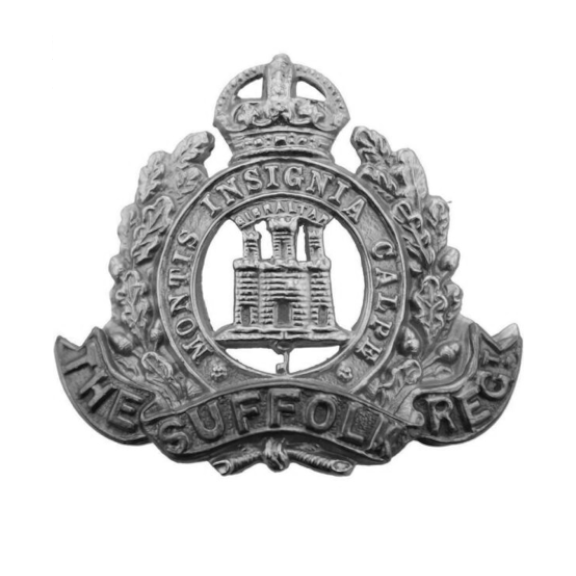
Motto Allgood was baptised in Kingston on 4 April 1886. His exact date of birth has not yet been found. His parents were Edwin Mills Allgood and Naomi Allgood, who lived on the Green in Kingston. The Allgoods were one of the larger Kingston families, and Motto’s unusual first name helps distinguish him from the many other Allgood men who appear in local records.
Edwin Allgood was the older brother of James “Mott” Allgood and appears to have been the only one of the four Allgood brothers of that generation who moved out of the family household. By the time of the 1891 Census, Motto was five years old and living in Kingston with his parents and siblings. Edwin was recorded as an agricultural labourer. The household included Charles, Hannah, David, Winnie, Benjamin, Motto and Susan. Motto himself was recorded as a five-year-old scholar, born in Kingston, Cambridgeshire. This places him firmly within the village before the war, and within the working rural world from which so many of Kingston’s servicemen came.
Although we do not have a photograph of Motto, a useful part of his service record survives. This means that his story can be pieced together more securely than some, though not without difficulty. His evidence is scattered across attestation, conduct, medal, pension, discharge and electoral records, and some of the most important documents survive only in damaged form.
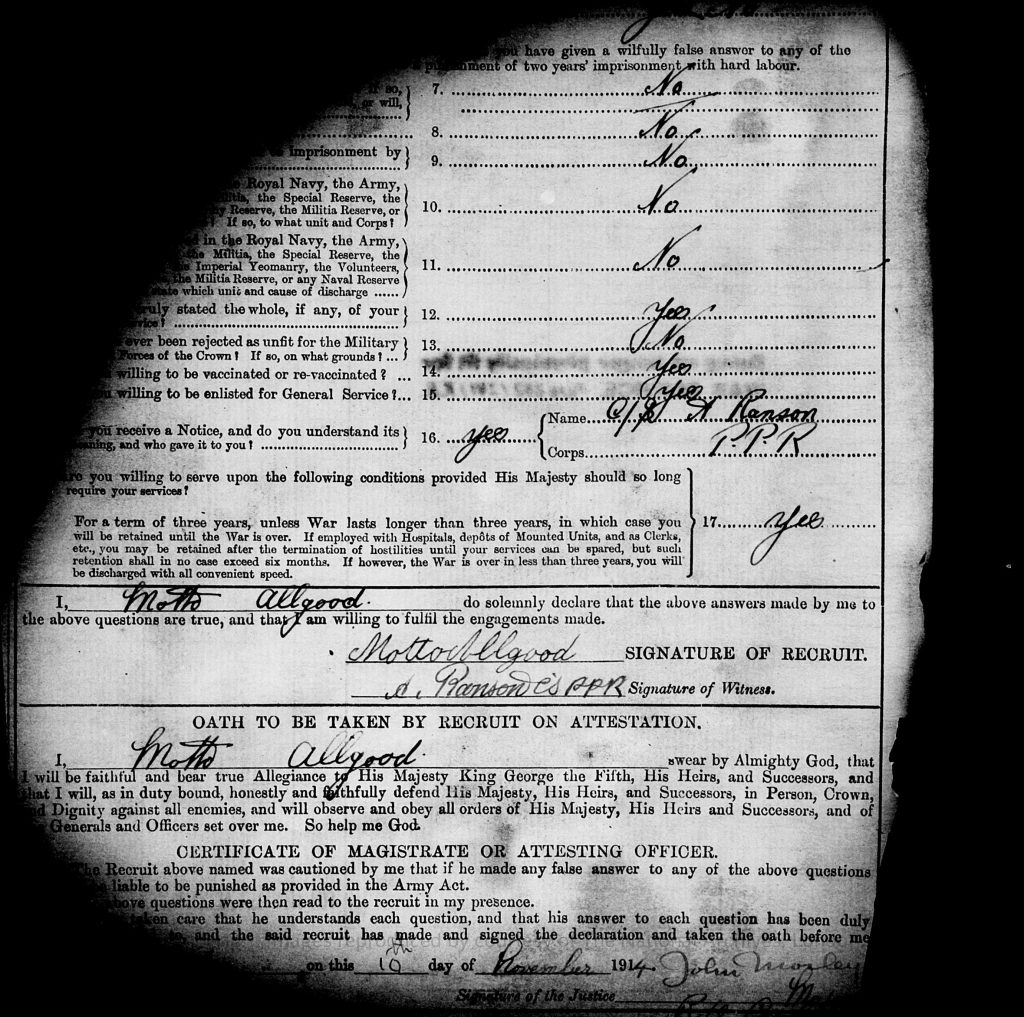
The first surviving document is part of his attestation form: the form completed when a man joined the Army. The blackened edges of the page are noteworthy. About 75% of First World War soldiers’ service records were destroyed in a bombing raid on London during the Second World War. Some survived intact, but many others, like Motto’s, survive only as part of the so-called “Burnt Records”. Depending on how the papers had been filed, the central part of a document might remain legible while the edges were destroyed. In Motto’s case, this is particularly frustrating because his original Suffolk Regiment service number would have been written in the top left corner of the form, exactly where the page is damaged.
What can still be read is that Motto began his attestation in the early months of the war. He enlisted for three years, or for the duration of the war if the war lasted longer. That was the standard form of wartime enlistment. It meant that a man could not simply expect to leave after three years if the war was still being fought.

Motto also appears in the Cambridge Independent Press Roll of Honour, published on 13 November 1914, as one of the men joining the Second Army the previous week. The gap between attestation and the newspaper reference probably reflects the multi-stage nature of enlistment. Joining the Army was not always one simple event. A man might attest, be examined, accepted, posted, and then moved between recruiting and training centres. For Kingston men this might involve travel to Cambridge, Bury St Edmunds, and sometimes Bedford.
Motto appears to have first served in the Suffolk Regiment, probably with the 11th Battalion. No record has yet been found of his Suffolks service number, but the date of his attestation places him alongside several other Kingston men who served with the 11th Suffolks, the battalion closely associated with Cambridge and the surrounding villages. Going to the end of his service, his Silver War Badge records him as being ‘ex 11thSuffolks’ and gives his enlistment date as 10 November 1914.
The 11th Suffolks were raised during the wartime expansion of the Army and became one of the local battalions into which many Cambridgeshire men enlisted. Motto’s apparent enlistment date fits that pattern very well. The timing suggests that he was not a conscript, but a volunteer from the first winter of the war, when the Army was still building the new battalions that would later fight on the Western Front.
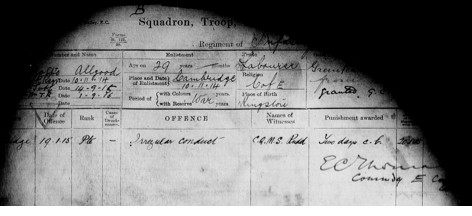
The next surviving page is Motto’s conduct sheet. In the margins of that document, a few more service details can be confirmed. It also records that, on 19 January 1915, Motto was charged with “irregular conduct” by Company Quartermaster Sergeant Rudd and confined to barracks for two days.
This should not be over-read. “Irregular conduct” could cover a minor offence in training: being improperly dressed on parade, failing to comply promptly with an order, being late, or some similar breach of military routine. The punishment, two days confined to barracks, was modest. The fact that the Company Quartermaster Sergeant was involved suggests something connected with discipline, kit, parade or the practical business of learning Army standards. It was not a serious crime; it was more likely the sort of early scrape that could occur while a civilian was being turned into a soldier.
Motto’s time in training was not all trouble. On 24 April 1915, he married Lily Hayes. The marriage record places him clearly in military service at the time, describing him as Private Allgood, 1st Service Battalion, Suffolk Regiment, at the Camp, Cherry Hinton Road, Cambridge. That detail is valuable because it links him to the Suffolk Regiment during the training period in Cambridge, even though his original Suffolk service number is lost from the burnt attestation page.
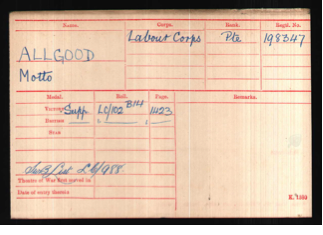
The next surviving page of Motto’s record is harder to read, but it helps show the shape of his service. Because his Suffolk Regiment number is not currently visible, it is difficult to say with certainty exactly which Suffolk battalion he served with and when. His medal record, however, shows that he served overseas.
The surviving record then suggests that Motto was wounded, and that the Army tried to find ways to keep him in useful service afterwards. At some point around September 1916, he appears to have been sent to a Training Reserve unit. He was granted Proficiency Pay Class II, which indicates that he had achieved a recognised standard of training or competence, and in November 1916 he was awarded a Good Conduct Badge. That is a useful counterweight to the small disciplinary entry from January 1915. Whatever that early irregular conduct had been, Motto later earned formal recognition for good conduct.
At some point, Motto transferred from the Suffolk Regiment to the Labour Corps. His Labour Corps service number was 198347, and he is recorded as serving in the London District Labour Corps. The Labour Corps was formally created in 1917 to provide organised labour for the Army’s huge practical needs. Its work included roadmaking, transport, salvage, stores, construction, loading, unloading and other essential tasks without which the fighting Army could not function. The Corps also included many men who had been medically downgraded: no longer fit for front-line infantry service, but still able to carry out useful military work.
This fits the fragmentary evidence for Motto. He had served overseas, had been wounded, and was eventually discharged as no longer fit for military service. It is therefore very likely that he was moved into the Labour Corps after being wounded or medically downgraded.
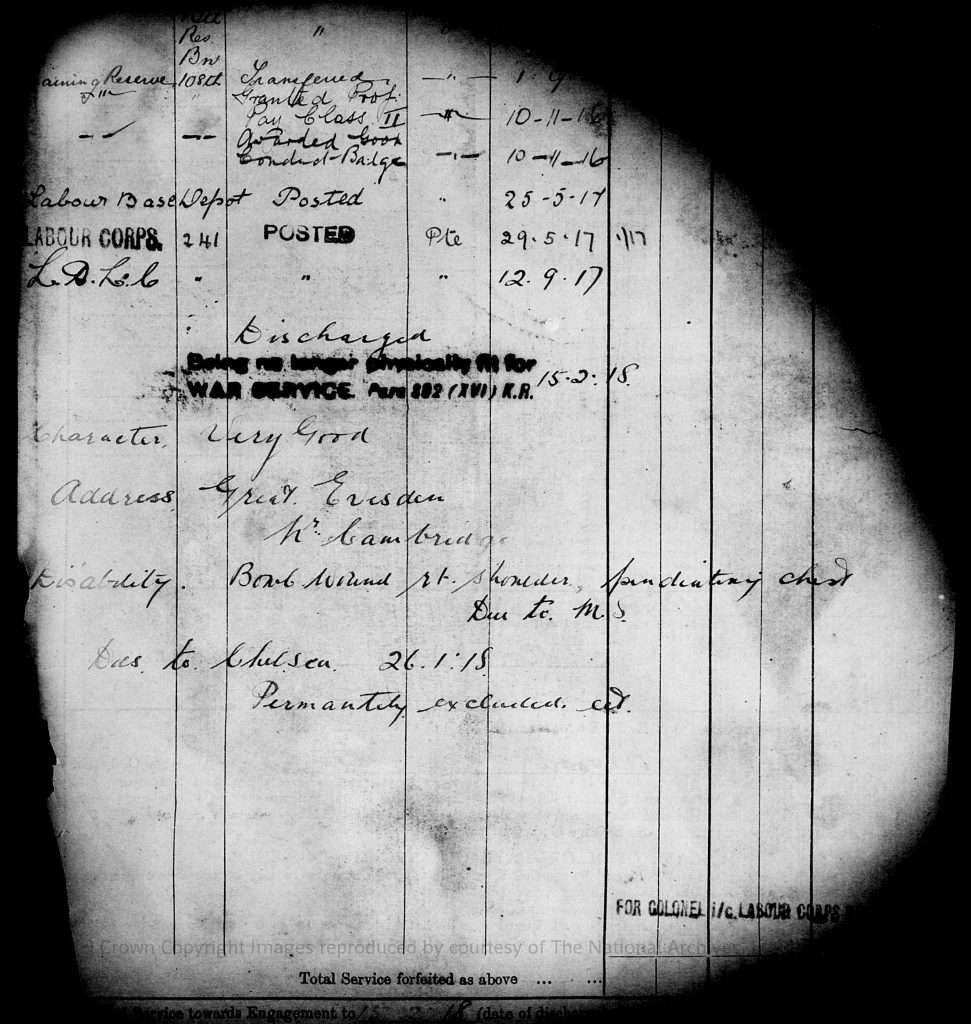
Motto’s discharge papers make the reason clearer. He was discharged from the Army on 15 February 1918, aged 32. His record states that he was “Wounded” and discharged under King’s Regulations paragraph 392 xvi (a) (i). Paragraph 392(xvi) was the standard discharge category for men who were no longer physically fit for war service. In Motto’s case, the additional wording indicates that he was discharged as a result of wounds.
Men discharged during the war because of wounds, sickness or disability could receive the Silver War Badge and King’s Certificate of Discharge, both intended to show that the man had served honourably and was no longer in uniform for a legitimate reason. In Motto’s case, the discharge was honourable but final. He was not simply being moved to another unit or released at the end of a normal term of service. The Army had decided that his wounds meant he was no longer fit for further service. He was awarded a Silver War badge number 328881.
He was also awarded the British War Medal and the Victory Medal, but not the 1914–15 Star. That means he served in a theatre of war, but not before the end of 1915.
The disability record adds an important detail. Motto was assessed as having a disability caused by a bomb wound to his right shoulder, with a penetrating wound to the chest, attributable to military service. The word “bomb” in this period could refer to a grenade or explosive projectile rather than an aerial bomb in the modern sense. Whatever the exact weapon, this was not a trivial injury. A penetrating wound involving the shoulder and chest could affect movement, breathing, strength and general fitness long after the wound itself had closed.
His case was referred to Chelsea Hospital, which indicates that he entered the pension and after-care system for disabled soldiers. “Chelsea” here does not mean that he went to live at the Royal Hospital as an in-pensioner. It reflects the administrative machinery of military pensions and medical assessment which originated in Chelsea. Motto was not simply released and forgotten; at least in theory, the state recognised that his wound had left him with a continuing disability.
The day after his discharge, from 16 February 1918, Motto was awarded a disability pension of 27 shillings and 6 pence per week, initially running to 21 May 1918. That pension rate is significant. Under the 1917 Royal Warrant, 27 shillings and 6 pence was the full, or 100 per cent, rate for a private in Pension Class V. The initial award therefore suggests that, at the point of discharge, his disability was considered serious. It may have been a short high award pending reassessment, because many men’s pensions were later reduced if medical boards judged that they had partially recovered. In 1921 he was awarded a grant of £70 “towards pig breeding”.
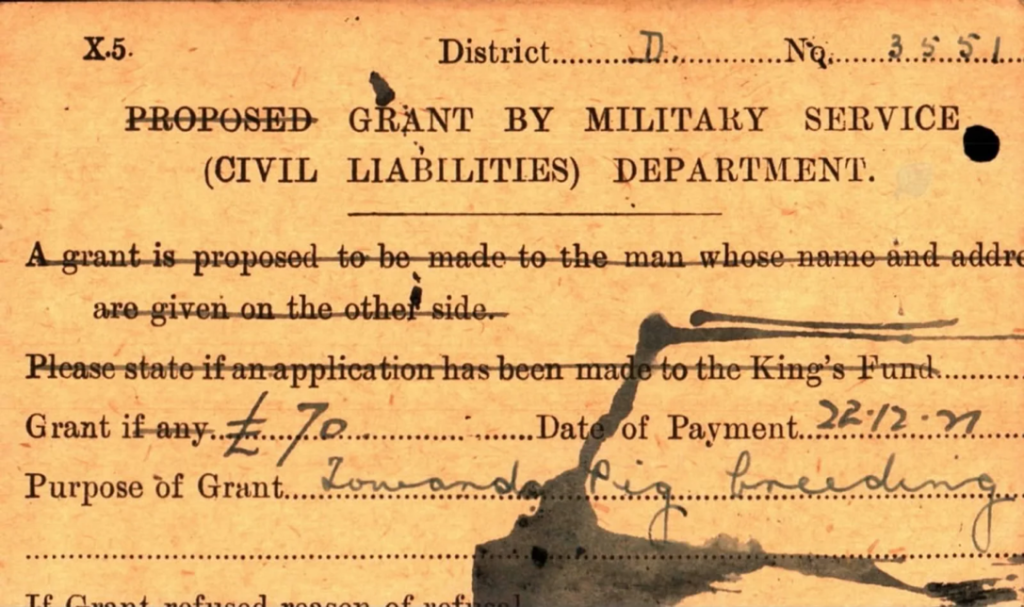
The pension reference, 11/M311698, suggests that the claim continued for some time. Later clipping and annotation on the record appear to indicate that the claim had ended by 29 September 1922. That does not necessarily mean that Motto was fully restored to health; it means that the pension administration had reached that conclusion, or that the claim had otherwise been closed. Those are not always quite the same thing.
There is evidence that Motto was living at Enham, near Andover in Hampshire, in 1923. This is significant because Enham was not simply an ordinary village address. After the war, it became one of the first “Village Centres” for disabled ex-servicemen. The Enham Trust records that by October 1919 there were 150 clients living at Enham, and that the centre had been established to house and support disabled men after the war. Other accounts describe Enham as a rehabilitation community where injured former servicemen could receive training and support for civilian employment.
Motto’s presence there strongly suggests that his war wounds continued to affect his post-war life. It may also explain why the pension claim seems to have remained active into the early 1920s. Enham was designed for men trying to rebuild a civilian future after military disability. For Motto, that may have meant retraining, rehabilitation, work, or simply a structured place to live among others who had also come back changed by the war.
His wife Lily appears with him in the electoral records at Enham in 1923. What seems clear is that Motto lived at Enham for several years, and that this part of his life belongs to the wider history of disabled ex-servicemen after the First World War.
Motto later returned to Cambridgeshire. By 1945, he was living at Graystones, Station Road, Fulbourn. He died in Fulbourn in 1962, aged 76.
Motto Allgood’s story is not as visible in the great set-piece battles as those of the Kingston men killed on the Somme or at Ypres, but it is no less a war story. He was a Kingston man from the Green, part of a large local family, who enlisted early in the war, probably into the 11th Battalion of the Suffolk Regiment. He trained in Cambridge, married Lily Hayes while still in camp at Cherry Hinton, served overseas, was wounded, and was then moved through the Army’s system of reassessment and redeployment.
The transfer to the Labour Corps shows the Army trying to extract continued usefulness from an injured man. His discharge and pension papers show official recognition that his wound had left him no longer fit for service. His later connection with Enham gives the story a post-war depth. It reminds us that the war did not end neatly when a man left the Army, nor even when the Armistice was signed. For wounded men, the war could continue through pension boards, medical reassessments, rehabilitation schemes, altered work, and the long business of living with an injured body.
Motto’s record survives only in fragments, and some of those fragments are literally burnt at the edges. But enough remains to tell a recognisable story: a Kingston man from the Green, drawn into the Suffolk Regiment in the first months of the war, injured seriously enough to be taken out of front-line service, and left to make a post-war life with the consequences.
Research note: The burnt fragments of Motto’s service record are recorded on FindMyPast under the record of John Robert Davies 198346.
Much of the information on Motto Allgood came from the generous, advanced research skills of members of the Great War Forum. I found a 2019 forum thread about Motto’s Silver War Badge. I re-opened the thread after 7 years with little expectation of any response, but asked for more information. Several members of the forum kindly used their skill and experience to find records I would not otherwise have known about.