
1st Battalion, Cambridgeshire Regiment; 9th Battalion, Northamptonshire Regiment
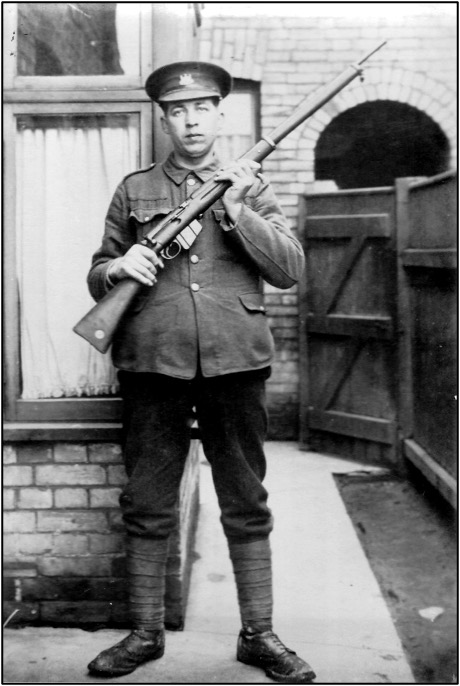
Frank Custerson was born in Kingston in January 1893, the third child of George Horatio Custerson and Mary Jane Custerson. His parents kept the Chequers public house, and his father also farmed, possibly at New Farm in Bourn. George Horatio Custerson was the elder brother of David Custerson senior, which made Frank a cousin of William, Israel, David and Robert Custerson.
Frank’s childhood was marked by repeated family loss. His brother Sidney Charles died in 1896, aged only one. Another brother Douglas died in 1902, aged three. His sister Elsie Kate died in 1906, aged seven, and his brother Ivor Richard died five months later, aged ten. By the time of the 1911 Census, Frank was the only surviving child. He was living at home with his parents and working on the farm managed by his father: New Farm, on the Bourn Road towards Longstowe. Management of The Chequers seems to have been transferred to his uncle, David, and the other branch of the Custersons.
There is an extensive account of a recruitment meeting in Bourn reported in the Cambridge Independent press on 4 September 1914.
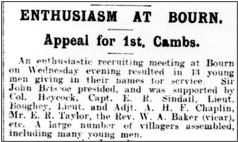
There were a series of speeches given by Sir John Briscoe, and various Army recruiters. The report notes the “During the evening songs were sung by the vicar and Mrs Baker played national aria. The following names were given in: Ernest Dazley (Territorials), Reginal Gordon Lee (RAMC), W Mattinson (Cavalry) and C Keep. F Custerson, Harry Grant, A Smith, B Gauge, F Clark, A Dawson, P Newman and S Pettit (Territorials)”.
So Frank was clearly encouraged by this patriotic fervor and enlisted in the 1st Battalion, Cambridgeshire Regiment, on 6 September 1914, right at the beginning of the war. His attestation papers survive, which gives us an unusually clear picture of him as a young man. He was recorded as 21 years and 284 days old, 5 feet 11½ inches tall, and weighed 160 pounds. His chest measured 36 inches. His physical development was recorded as “Good”, and his eyesight was 6/6 in both eyes. The only notable defect recorded was “marked flat feet”. Even so, he was found fit for service in the Territorial Force. His Cambridgeshire Regiment service number was 2318.
Soon after he enlisted, Frank was transferred. In September 1914, the 9th Battalion of the Northamptonshire Regiment was being formed, drawing men from the 1st and 2nd Battalions of the Cambridgeshire Regiment and the 2nd and 4th Battalions of the Northamptonshire Regiment. Frank became part of this new battalion, with the later service number 225109. He served with the 9th Northamptons for the duration of the war.
The 9th Battalion, Northamptonshire Regiment was a home defence unit. Its role was to help protect the east coast of England, particularly in Norfolk. This may sound less dramatic than service on the Western Front, but in 1914 the fear of invasion was real. The east coast was vulnerable to raids, bombardment and the possibility — however remote it may look with hindsight — of German landings. Home defence battalions guarded the coast, watched vulnerable points, trained, patrolled, and formed part of the wider system intended to reassure and protect Britain while so many regular and service battalions were overseas.
Frank’s battalion began its service at Sheringham, then moved to Blakeney, then to Cley-next-the-Sea. In 1918 it moved back to Sheringham. These Norfolk postings placed him in a very different wartime landscape from that of the Kingston men who went to France: a landscape of beaches, salt marshes, coastal roads, small ports, signal posts, patrols and watchful waiting rather than the trenches of the Somme or Ypres.
The photograph of Frank gives some useful detail. He is holding a Lee-Enfield .303 rifle, the standard rifle family used by the British Army from the late nineteenth century well into the twentieth. The rifle in the photograph appears to be the earlier Magazine Lee-Enfield Mk I, nicknamed “Long Tom”. This was longer than the later Short Magazine Lee-Enfield, which had become the more familiar front-line rifle by the First World War. The presence of the older rifle supports the evidence that Frank served in Britain. Home service and reserve units often used older equipment after newer rifles had been prioritised for men serving overseas.
Frank was discharged from the Army through No. 1 Dispersal Unit at Thetford on 20 January 1919. His medical category was B1. This meant that he was not in the highest category of physical fitness, but was still considered capable of useful military service, especially away from the most demanding front-line conditions. On discharge, he had to sign an acknowledgement that, in the event of a national emergency, he could be recalled to the Army and required to serve anywhere in the United Kingdom. This was part of the unsettled end of the war: the fighting had stopped, but the Army was not yet quite ready to let go of its men entirely.
After the war, Frank married Ida Kate Dentin at Manningtree, Essex. He and Ida then returned to the Kingston area. Their first child, Audrey Mary was born in June 1922 and baptised in Bourn. Douglas Frank followed in December 1923 his baptismal record suggests the family were living at Fox Farm in Bourn, and Phyllis I was born in 1927.
Frank died in 1969, aged 76.
Frank Custerson’s war was not the trench war of France and Flanders, but it was still a form of service shaped by the anxieties of 1914 and the long demands of mobilisation. He enlisted very early, passed into the newly formed 9th Northamptonshire Regiment, and spent the war in home defence on the Norfolk coast. His story also reminds us that not all service followed the same pattern. Some men fought overseas; some trained and guarded Britain; some were wounded; some waited, watched and were held ready. Frank, the only surviving child of a family already marked by loss, served through the war and returned to civilian life, marriage and family.