
8th Battalion and 15th Yeomanry Battalion, Suffolk Regiment
Walter Rayner was the older brother of Bertie Rayner. The brothers lived at Church Farm in Kingston with their younger brother Albert and their parents, William and Rebecca Rayner. William Rayner ran the farm, and the Rayners seem to have been one of the few Kingston families able to afford a resident servant. In 1901, James Marsh was living with them in that capacity.
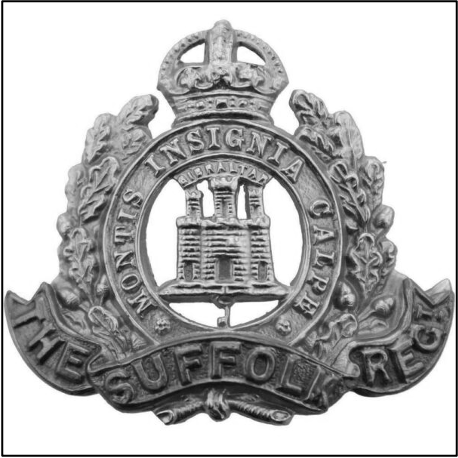
One of the photographs in the earlier Kingston display had been shown as “unknown”. Digital cleaning of the image now suggests that the cap badge is probably that of the Suffolk Regiment. Based on very limited comparison of relatives, the photo has been attributed to William Rogers Allgood, because it bears a closer resemblance to James Allgood than to Bertie Rayner. However, we cannot be certain, it may be Walter Rayner and might sit in this story.
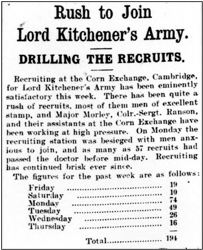
Walter’s service record has not survived, so his story must be pieced together from fragmentary evidence and inference. We know Walter’s name appears in the Cambridge Independent Press on 11 September 1914 as one of the “men who have enlisted in lord Kitchener’s Army since last Thursday” – that puts his enlistment somewhere between 3rd and 10 September 1914.
The 1918 Absent Voters List confirms that Walter was serving as a Private in the Suffolk Regiment, with the service number 320931, in the 15th Yeomanry Battalion. This detail is especially useful because there were two men named Walter Rayner serving in the Suffolk Regiment at around the same time. The Absent Voters List ties this Walter Rayner to Kingston and gives the service number needed to identify the correct medal record.
Walter’s medal card gives an earlier service number: 14831. It also shows that he was awarded the 1914–15 Star, as well as the British War Medal and the Victory Medal. The 1914–15 Star was awarded to men who served overseas before 31 December 1915. In Walter’s case, the theatre of war is given as “1”, meaning France, and his date of entry into France was 25 July 1915.
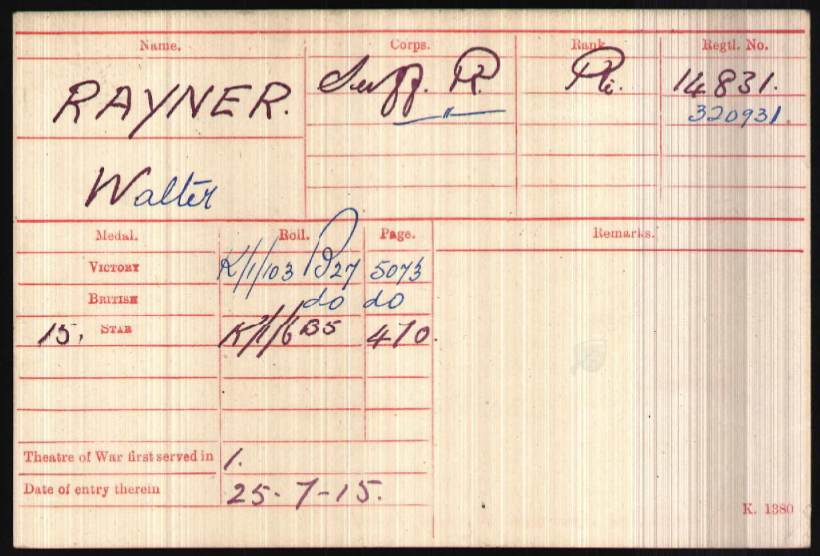
That date of entry into France is a strong clue to his original battalion. The 15th Yeomanry Battalion of the Suffolk Regiment did not yet exist in that form in July 1915. Its predecessor unit had served in Gallipoli and Egypt and did not arrive in France until 1916. Walter must therefore have gone to France with another Suffolk battalion.
The most likely candidate is the 8th (Service) Battalion, Suffolk Regiment. This battalion was formed at Bury St Edmunds in September 1914 as part of Kitchener’s Second New Army. It landed in France on 25 July 1915 — exactly the date shown on Walter’s medal card. Walter probably enlisted in late 1914, trained with the 8th Suffolks, and crossed to France with them in July 1915.
The 8th Suffolks served on the Western Front through some of the hardest years of the war. Without Walter’s full service record, it is not possible to place him in every action, but his date of arrival means that he was in France well before many of the other Kingston men who landed in January 1916 with the 11th Suffolks. He was part of the earlier wave of Kitchener battalions that reached the front in 1915.
In February 1918, the 8th Battalion was disbanded. This was part of the wider reorganisation of the British Army after years of heavy losses and growing manpower pressure. Men from disbanded battalions were redistributed to other units. This is probably how Walter eventually came to serve with the 15th Battalion, Suffolk Regiment. There remains a small gap in the sequence, because the 15th Battalion did not arrive in France until May 1918, but the broad pattern is clear: Walter began with the 8th Suffolks and later served with the 15th.
The 15th Battalion had an unusual history. It was formed from yeomanry troops; men originally connected with mounted Territorial units and was converted into infantry as the Army’s needs changed. By 1918, the old distinctions between infantry, cavalry and yeomanry had become increasingly blurred. Units were reorganised, dismounted, renamed, absorbed and redeployed as the Army tried to keep enough trained men in the line.
When the 15th Suffolks reached France in May 1918, they moved into the Robecq sector. This was a relatively quiet part of the front at that moment, and it was often used to allow units newly arrived from other theatres to acclimatise to the Western Front. “Quiet”, however, is a relative term. Even in quieter sectors, men lived under the threat of shelling, sniping, trench raids, gas alarms, patrols, sickness, fatigue work and sudden orders to move.
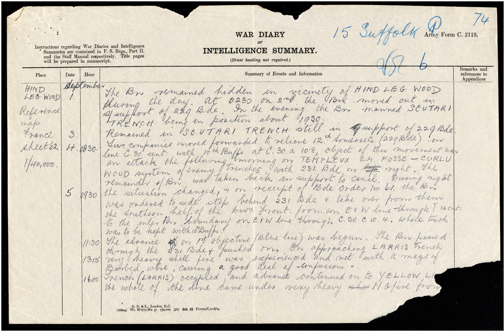
The battalion’s daily reports are typical of the records that survive for front-line units. Written by officers, they note movements, reliefs, patrols, enemy activity, intelligence, weather, health, working parties, casualties and conditions in the line. They rarely name ordinary soldiers, but they are often the best way to reconstruct the world in which men like Walter served. Through them, an individual soldier can be placed not always in a single dramatic moment, but in the daily rhythm of the battalion: holding trenches, repairing defences, observing enemy movement, carrying supplies, standing to, and waiting.
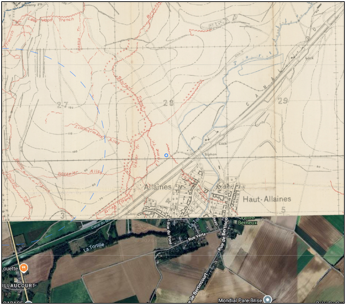
Walter survived the war. His record, as far as it can currently be reconstructed, suggests he served the entire war in France and Flanders. He joined the Suffolk Regiment in early September 1914, entered France with the 8th Suffolks on 25 July 1915, and later, after the disbandment of that battalion, served with the 15th Yeomanry Battalion. That makes him one of the Kingston men whose war stretched across several phases: early Kitchener enlistment, the Western Front from 1915, Army reorganisation in 1918, and continued service into the final year of the war.
Walter Rayner’s story is also a good example of how electoral records and medal cards can work together. The Absent Voters List alone could not tell the full story. The medal card alone might have been confused with another Walter Rayner. But together they create a plausible and coherent account of Walter Rayner of Church Farm, older brother of Bertie, and a long-serving private of the Suffolk Regiment.