
Army Service Corps
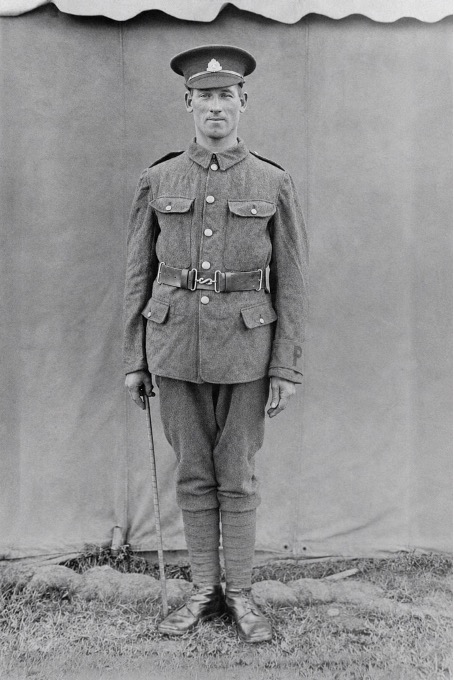
James Allgood was born in Kingston on 16 October 1861 and baptised here on 20 July 1862. The Allgoods were a very large family; there were often at least three distinct Allgood households in Kingston. James was one of eight siblings, seven of whom survived to adulthood.
By the time of the First World War, James was a familiar working figure in Kingston. He was the local roadman, employed by the Rural District Council. His work was practical, physical and essential. He kept the village roads in repair, filled potholes, cut back and cleared the verges, and made sure that the roadside drainage gullies remained open and free flowing. It was the kind of work that was only noticed when it was not done.
Before the war, James was living on Bourn Road with his elderly mother, Emma, and two of his brothers, Charles and George. Charles was known locally as “Hoppy”, apparently because he had lost a leg at some point, while George was known as “Happy”. The family seems earlier to have lived in Tinkers Lane. Another brother, Edwin, had married and by 1911 was living on the Green.
James was unusually old for a recruit; he was already 52 when war broke out in August 1914 and 54 by the time he volunteered in November 1915. No full-service record has survived for James’s First World War service. The surviving evidence is mainly a medal roll and associated records, so the account must be built from fragments.
The only likely First World War record for a James Allgood suggests that he served in the Army Service Corps. This is consistent with the surviving photograph of James in uniform. His cap badge appears compatible with the Army Service Corps, and on his left sleeve he wears a cuff-band marked “RP”. This indicates that, at the time the photograph was taken, he was acting as a Regimental Policeman.
A Regimental Policeman was not a separate police officer in the modern civilian sense. It was an internal appointment within a unit. The man selected helped maintain order and discipline, supervised men under punishment or restriction, and carried out other duties connected with the good running of the unit. It was often a role given to older, steadier or more experienced soldiers. In that respect, it fits James’s age and likely background very well (but hold that thought dear reader!).
His service number was T4/186522. In the Army Service Corps, the prefix “T” usually indicated Horse Transport. This means that James probably served in the branch responsible for moving supplies by horse-drawn transport. For a man such as James, accustomed to hard outdoor work and practical village labour, the Army Service Corps would be a natural place to serve.
At the start of the First World War, the British Army still relied heavily on horse transport. Motor vehicles became more important as the war went on, but horses remained central to military logistics for much of the conflict. The Army depended on horses for the movement of food, ammunition, equipment and other supplies. Horse transport required a large human effort behind the scenes: fodder had to be found and moved, tack maintained, horses had to be handled, groomed, fed, kept healthy and moved safely, often in difficult conditions. The branch included drivers, horse handlers, farriers, saddlers and leatherworkers, as well as men involved in taking horses to and from the front. James is recorded as a Driver in his medal card.
The “4” in his service number probably connects his enlistment with the period of the Fourth New Army, which fits with an enlistment date of 19 November 1915. By then James was 54. He was not a young volunteer caught up in the first rush of patriotic recruiting, but an older working man entering service after the war had already become long, costly and industrial in scale.
James did not serve overseas. His Silver War Badge records show that he was discharged on 21 November 1917 under King’s Regulations paragraph 392(xvi), meaning that he was considered permanently unfit for further war service. The Silver War Badge record gives the reason for his release simply as “sickness”, it was badge number B298530. This badge was issued to men who had been honourably discharged because of wounds or illness, and it helped show that they had served, even if they were no longer in uniform.
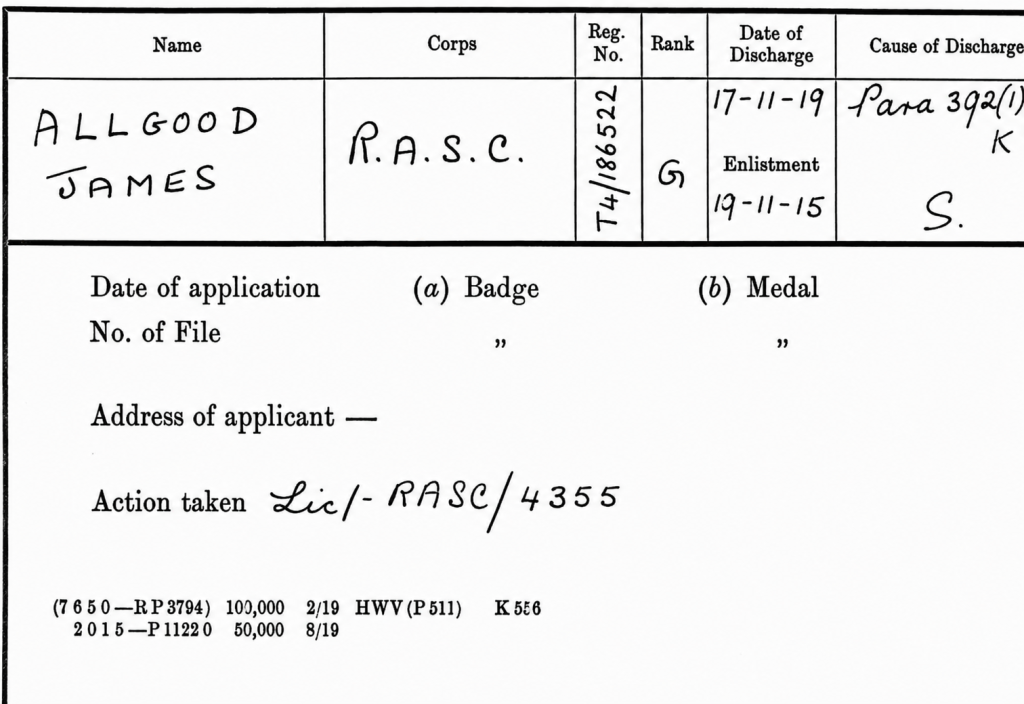
By late 1917 the Army was becoming more selective about how men were used. Logistics units such as the Army Service Corps were also being reorganised and professionalised as the demands of modern war changed. It seems likely that James, who had spent his life in a hard manual occupation and had enlisted at an advanced age for a soldier, was no longer considered physically fit enough for the pace and demands of Army service.
After his discharge, James returned to civilian life. He never married, and he continued to live with his brothers Charles and George. He died at the age of 78 and was buried in Kingston churchyard on 20 February 1940.
James Allgood’s war was not the familiar story of a young infantryman in the trenches. It is instead the story of an older village workman whose service lay in the practical machinery of war: roads, horses, transport, order and supply. His record is fragmentary, but what survives suggests a man whose usefulness came from experience and a lifetime of physical labour. In that sense, his service sits very naturally within the wider history of Kingston’s contribution to the First World War: not only the men who fought at the front, but those whose work helped keep the whole vast military system moving.
However …
James was not all he seemed, and the Army’s record-keeping was perhaps less than perfect in his case. James was not eligible for further military service because he had previously served and had been court-martialled for murder!
James Allgood attested for short service with the Bedfordshire Regiment in February 1883, with the service number Bfd/611. His service record gives Kingston as his place of origin, and he also cites Emma Allgood as his mother and next of kin, so it’s the same James. The age recorded on enlistment was 19 years and 4 months, while James would in fact have been about 21 years and 4 months. Such discrepancies are not unusual in nineteenth-century military records, particularly where age might affect eligibility.
Military service also seems to have run, at least intermittently, through the family. James’s brother Edwin Allgood enlisted in the Suffolk Regiment in 1888, with the service number 2439. There are also records relating to his brother Charles, including references to desertion while in Cambridge.
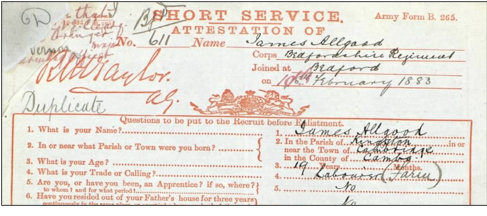
At this time James was unable to sign his name and simply ‘made his mark’ with an X on the attestation papers.
In his medical examination he was recorded as 19 years and 3 months old, but with an “Age physically equivalent to above 19”, which lends credence to the age discrepancy. He was 5 ft 6½ in tall, weighed 151 lb, and had a chest measurement of 36½ in. His complexion was recorded as fresh, his eyes blue, his hair light brown and his religion C of E. In terms of distinctive marks, he had a deformity of the nose and had lost two upper front teeth. He was duly passed fit in early February 1883 and joined the Bedfordshires for a 12-year engagement.
Things then went downhill for Private Allgood. He remained at the depot at Shorncliffe for basic training until May 1883, when he was posted to the 1st Bedfordshire Regiment in the same garrison. He then went absent without leave from 27 December 1883 to 7 January 1884, was court-martialled at regimental level and confined — i.e. jailed at the barracks — from 8 to 13 January 1884. The records are so precise because the paymaster became involved. A soldier was paid but did not accrue pension entitlement for days when he was absent without leave, awaiting court martial or in confinement. James did not reform: he was again confined, probably in a small prison block on the base where he was serving, from 29 May to 5 June 1884. He then faced a district court martial and was sentenced to imprisonment from 6 June to 9 September. The sentences involved suggest that he was a persistent defaulter, absentee or drunk: not guilty of civilian crimes, but disruptive enough to be an administrative burden. The 1st Battalion clearly gave up at this point and posted James to the 2nd Battalion.
The clever bit of Army thinking, perhaps, was that the 2nd Battalion was serving in Burma in 1884, before moving to Bellary in Madras, India, in 1886. It seems that, on the day of his release from jail, 9 September 1884, James embarked on the Malabar and sailed to India, potentially away from the temptations of Kent.
It did not work. James merely adapted. Having already racked up 20 days in hospital in England, variously for bronchitis, boils and a burn, James managed to spend 158 days of the next two years in hospital in Bellary with six episodes of syphilis and one accidental wound while off duty. Nevertheless, there were no further disciplinary proceedings until 1888, when the regiment had moved to Secunderabad, now part of Hyderabad.
On 6 June 1889 James was involved in an incident that resulted in the death of a man named Jaffar Khan. James was placed in confinement awaiting trial on a murder charge. On 30 August the general court martial was convened. Initially, James was sentenced to five years’ penal servitude, but this was commuted to two years’ imprisonment with hard labour.
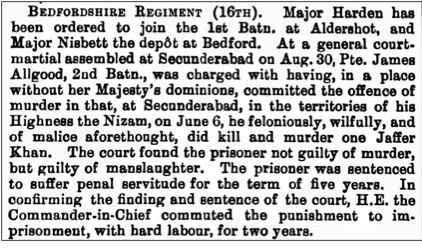
The reduction in charge from murder to manslaughter says something about the circumstances, but 2 years is still a very lenient sentence. It strongly suggests there were substantial mitigating circumstances. Unfortunately, the details of the case are not available without an in-person visit to the National Archive at Kew, but it seems as if the full court martial papers might change our understanding of the bare facts.
James was released from the Army, presumably on his return to England, on 19 February 1890. In the 1891 Census, James is recorded as a prisoner in St Peters Prison, Dorchester.

In total, James served nearly 7 years of his nominal 12-year engagement. He had spent 238 days of his service in hospital, primarily for an STD, and 181 days in prison, not including his sentence for manslaughter. That’s about 14 months of 7 year’s service as a non-effective soldier.
It is therefore perhaps not surprising to see his discharge conduct comment describing him as “incorrigible and worthless”. In fact, “Incorrigible and worthless” was an official discharge category, not merely a particularly exasperated colonel letting off steam.
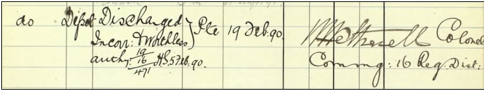
Under the Army Act 1881, a man discharged as “incorrigible and worthless” was treated as having been “discharged with disgrace”. The Act grouped it with:
- discharge with ignominy; and
- discharge following conviction for felony or a sentence of penal servitude.
The parliamentary debate preceding this legislation is revealing. When the provision was challenged in 1879, the government explained that it was intended for men regarded as “utterly incorrigible”—typically persistent offenders who had spent substantial periods imprisoned and repeatedly re-enlisted or caused continuing disciplinary trouble. In other words, it was meant to identify the Army’s most irredeemable disciplinary cases, not merely men whose conduct fell below “Good”. The Queen’s Regulations and Orders for the Army, 1885 also treated it as a prescribed administrative category. Paragraph 983 provided that a soldier discharged because of an “incorrigible and worthless character” forfeited medals, alongside men discharged expressly for misconduct, following civil conviction, or after being sentenced to penal servitude.
A man who subsequently enlisted again, without declaring such a discharge, committed a military offence. However, when attesting the Army required no evidence of a man’s name, nor of his date of birth. All it took was confidence and sticking to your story, which is also how so many under-age boys were able to enlist. Presumably the Army had no mechanism to connect a volunteer enlisting to the Army Service Corps in 1915 with a soldier discharged from the Bedfordshires some 25 years earlier.
In his memoirs, Terry Osborne described the three Allgood brothers, James ‘Mott’ and George ‘Happy’ and Charles ‘Hoppy’, who had at some point lost his leg and acquired a wooden one. They lived together on a house at Claypit Hill, near the waterworks.
“Bert [Chapman]told me many tales about Kingston. I wished his tales had been written down at the time, but I have forgotten so many: A man named Mott Allgood always getting drunk in Eversden and falling in a ditch on the way home and sleeping there all night. This would happen every weekend”
Terry Osborne’s memoirs
Lois Jacklin also remembered the Allgood brothers in his memoirs Kingston Remembered. The extract for Charles is recorded in William Allgood’s biography, but of James and George he recalled from the 1920’s –
“George (Happy George) managed a living by casual work and poaching. He always had money for beer and tobacco, which he would smoke in the shortest of clay pipes. Next was James. Everyone knew him as Mott. He was a much more amiable man. His favourite saying was “well done, old boy”. He was an old soldier who had served in India. He had a mongrel dog which, though often beaten, was the most faithful animal. This bachelor trio all lived together. They had a married brother, Edwin. Known as Dewey, whose wife was Naomi. Just prior to the 1920s, they lived in part of what is now the late Mrs Wilkinson’s house on the Green.
Lois Jacklin’s memoirs
James Allgood’s story is perhaps one of the most unexpected of Kingston’s soldiers. He was not simply an older man volunteering to serve his country in 1915. More than thirty years earlier he had already served in the Bedfordshire Regiment, accumulated a remarkable disciplinary record, been convicted of manslaughter in India and discharged as “incorrigible and worthless”. Yet somehow, at the age of 54, he joined the Army again and served, apparently effectively, for nearly two years before sickness finally ended his military career. Back in Kingston, the troublesome young soldier of the 1880s became the familiar village roadman known to everyone as “Mott” and remembered as a more amiable member of the community, despite his drinking habits. His story is a reminder that the men who went to war in 1914–18 brought with them whole lives already lived — and sometimes histories the Army itself had apparently forgotten.