
216th Siege Battery, Royal Garrison Artillery
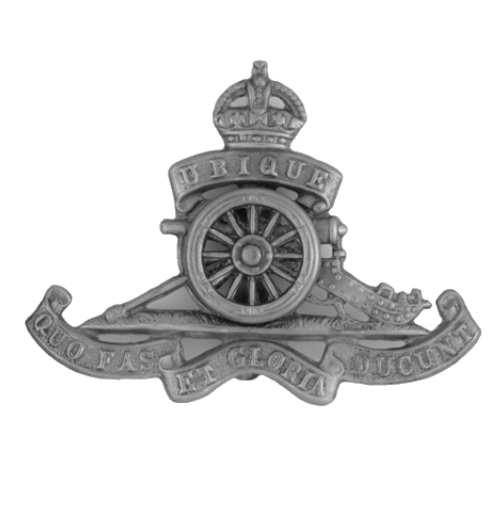
Simeon Rutter Johnson was born in Kingston on 3 April 1898 and baptised on 6 July 1902. When Britain entered the conflict in August 1914, Simeon was only sixteen.
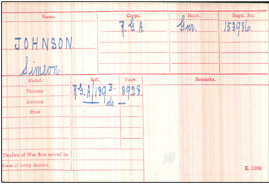
His service therefore belongs to the later wartime intake. He was almost certainly drawn into the army through the manpower systems created by the Derby Scheme and then the Military Service Acts of 1916. These brought younger men into service as they reached military age. Simeon joined the Royal Garrison Artillery, with the service number 153986, and served as a Gunner. His Commonwealth War Graves Commission entry records him as serving with 216th Siege Battery, Royal Garrison Artillery.
There are no service record documents surviving for Simeon, so again, in order to get an indication of when he enlisted, we have to infer from the adjacent service numbers of men for whom records do exist. This is slightly more inexact with large Corps such as the RGA where they recruited nationally, and it might be that different number blocks were given to different recruiting depots. Nevertheless, it is usually still accurate to a 3 month window. Somewhat frustratingly, one can reconstruct the recruits either side of Simeon – 153980 Matthias O’Donovan, 153981 William Sims, 153982 Frederick G Tredger, 153983 Harold Challis, 153984 Henry Fuller from Fordham, 153987 Ernest Matthews from Guilden Morden, 153988 William H Osborne, 153989 Albert Utteridge form Knapwell – all Gunners in the Royal Garrison Artillery, apparently many from Cambridgeshire, but not a single one has a record that gives their attestation date. 153993 Reginald Octavius Dellow, just 7 numbers later, but from London, has discharge papers that say he enlisted on 10 April 1917. It seems very likely that Simeon enlisted in the spring of 1917 when he was on the cusp of 19 years old.
The Royal Garrison Artillery operated the Army’s heavier guns. These were not the mobile field guns that moved close behind the infantry, but larger weapons used for long-range bombardment, counter-battery fire against enemy artillery, and the destruction of strongpoints, trenches, roads and communications. Siege batteries used heavy howitzers and guns, including weapons such as 6-inch, 8-inch and 9.2-inch howitzers. Their crews were usually positioned behind the front line, but they were not safe. Once an enemy battery located them, they could be subjected to counter-battery fire, often very accurately.
Siege Batteries 206 through to 221 were authorised by Army Council Instruction 1544/1916, with effect from 31 July 1916, and that the 216th was raised at Portland. The battery went to France in December 1916, landing at Le Havre on 21 December. Simeon joined later, after about 5 months training and after the unit had been deployed to France. By the summer of 1917 the Battery had been in the Loos sector, supporting operations around Hill 70. By September, the wider British effort had shifted back to Flanders and the Third Battle of Ypres.
Simeon died during the period of the Battle of the Menin Road Ridge, fought 20 – 25 September 1917. This was one of the major British attacks during Third Ypres. After the mud and failures of earlier fighting, the British used more careful preparation, limited objectives, and intense artillery support. Artillery was central to the plan: not only to bombard German positions before the attack, but to provide protective barrages as the infantry advanced, and to suppress German guns and counterattacks.
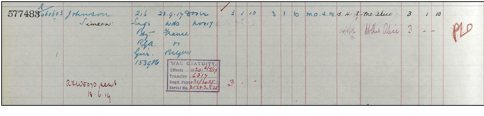
We do not have Simeon’s individual wound report, so we cannot say exactly where or how he was injured, but the timing is highly suggestive. A separate account of a man from 216th Siege Battery places the battery shelling German lines for the Battle of the Menin Road on 20 September, and another man of the same battery was wounded around Polygon Wood and died on 29 September. Since Simeon died of wounds on 23 September, three days after the opening of the Menin Road attack and during the build-up to the Battle of Polygon Wood, it is a strong inference that he was wounded in the very early days of the battle.
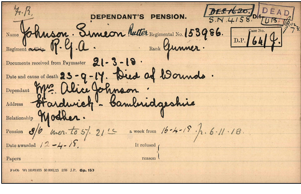
His burial also supports that reading. Simeon is buried at Maroc British Cemetery, Grenay, in grave II.M.4. Maroc is near Loos, not at Ypres itself. That suggests that after being wounded he was evacuated away from the Ypres battlefield through the medical chain to a hospital or casualty clearing area in the Loos sector, where he died of his wounds. He is also buried alongside Gunner Albert Staniford, from the same unit as Simeon, who also died of wounds on 23 September. It may well have been the same incident that fatally injured them both.
Simeon also appears on the Hardwick Roll of Honour as having died of wounds. That wording is important. He was not recorded simply as killed in action at the gun position. He survived long enough to be treated and moved, but unfortunately not long enough to recover.
Simeon Rutter Johnson’s story is one of the later wars and of the artillery war. He was too young for the first rush of enlistment, but by 1917 the Army needed men of his age. He became a Gunner in a siege battery, part of the heavy artillery system that shaped the later fighting on the Western Front. He was not in the front trench with a rifle, but he was still in a dangerous arm of service, working guns that the enemy tried hard to find and destroy. He died having probably been in Flanders for just one or two months, during one of the major artillery-driven phases of Third Ypres. Aged just 19, he was buried far from Kingston at Maroc British Cemetery.