
2nd Battalion, Suffolk Regiment
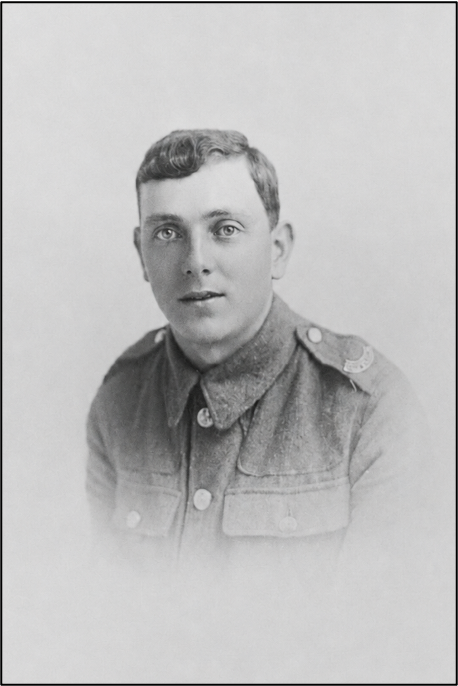
William was the middle of the three Custance brothers that enlisted, Charles was two years older, Joseph 3 years younger.
William Custance’s service number, 15761, indicates that he joined the Suffolk Regiment alongside several other men from Kingston, including both his brothers. The close grouping of numbers is important. Frank Allgood was 15763, Joseph Chapman was 15768, and Charles Thomas Custance was 15770. It is clear from the collective record that many men in Kingston were heavily influenced by Kitchener’s appeal to volunteer and joined up in Cambridge in October of 1914.
William served in the Suffolk Regiment and was a Lance Corporal by the time of his death. A Lance Corporal was still close to the men he served with, but he carried additional responsibility: helping direct them, maintain discipline, pass orders and steady them in action. In a confused attack, that could make him particularly exposed.
Unlike the Kingston men who served with the 11th Suffolks, William was serving with the 2nd Battalion, Suffolk Regiment when he was fatally wounded. We cannot be certain which company he was in, but the battalion’s records provide an unusually detailed account of the fighting immediately before his death. They allow us to place him very close to one of the most difficult and costly attacks experienced by the 2nd Suffolks.
On 13 November 1916, the battalion was ordered into another major attack against German trenches near Serre. The men had already suffered at Longueval, but there was little time for rest or recovery. They were pressed back into action in the bitter final phase of the Battle of the Somme.
The original operation order survives, as does the Commanding Officer’s handwritten after-action report. The report gives a stark account of the attack:
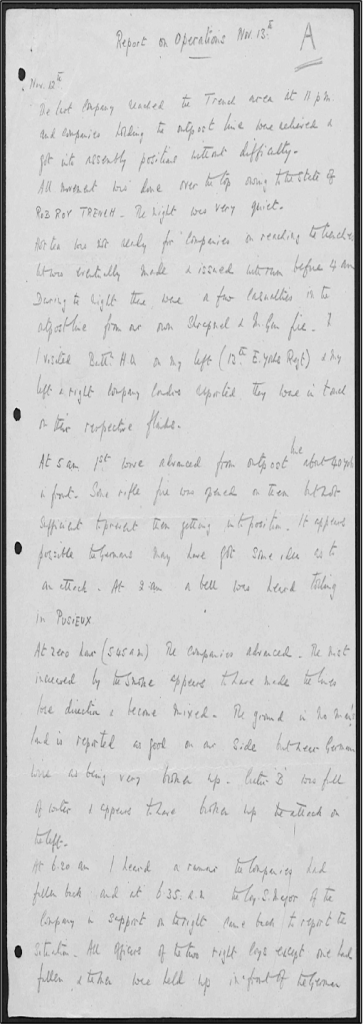
Report on Operations Nov. 13th
The last Company reached the Trench area at 11 p.m. and Companies taking the outpost line were relieved & got into assembly positions without difficulty.
All movement was done over the top owing to the state of ROB ROY TRENCH. The night was very quiet.
Hot tea was not ready for Companies on reaching the trenches but was eventually made & issued between before 4 a.m.
During the night there were a few casualties in the outpost line from our own shrapnel & M.Gun fire. I visited Battn H.Q. on my left — 13th Essex Regt — & my left & right Company Comdrs reported they were in touch on their respective flanks.
At 5 a.m. 1st wave advanced from outpost line about 40 yds in front. Some rifle fire was opened on them but not sufficient to prevent them getting into position. It appears possible the Germans may have got some idea as to an attack. At 2 a.m. a bell was heard tolling in PUSIEUX.
At zero hour (5.45 a.m) the Companies advanced. The mist increased by the smoke appears to have made the two lose direction & become mixed. The ground in no man’s land is reported as good on our side but near German wire as being very broken up. Crater B was full of water & appeared to have broken up the attack on the left.
At 6.20 a.m. I heard a rumour the Companies had fallen back and at 6.35 a.m. the Coy S. Major of the Company in support on the right came back to report the situation. All Officers of the two right Coys except one had fallen & the two were held up in front of the German
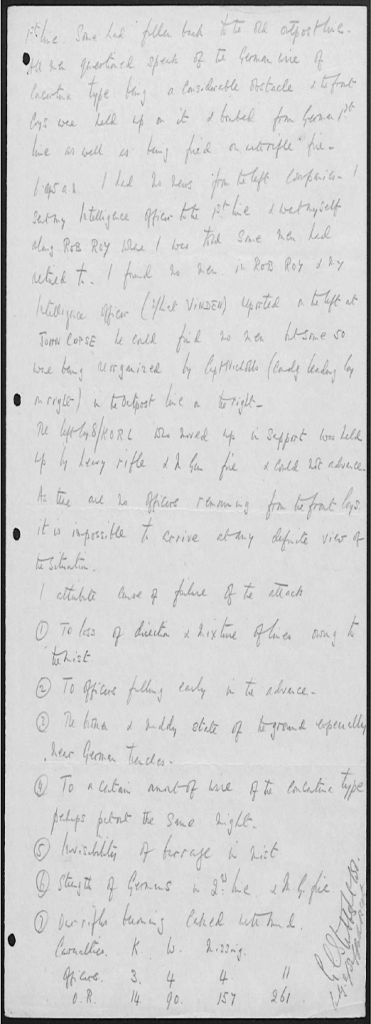
1st line. Some had fallen back to the old outpost line. All men questioned speak of the German wire of concertina type being a considerable obstacle & two front Coys were held up on it & bombed from German 1st line as well as being fired on with rifle fire.
6.45 a.m. I had no news from the left Companies. I sent my Intelligence Officer to the 1st line & went myself along ROB ROY where I was told some men had retired to. I found no men in ROB ROY & my Intelligence Officer — 2/Lt VINDEN — reported on the left at JOHN COPSE he could find no men but some 50 were being reorganized by Capt Nickolls — calmly leading by a rifle — in the outpost line on the right.
The left Coy, 8/KORL, who moved up in support, was held up by heavy rifle & M.Gun fire & could not advance.
As there are no Officers remaining from the front Coys it is impossible to arrive at any definite view of the situation.
I attribute cause of failure of the attack:
- To loss of direction & mixture of lines owing to the mist.
- To Officers falling early in the advance.
- The broken & muddy state of the ground especially near German trenches.
- To a certain amount of wire of the concertina type perhaps put out the same night.
- Invisibility of barrage in mist.
- Strength of Germans in 2nd line & M.G. fire.
- Difficulty bringing Lewis[?] with much casualties.
Killed Wounded Missing [Total]
Officers: 3 4 4 11
O.R.: 14 90 157 261
The report is military prose, but what it describes is chaos. The men had to move over open ground at night because Rob Roy Trench was in such poor condition. Hot tea, a small but important preparation before an attack, did not reach them properly until close to 4 a.m. There were casualties even before the attack began, including from British shrapnel and machine-gun fire. Then, at 5.45 a.m., the companies advanced into mist, smoke, mud, broken ground and wire.
The following account, from the Friends of the Suffolks website, gives a fuller narrative of the same attack:
The previous evening, all Companies were in their allotted positions by 11.00pm, from where they would be moved to their start positions within a few hours. The recent heavy rains had made their journey difficult and owing to the waterlogged condition of “Rob Roy” trench – from where the attack was to commence from, so the majority of their journeys that night in the darkness, was made above ground.
After being roused and moved into their start positions, the men were to be greeted by a hot cup of tea, but the condition of the trenches meant that the ration party could not get forward with the dixies. When the tea did arrive, it was close to 4.00am and lukewarm.
Around 4.30 am the Commanding Officer, Major G.C. Stubbs, went around the frontal Company’s and made sure that they were in touch with their neighbours on the flanks. The objective for the forthcoming attack was a German trench on the left flank, known as “Serre” trench, which had a strongpoint at a junction of a communication trench called “Suffolk Avenue”.
At Zero Hour; 5.45 am on the 13 November, the leading Company’s advanced in a thick, eerie. mist. ‘Y’ Company on the left in two waves, with the same on the right being carried out by ‘X’ Company. Bombers were to protect their flanks. In support were ‘W’ Company, with ‘Z’ in reserve to be called upon when necessary. Each company’s frontage was around 190 yards, which narrowed on a compass bearing to around 100 yards at the objective.
The mist covered their initial movements well but caused the usual chaos within the Company’s. Direction was lost, and the advancing waves became mixed. The muddy ground caked their boots and slowed their progress. The artillery barrage that they were closely following had cut the first belt of German wire in no-mans-land and it was passable in several places.
A large crater in no-mans-land which had been agreed upon as a pausing point, was found by the first waves upon their arrival at its lip, to be full with water. It could not be used for shelter, so they had to carry on. Disorientated, the advancing troops, veered leftwards. As the barrage slowed, the men reached the German front line. Its wire was still intact and was of a newer concertina style that was only recently introduced by the Germans. Though they tried in vain, it was extremely difficult to cut with wire-cutters. Held up, the attack started to falter. The men were caught in the open as the Germans raked no-mans-land with machine-gun fire. Those who could retire, began to do so.
With no news arriving at Battalion HQ, the CO was getting worried. “At 6.20am” wrote Stubbs, “I heard a rumour that the Companies had fallen back and at 6.35am the Coy. S. Major of the Company in support on the right, came back to report the situation. All officers of the two right Coys except one had fallen and the men were all held up in front of the German 1st line. Some had fallen back to the outpost line. All men questioned speak of the German wire as concertina type being a considerable obstacle and the front Coys were held up on it and were bombed from the German 1st line as well as being fired on with rifle fire”
At 6.45am, Stubbs sent his Intelligence Officer, 2nd Lieutenant Vinden (who would serve later with 4th Suffolk in the war that was to follow), along to the front line to see what was happening. Stubbs himself, negotiated the waterlogged “Rob Roy” trench; which, he was informed, held some of his men who had retired. He found no one except the first of the wounded and many dead.
Vinden was heading north in the direction of “John” Copse, where he eventually found Lieutenant Nicholls (the younger brother of Captain Nicholls who was captured with 2nd Suffolk at Le Cateau) with around 50 men. Nicholls had been commanding the right-hand leading Company (X) during the initial assault, and had held onto the right hand outpost line, before it became untenable and he was forced to retire.
Total losses that day were 3 officers killed, including Lieutenant Douglas Steel, 4 wounded and 4 missing. 14 other ranks killed, 90 wounded but over 157 missing.
Following the battle, the Battalion Commander, Lieutenant-Colonel G.C. Stubbs, was asked to provide a report of the actions. His report, shown above, was short but concluded saying;
“I attribute the cause of failure of the attack:
- To loss of direction and mixture of lines owing to the midst.
- To officers falling early in the advance.
- The broken and muddy state of the ground especially near the German trenches.
- To a certain amount of wire of the concertina type perhaps put out the same night.
- Invisibility of the barrage in the mist.
- Strength of the Germans in 2nd line and machine gun fire.
- Our rifles being caked in mud”.
As the Friends of the Suffolks website comments – “It was perhaps the final comment that was the most damming. The conditions that the men had to fight through that day to get to the enemy wire, were atrocious. It meant that when they did arrive, they were so exhausted and caked with the mud of the ground they had just covered, that they could bring down sustainable small arms fire upon the enemy, because their rifles were unusable. Harsh lessons were learnt that day by the Battalion. In the years that were to follow, 2nd Suffolk veterans talked of it being the worst battle of the entire war.“
This account places William’s final days in a very precise setting. The attack did not fail because the men lacked courage. It failed because they were sent forward through mud, darkness, mist, waterlogged trenches, broken ground and uncut wire, against German defenders who still had rifles, bombs and machine guns in position. Officers fell early. Companies lost direction and became mixed together. Men reached wire they could not cut, with rifles caked in mud and the barrage invisible ahead of them. It was, in miniature, the whole problem of the Somme: human bravery pressed against physical conditions, poor visibility, damaged communications and defensive firepower.
William was wounded in this action and died of his wounds on 15 November 1916, two days after the attack. He was 21 years old. He is buried at Quéant Road Cemetery, Buissy, in grave VIII.F.7.
William was the first of the two Custance brothers to be killed in the war. Charles Thomas Custance, serving with the 11th Suffolks, would be killed in June 1918. Between them, the brothers’ deaths link Kingston to two very different phases of the war: the mud and failed attacks of the Somme in 1916, and the dangerous holding actions of the final year.
William Custance’s story is not just a name on a casualty list. Through the survival of the 2nd Suffolk records, we can see something of the attack in which he was fatally wounded: the night movement, the mud on the boots and rifles, the crater full of water, the mist, the wire, the loss of officers, the men falling back or lying wounded in No Man’s Land. We cannot know exactly where William was when he was hit, or who was near him, or how long he survived before reaching medical care. But we can say that he died from wounds received in one of the 2nd Suffolks’ most difficult actions of the war.