
1st/4th Suffolk Regiment; 5th Northumberland Fusiliers
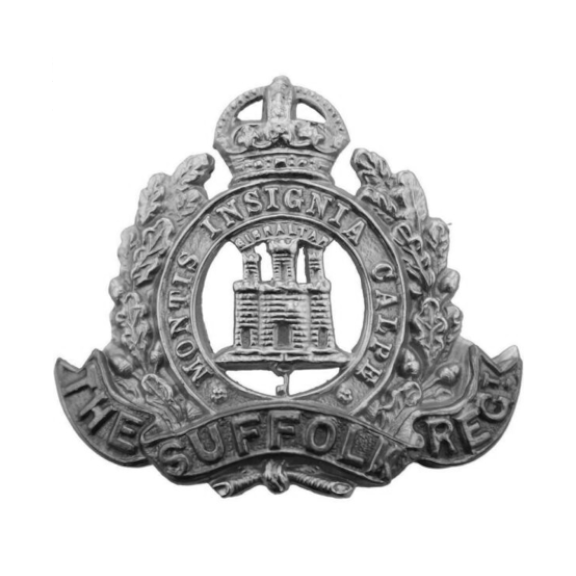
Payne Custerson’s life is another example of one where we have to piece together very occasional administrative points in his life to pull together a chronology but bearing in mind that these records tell us nothing of the experiences of his life, and in particular, how his war felt to him.
Payne was born in Harlton on 16 September 1884, to Joseph and Sarah Ann Custerson. He wasn’t baptised until he was about 7, and then in Little Eversden. By the time of the 1891 Census the Custersons were living in Kingston. Payne was still living in Kingston in the 1901 census when he was recorded as 17.
Payne’s mother Sarah Ann had died in 1896 when he was 11. When he was about 24, he had a series of family deaths, losing four more of his family in rapid succession, his brother Richard W (42), in July 1908, his father Joseph (77), in October 1908, a second brother Robert James (24)in January 1909, and his sister Susanna, (33), also in January 1909.
On 27 October 1909 Payne married Emmeline Annie Wenham in Wendy parish church. They were both 25 years old. Payne was still living in Kingston, and it seems they made Kingston their home for a while. By the time he joined up though, Payne was living in School Lane in Toft.
The service number we have for Payne, 203052, is from a block allocated to the 4th Battalion of the Suffolks in 1917, when the Territorial Force went through a renumbering process. What we cannot be sure of is whether Payne was in the army before early 1917, though his medal card gives his enlistment date as 20 January 1917 indicating he wasn’t. The 1/4th Suffolks were already in France at this point, so Payne would likely have been trained in the Cambridge and Suffolk Reserve Battalion in England for about six months and then moved to France to join the 1/4th, probably in late summer 1917.
However, in early 1918 the Army went through a significant restructuring, and the 1/4th Suffolks changed from an infantry unit to a Pioneer Battalion — builders of roads, trenches, airfields, headquarters structures, etc. Men still fit for front-line infantry work would have been moved out of the regiment at this point, and it seems likely that this is what happened to Payne. The Army’s original practice of regional regiments had long since been lost, and men were moved into units wherever they were needed, which explains why Payne moved into the 1/5th Northumberland Fusiliers.
Payne was transferred to the 1/5th at what, with hindsight was a significant period, just prior to the German Spring Offensive of 1918. The 1/5th NF formed part of 149th (Northumberland) Brigade, 50th (Northumbrian) Division, alongside the 1/4th and 1/6th Northumberland Fusiliers. After the terrible fighting of the March German offensive, the brigade was withdrawn on 1 April 1918 to Lillers. It was down to only about 400 all ranks and was rebuilt there with drafts sent from home.
Payne’s Northumberland Fusiliers number, 235357, is very close to 235341, Edgar Ernest Brown of Somersham, Cambridgeshire, who was serving in D Company, 1/5th NF and was killed on 10 April. That clustering suggests that Payne and Brown were part of a block transfer/reinforcement, of men drawn from East Anglian territorial units and posted into the badly depleted Northumberland battalions.
On 9 April, Operation Georgette, the German Lys offensive, began. The 50th Division had been preparing to take over the sector from the Portuguese, but the German attack shattered the Portuguese front before that relief could occur.
At 7.30 a.m. on 9 April, the 1/5th and 1/6th Northumberland Fusiliers were moved forward together to Le Trou Bayard, just north-east of Estaires. During the remainder of the day, they were shuffled between positions as commanders tried to establish where the German breakthrough was likely to be focused. So, on the evening of 9 April Payne was likely somewhere between Le Trou Bayard and Pont Levis.
Early on the 10 April, the German advance had broken through south of the brigade and Estaires itself was being lost. The 149th Brigade was trying to establish a defensive flank while German troops poured westwards. The neighbouring 1/6th NF was ordered at 7.15 a.m. to counterattack into Estaires and succeeded temporarily in recovering much of the town, before being progressively forced back under shellfire and renewed attacks.
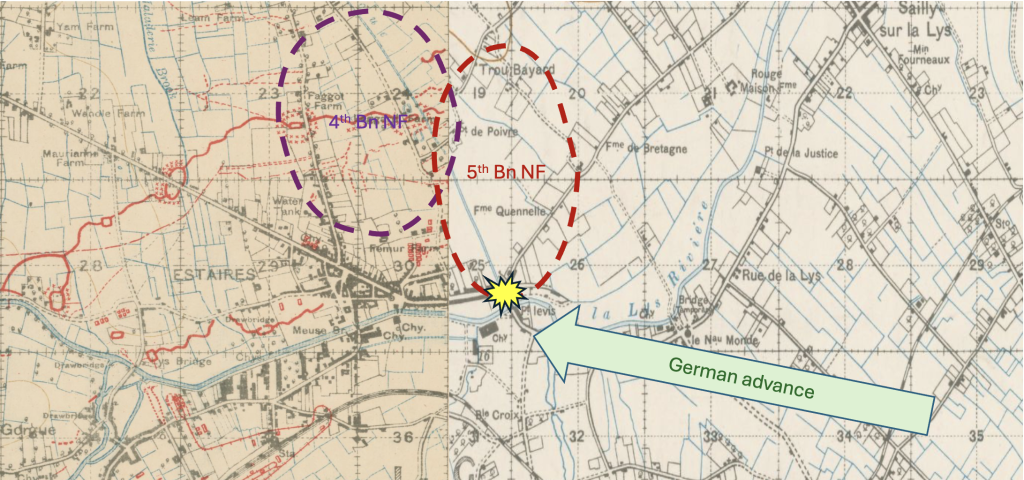
The 5th NF were fighting around Pont de Poivre–Trou Bayard. By about 4 p.m., A Company and the remnants of the battalion were holding strongpoints there, alongside the 4th NF. At 6 p.m. the Germans attacked under machine-gun cover; the battalion’s Lewis guns and rifles inflicted casualties, but the situation was deteriorating rapidly. It appears the Germans first captured Pont Levis and then pushed up through the 5th Battalion and on to the 4th Bn dug in around Le Trou Bayard. It was at some point in this battle that Payne was probably captured.
The 5th Bn War diary for 10 April reports
Killed: 19 Wounded: 83 Missing: 1 officer + 218 other ranks.
We have an extract from the German prisoner-of-war record. It says that he was shot in the left leg and treated in hospital in Münster. He does not seem to have been reported by the Red Cross until 5 September 1918, when he was recorded in Soltau prison camp. So it seems likely that his wife Emmeline and his family knew nothing more than that he was missing for the 5 months between April and September 1918.

Payne remained a prisoner of war until he was released at the end of the war and arrived back in England on 21 January 1919. He was discharged from the army on 30 April 1919.
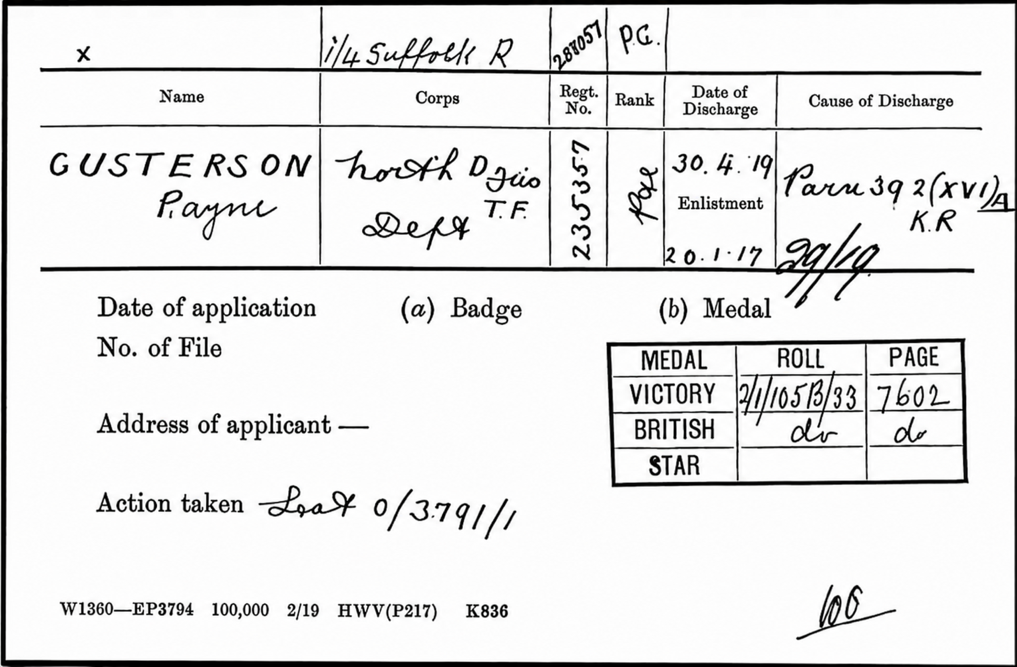
Payne was awarded the standard British War medal and Victory medal, but also a Silver War Badge, indicating he was wounded during the war. His Silver Badge record confirms his service number his badge number was B190767, he enlisted in 20 Jan 1917 and was discharged on 30 April1919 as no longer fit for service, and he had served overseas.
In the 1939 Register Payne was listed as living at 9 Council Houses, Toft, a widower and a disabled war pensioner. Sadly, Emmeline had died in 1939, before the register was compiled.
Further misfortune befell Payne when his only child, Norman, died of dysentery the Railway Camps in Thailand in November 1943 while serving in the 1st Cambridgeshire Regiment.
Payne lived until 1968 and is buried in Toft, alongside Emmeline.
Payne Custerson’s story is one of repeated loss, endurance and extraordinary uncertainty. By the time he went to war in 1917, he had already lost his mother, father, two brothers and a sister, and had built a new life with his wife Emmeline. Sent first to the Suffolks and then transferred to the depleted 1/5th Northumberland Fusiliers, he arrived just in time to be caught in the German Spring Offensive. On 10 April 1918, during the desperate fighting around Pont de Poivre and Le Trou Bayard, Payne was wounded and captured. For months his family may have known little more than that he was missing. He survived captivity and returned home in January 1919 but carried the consequences of the war for the rest of his life as a disabled pensioner. Nor was war finished with his family: in 1943 his only son Norman died as a PoW while serving with the Cambridgeshire Regiment in Thailand. Payne nevertheless lived on until 1968, his life spanning two world wars and marked by both remarkable survival and repeated personal loss.