
11th Battalion, Suffolk Regiment
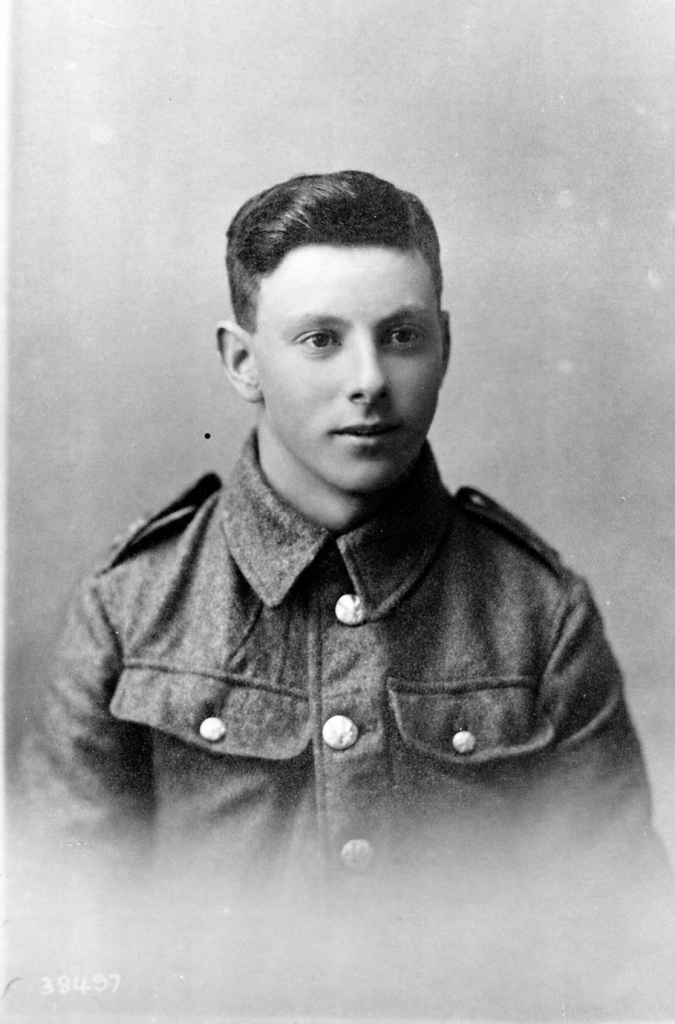
Thomas Charles Custance (sometimes Charles Thomas) was born in Kingston on 25 November 1893, to Thomas and Mary Anne Custance.
In the 1911 Census he was living with his parents on the Green in Kingston and working as a cattleman on a farm. Of note, here he is clearly recorded as Thomas Charles Custance.
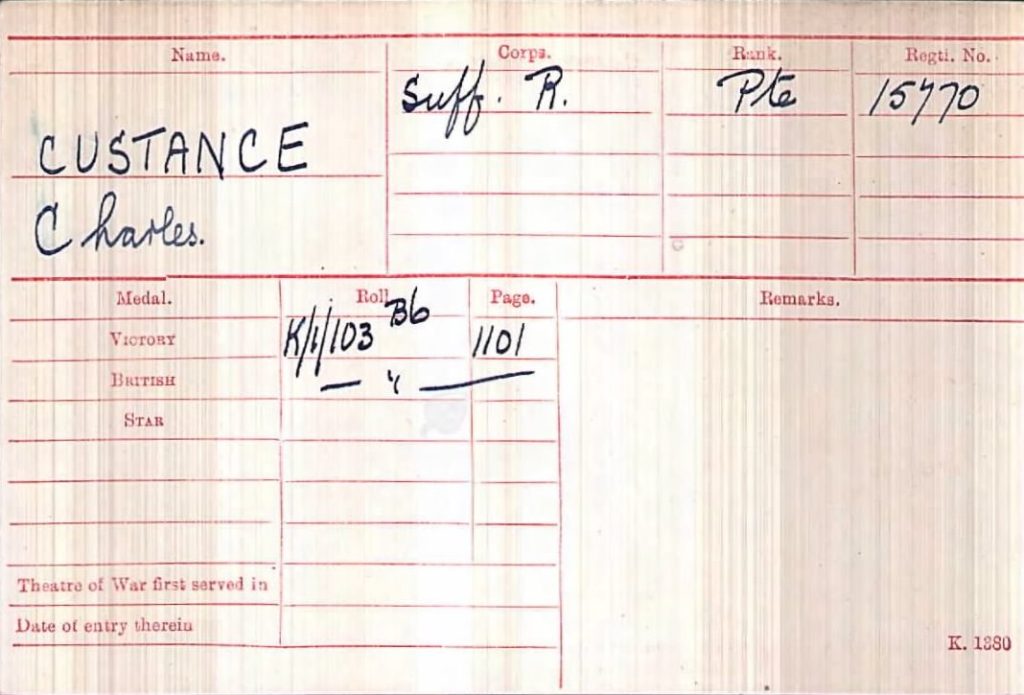
Charles joined the 11th Battalion of the Suffolk Regiment, as several other Kingston men did. His service number was 15770, which places him in the same recruiting line as Joseph Chapman, 15768, and Frank Allgood, 15763. This strongly suggests that they enlisted in Cambridge at the same time, probably around 19 October 1914.
The 11th Battalion, Suffolk Regiment, also known as the Cambridgeshire Battalion, was raised at Cambridge in September 1914 during the rapid expansion of the Army. These new battalions were often called Kitchener battalions, after Lord Kitchener, the Secretary of State for War, whose recruitment campaign called for volunteers in the first months of the conflict.
The battalion’s early training was local. It moved to Melbourne Place Schools in Cambridge on 30 September 1914 and then to Cherry Hinton Camp on 18 December. At this stage the men were still some distance from being fully equipped soldiers. Many of the new units were short of proper uniforms, rifles, instructors and equipment. Even in February 1915, when the King inspected troops in Cambridge, the 11th Suffolks were still not fully kitted out in standard fashion.
From June 1915, the battalion moved north to the Ripon and Fountains Abbey area in Yorkshire, where it trained as part of the 34th Division. This was when the men began to move from being enthusiastic civilians in uniform towards becoming a formed fighting battalion. Route marches, musketry, field discipline, entrenching, company drill, battalion drill and larger exercises would all have intensified.
In late August 1915, the 11th Suffolks moved again, this time to Salisbury Plain, based at Perham Down and later Warminster. This was the final training phase before overseas service. By then, the men had been in uniform for nearly a year.
A soldier serving in a home-based battalion could sometimes get short local passes, occasional leave, or leave for particular family reasons. Charles seems to have made good use of such opportunities. In October 1915 he married Lilian Maud Harrup. Their first son, Stanley Charles, was born in Kingston on 27 November 1915, just over a month before the battalion left for France.
The 11th Suffolks landed in France on 9 January 1916. Charles then joined the battalion’s long and costly service on the Western Front. The battalion would be involved in the Somme in 1916, the fighting around Arras in 1917, and the difficult defensive fighting of 1918. Charles survived the Somme although there is evidence he was awarded a wound strip after an incident on 21 August 1916. He also participated in the later attritional battles in which the 11th Suffolks suffered so heavily through 1917. Following this intensive period of fighting, in October 1917 the whole 34th Division, including the 11th Suffolks was withdrawn to a quieter sector. During this period, it seems that Charles may have managed some home leave, back in Kingston.
By early June 1918, British forces were holding a fragile defensive line along the La Bassée and Lys canal area in northern France. The German Spring offensives had driven the Allies back across parts of Flanders, and the front was still unsettled. Around Robecq and St Floris, units including the 11th Suffolks were helping hold the line against further German pressure.
The ground was flat, exposed and difficult to defend. By this stage of the war, many of the older trench systems had been destroyed or abandoned during the rapid movement of the spring offensives. Defence often depended on shallow positions, shell holes, scattered posts, support lines, reserve lines and farm buildings. Units were understrength and frequently reorganised, with drafts brought in from elsewhere to keep a continuous front.
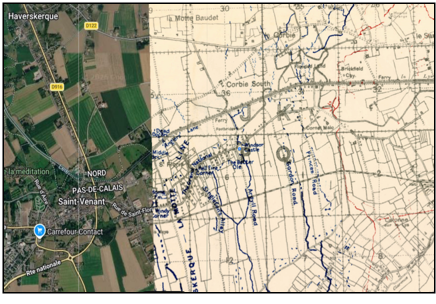
Charles was killed on 9 June 1918. He does not appear to have died in a major set-piece attack. The war diary of the 11th Suffolks records no heavy fighting that day. Instead, it notes that five officers and 107 other ranks were sent to the Divisional Wing Infantry Reception Camp for further training under Major J. H. Brett. The battalion was also ordered to relieve the 2/6th Battalion, Royal Warwickshire Regiment, in the left subsection of the St Floris sector. The relief began at 9.30 pm and was complete by 1.51 am. The battalion then held a system of forward posts, with support and reserve lines, with the 5th Division on the left boundary of the Lys Canal.
The map below shows the area of the positions held by the 11th Battalion on the night of 9–10 June 1918 were along the Lys Canal, running east to west. The company positions were mainly in the centre of the map, near a place known to British troops as “Windsor Castle”.
June 1918 was, by the standards of the 11th Suffolks’ war, a relatively quiet month. The battalion’s total casualties for the month were two officers wounded, two other ranks killed, and seventeen other ranks wounded. There were no recorded deaths from wounds and no missing men. That context makes Charles’s death all the more stark. He was one of only two other ranks killed in the battalion that month.
The most likely explanation is that Charles was killed by the everyday violence of the front line: a sniper’s bullet, a shell fragment, random machine-gun fire, or some other incident too small to be recorded in detail in the war diary but fatal to the man concerned. This was one of the cruellest facts of trench warfare. Men could survive the named battles — the Somme, Arras, Roeux, the German offensives — only to be killed on a day that appears in the battalion record as routine.
Charles was buried at St Venant-Robecq Road British Cemetery, Robecq, in grave IV.B.11.
A memorial service for Charles, the second of the three Custance sons to be killed, was held in Kingston Church on 30 June 1918.
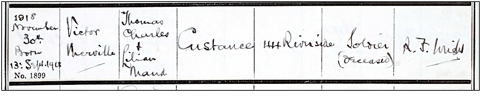
Three months after his death, on 13 September 1918, Lilian gave birth in Kingston to their second son, Victor Merville Custance, presumably named after the town of Merville, close to where his father had been killed. Lilian was awarded a pension of £17, it is not clear if this was a lump sum, or a regular payment.
Charles Thomas Custance’s story is, in many ways, the story of the 11th Suffolks themselves. He was a young farm worker from Kingston who enlisted early, trained with the Cambridge Battalion, married while still in England, became a father, and then crossed to France in January 1916. He endured more than two years of front-line service before being killed in June 1918, when the war still had five months to run. His death was not part of one of the famous opening days or great advances. It came in the dangerous, weary middle ground of war: holding a line, relieving another battalion, living under fire, and waiting. Perhaps most tragically, he had two sons, one of whom he perhaps saw for one week of leave, the other was born after his death.