
1st Battalion, Bedfordshire Regiment
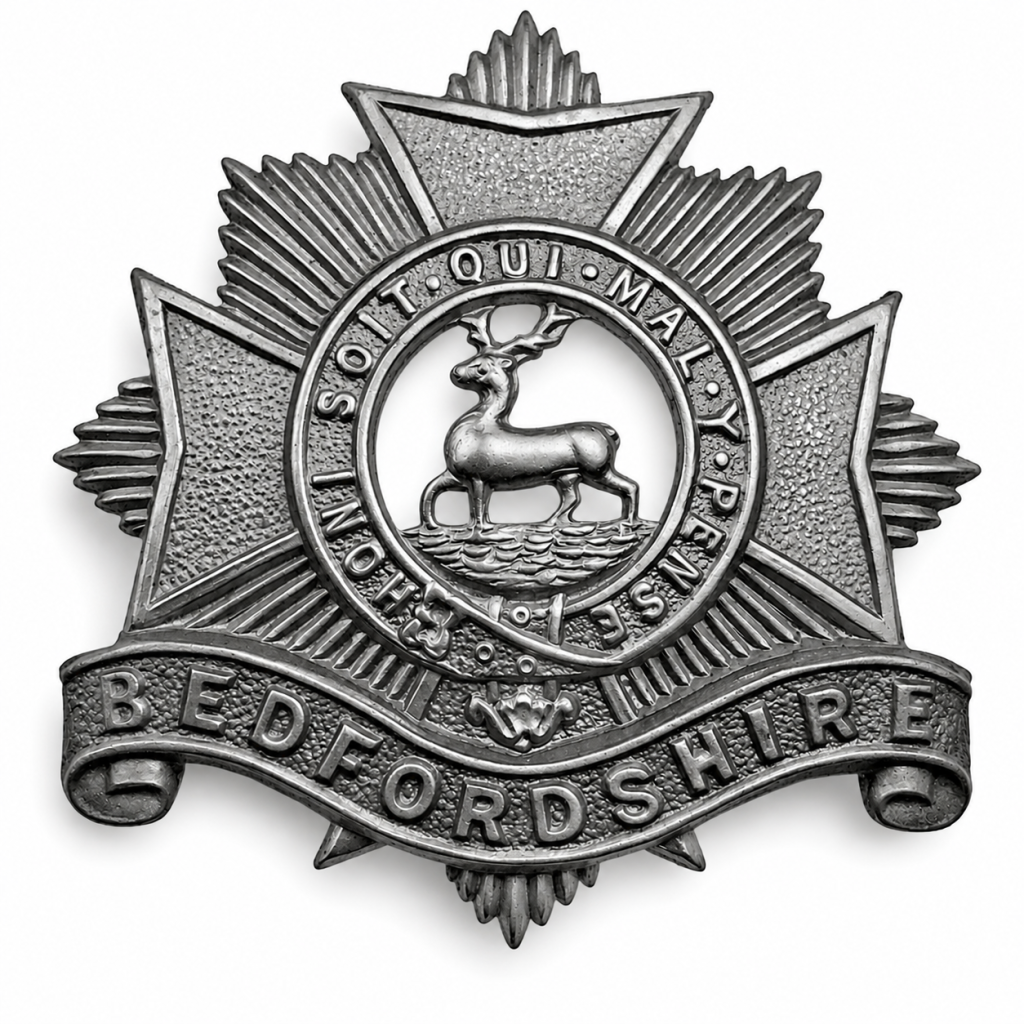
Albert Jackson was born to William John and Mary Ann Jackson and was christened in Kingston on 27 August 1893.
By the 1911 Census the family had moved to Plough and Harrow Cottages, Madingley Road, Cambridge. William John Jackson was a farm labourer and worked in Bourn, with his eldest son Harry. Albert was 17 and worked as a farm labourer in Kingston.
The Jacksons clearly moved around a lot though, the younger children were born in Wintringham, Alconbury Weald and in Wintringham again.
By the time of Albert’s death, his family address was given as Ladysmith Cottages, Huntingdon Road, Girton, though Albert’s birth in Kingston is confirmed in Bedfordshire roll of honour material and he clearly began his working life in the village he grew up in.
Albert served as a Private in the 1st Battalion, Bedfordshire Regiment, with the service number 10361. That number suggests that he was already serving as a regular soldier before the war began. The block of Bedfordshire Regiment numbers around his was being issued in early 1914, so Albert was not a Kitchener volunteer, but a young man who had joined the regular Army shortly before the outbreak of war.
The 1st Battalion was a regular Army battalion. In 1913 and early 1914 it was serving in Ireland. Albert may not have spent long there, if he reached the battalion only after training. The battalion went to France with the British Expeditionary Force in August 1914, and Albert’s service belongs to that early regular Army phase of the war. His medal record shows he landed in France on 11 November 1914, qualifying him for the 1914 Star.
This made Albert different from many of the Kingston men who enlisted at the outbreak of war, the so called Kitchener volunteers. Most Kingston men, called up from civilian life, trained for many months before reaching France in January 1916. Albert, by contrast, was serving with a regular battalion during the first year of the war, when the British Army was small, professional, and heavily engaged in trying to hold the line around Ypres.
On 5 May 1915, the 1st Bedfordshires were involved in the fighting around Hill 60 during the Second Battle of Ypres. Hill 60 was a low but important piece of high ground to the south-east of Ypres. In the flat landscape of Flanders, even a modest rise could matter, because it gave observation over trenches, roads and artillery positions. The Germans were determined to regain control of the area, and the British were equally determined to hold it.
The Bedfordshires were not defending the summit of Hill 60 itself, but they were holding trenches connected to the position, west and north-west of it. This placed them on an exposed flank of the fighting. Bedfordshire Archives’ summary of the battalion’s war diary for 1 May records that the enemy attacked trenches to the right of the battalion with asphyxiating gas and shells, and that the Bedfordshires’ right-hand trenches felt the effects, with men violently sick and some taken to dressing stations suffering from gas.
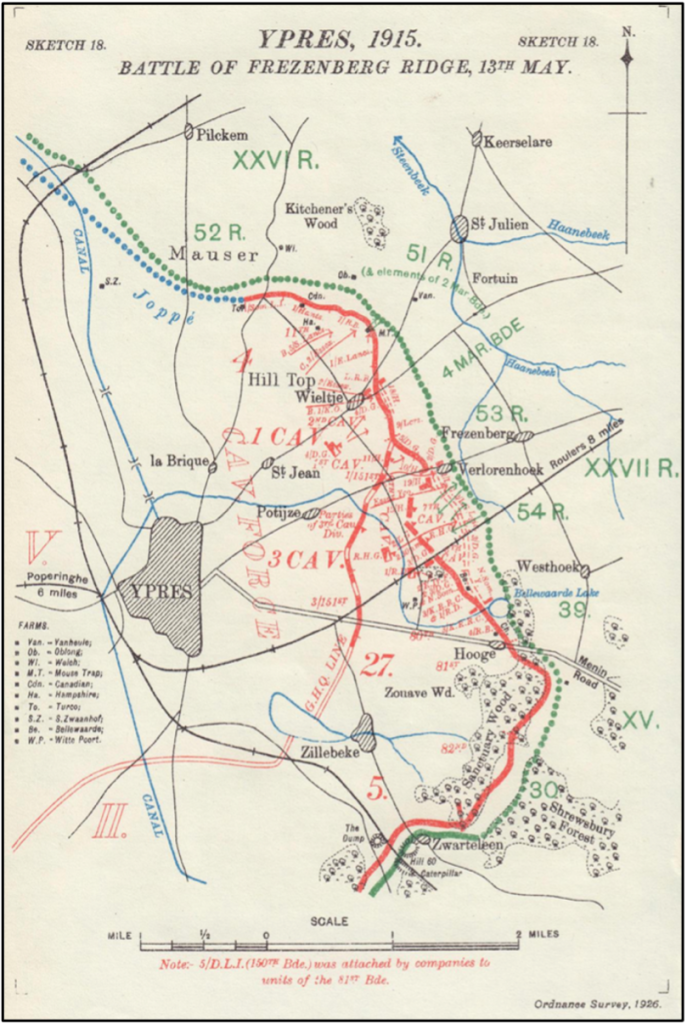
Map of the Battle of Frezenburg Ridge showing Hill 60 at the bottom, centre
The attacks continued over the following days. German forces used heavy artillery and poison gas, followed by infantry attacks. Gas was still a terrifyingly new weapon in May 1915. Men had little effective protection, and gas clouds could create confusion, panic, choking, blindness, vomiting and delayed lung damage. Phosgene and chlorine were among the agents used in this period; both could disable or kill, and symptoms were not always immediate.
Bedford Borough’s roll of honour records the battalion as engaged in the defence of trenches west of Hill 60 against German attacks and lists Albert among those killed in action that day. It records him as 10361 Private Albert Jackson, aged 21, son of William John Jackson of Ladysmith Cottages, Huntingdon Road, Girton, born in Kingston.
The same roll lists a long sequence of men of the 1st Bedfordshires killed on 5 May. That clustering tells its own story. Albert was not an isolated casualty on a quiet day; he was one of many men killed as the battalion endured the German attacks around Hill 60.
Albert’s body was not recovered nor identified after the fighting. He is commemorated at Ypres, on the Menin Gate Memorial, on Panels 31 and 33. The Menin Gate records the names of men who died in the Ypres Salient and have no known grave. In Albert’s case, that absence is itself part of the story. The conditions around Hill 60 — shellfire, gas, repeated attacks, damaged trenches and contested ground — made recovery and identification of bodies extremely difficult.
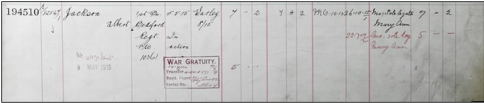
Figure 2. Albert Jackson’s war gratuity paid to his mother (Ancestry)
Albert Jackson’s war was short but intense. He was not part of the later mass volunteer Army, but of the regular Army that went to France in the first months of the conflict. He served with the 1st Bn Bedfordshire Regiment in the Ypres Salient, where the old professional Army was worn down in some of the hardest fighting of 1914 and 1915. He died on 5 May 1915, aged 21, in the gas and artillery fighting around Hill 60. Kingston’s connection to him is therefore also a connection to the early war: before the Somme, before the 11th Suffolks reached France, and before many later volunteers had even completed their training. Albert is also listed on the War Memorial by St Andrew’s church in Girton.
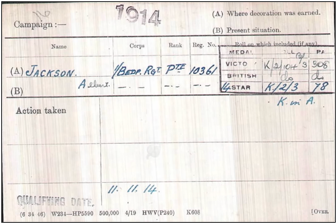
Figure 3. Albert Jackson’s medal card (Ancestry)