
11th Battalion, Suffolk Regiment
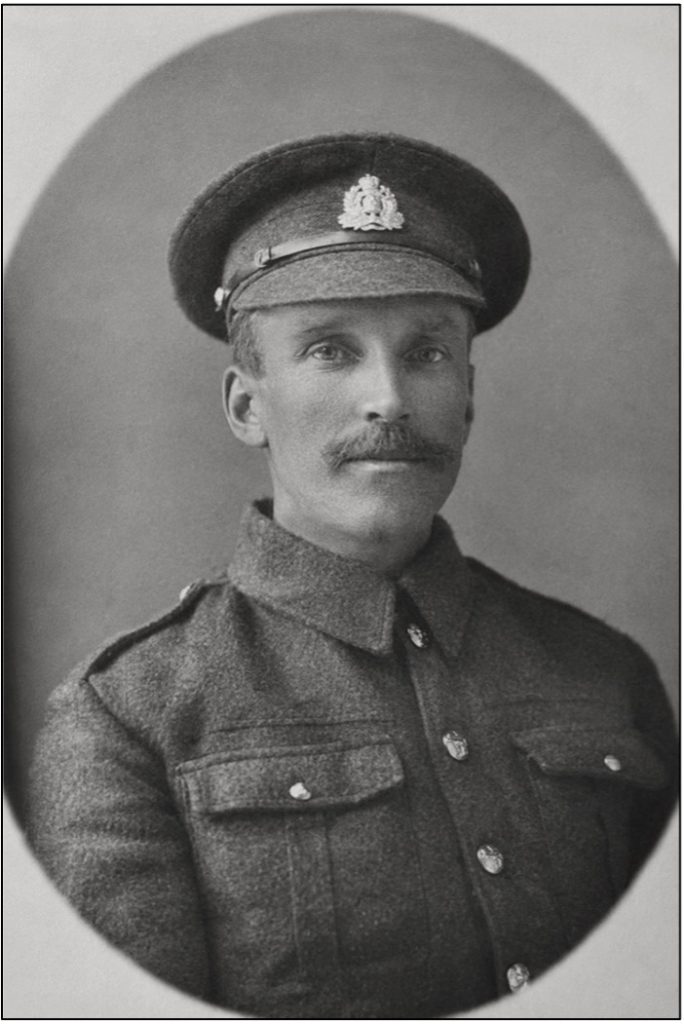
William Charles Rogers Allgood proved one of the more challenging men to research for two reasons.
The first reason was that he was simply listed in our record as William Allgood, and there were many William Allgoods in and around Kingston, of various generations, so being certain that any one document was connected to another by the same man was difficult. Secondly, William Allgood’s Attestation paperwork that tied his service career to the Kingston man is filed in Ancestry.com in the records of a William Rogers.
This picture was one of the unknown photos in the previous picture collection. The cap badge is definitively the Suffolk Regiment, and there are only 2 men we have discovered that were in the Suffolks and for whom we didn’t have a known photo, William Allgood and Walter Rayner. On balance, this picture seems to bear more resemblance to James Allgood than Bertie Rayner, the only two comparisons we really have. So, we have put the photo under William Allgood’s biography.
Like many men from Kingston, William Rogers joined the Army in 1899. For a farm labourer, this was a relatively secure and safe way to earn a living and maybe do some travelling. William joined the Suffolk Regiment, Service Number 5342, on 11 July 1899 under the surname Rogers. He signed up for a Short Service engagement of 7 years in the Army and 5 years in the Reserve thereafter.
William voluntarily extended his time in the Regular Army to 12 years and was discharged at the termination of his engagement on 10 July 1911. He had spent 18 months in South Africa (30 Aug 1900 to 4 March 1902) where he was awarded the South African War Medal and the King’s South Africa Medal. Then he spent nearly 6 years in the East Indies from 5 March 1902 to 24 December 1907, before coming back to England for his final 3 years of service.
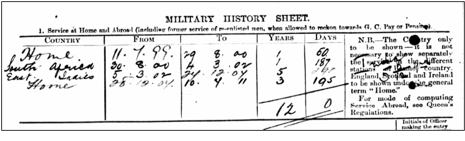
In the 1911 Census William is recorded as living in Barrosa Barracks, Stanhope Lines, Aldershot. He was living as a single soldier, in barracks, with 2nd Battalion the Suffolks.
In his next of kin details, he gave his grandmother, Emma Rogers of Kingston, Cambs. So, at this point, we have a William Rogers of Kingston, who served in the Suffolks, but completed his service before the outbreak of war.
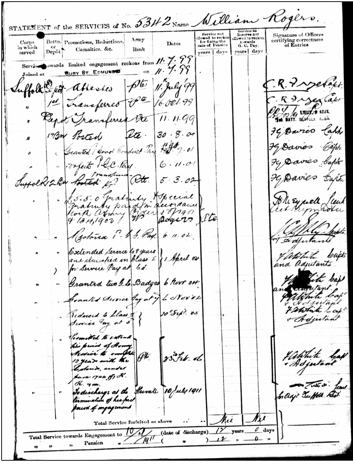
However, appended to this file are the service records of William Allgood, of 20 Trinity Place, King Street, Cambridge. William Allgood enlisted on 20 November 1915 in the Suffolks. A close reading of the record shows that in answer to question 7. Have you ever served in any branch of His Majesty’s Forces, naval or military, if so*, which? The answer in miniscule writing is “No 5342 Suffolk Regiment (12 years) Time Ex 10.7.11”. This is the key line that connects the records of William Rogers and William Allgood as being the same man. On these attestation records, William gives his father Charles Robert Allgood of Kingston as his next of kin.
There is no specific evidence explaining why William changed his name and next of kin details. He had a good record with the Army and on his second enlistment he has been clear about his previous service, so he wasn’t trying to hide anything. It was presumably a personal decision about familial affiliation.
A little wider digging and a few contemporary assumptions might shed some light. William was the son of Charles [Robert/Lee] Allgood and Lucy Allgood, nee Rogers. This was the same Charles Allgood that Lois Jacklin wrote about in Kingston Remembered.
“The most colourful characters if the time were undoubtedly the Allgood brothers. Firstly, there was Hoppy Charles, so called because he had a wooden peg leg. He would stump about the village and always I remember wore a bowler hat! He was a man of small stature and probably the least robust of the 4 brothers. I cannot remember him ever working and suppose he drew parish relief. This, coupled with his two brothers’ income enabled them to live the sort of life they wanted to”.
Lois Jacklin, Kingston Remembered
As a young man, perhaps William felt closer to his grandmother, maybe even brought up by her, and perhaps he wanted to distance himself from the growing reputation of his father and uncles in the village?
The records remain hard to pin down, Lucy Rogers seems to have also gone by the name of Lydia, she is clearly named as Lucy in the marriage certificate to Charles, her father is James Rogers, the come from Toft, but later in the 1881 Census, she is equally clearly noted as Lydia Rogers. But Lucy/Lydia died in 1881 when William was only two years old. James Rogers of Toft was married to Emma. James and Emma had many children, but none called Lucy or Lydia. Nevertheless, it seems most likely that William had some familial connection to Emma Rogers in Toft, and she was a ‘grandmother’ equivalent he preferred to be associated with in his younger years. However, Emma died in December 1913, and James died in April 1914, so William would have been unable to use them as next of kin when he enlisted in the First World War, which may explain the reversion to his father and his father’s surname.
From his record we can see that William attested on 20 November 1915, with service number 27851, and was put in the Reserve. The rate of recruitment to the Army was such that it could not train all recruits immediately, so William was not mobilised until 18 March 1916. He was posted to the 3rd Battalion of the Suffolks on 11 April 1916, the 3rd being the training unit for new recruits. Just a few days later, he was promoted to Lance Corporal, almost certainly on the strength of his previous 12 years of service. That experience would have been very valuable in a battalion of new recruits. On 12 December 1916 he was posted to the 15th Infantry Base Depot. This was the Suffolks clearing unit at Etaples in France, from where they allocated men to the unit most in need or reinforcement. On 20th December, he was posted to the 11th Suffolks, joining Charles Custance, Frank Jacklin and John Wayman who were still on the frontline unit at this time.
This puts William at the first and second battles of the Scarpe and at the famous Suffolks battle of Arles and the Rouex chemical works, then later at Hargicourt, the Menin Road and Polygon Wood, Ypres and Cambrai.
There is a record for William in the 18th General Hospital records dated 4 March 1918 that shows he had an operation for a simple fracture of his left femur which seems to have been fixed with a ‘Steinman nail thro Os Calcis’ – presumably pinned in some way. He was operated on by Major Speed and Lt Gospel.
At the time, the 11th Suffolks had just undergone a substantial restructure and received additional soldiers as reinforcements, so they were in reserve and training men in the new structure. William’s injury was the result of an accident in this reserve training period, rather than a gunshot wound or similar combat injury in the trenches.
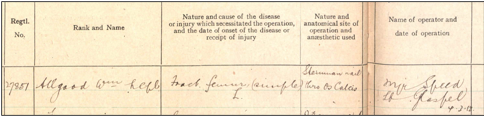
This surgery did not produce a full recovery. William’s records indicate he came back to England on 3 April, possibly for further treatment or recuperation.
However, on 20 September 1918 he was discharged from the Army under King’s Regulations, para. 392 (xvi) no longer physically fit for war service. The injury was deemed attributable to service during the war, and his earning capacity was assessed as lessened to 70% enabling him to claim a pension.
William was awarded a Silver War badge recognising he was discharged from the Army because of an injury or health attributable to his service. The Silver War Badge was often worn by men who had returned from the war, to show they had served, and to deflect any criticism for not being away fighting. William’s Silver War badge records confirm his service number gives his rank as Lance Corporal, he was discharged from the Suffolk Depot, his War Badge was numbered B11973. His date of enlistment was given as 20 November 1915 and discharge on 20 September 1918. The reason for discharge was given as fractured femur.
Then it seems that William’s prior service further enhanced his pension, so he had not only 2 years and 186 days of war time service, but the previous 12 years as well.
After the war he married Amy Alice Lander in 1926 and returned to live at 20 Trinity Place in Cambridge. He died in 1956 and is buried alongside Amy in Mill Lane Cemetery, Cambridge.
William Allgood’s story is one of a man who had already made the Army a substantial part of his life long before the First World War began. He had served twelve years with the Suffolk Regiment as William Rogers, including service in South Africa and India, before returning to civilian life in 1911. When he enlisted again in 1915, this time under his birth name of Allgood, he brought with him the experience of a professional soldier and was quickly promoted to Lance Corporal. His second period of service took him to France but ended not in battle death but through a seriously broken leg which left him permanently impaired and led to his discharge in 1918. His surviving records, split between two names, make his story unusually difficult to reconstruct, but they also reveal one of Kingston’s most experienced soldiers: a man whose military career stretched across two wars and nearly twenty years.