
Royal Field Artillery
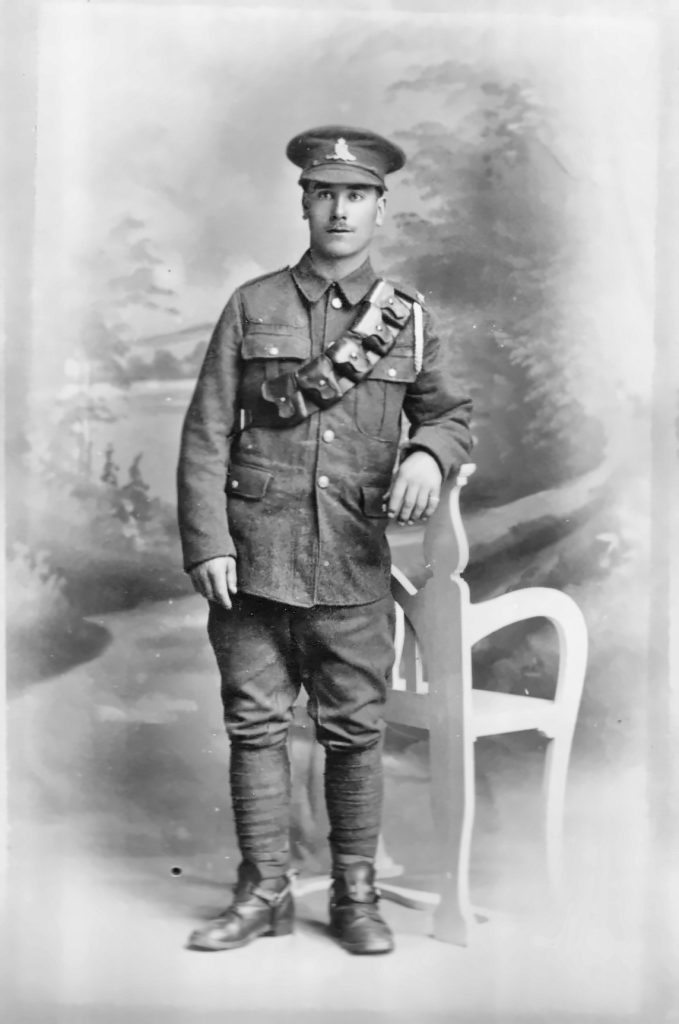
Joseph Custance was born on 28 May 1898 and baptised in Kingston on 4 September that year. He was the third son of Thomas and Mary Ann Custance. In the 1901 Census, the family was living on Field Road. Joseph was two years old. His older siblings were Florence, aged 9, Charles, aged 7, and William, aged 6.
Like several other Kingston men, Joseph served in the Royal Field Artillery. His service number was 211287, and his rank was Driver. Although no service records survive for Joseph, checking out the records of men with service numbers very close to him, we can determine that he enlisted on 4 April 1917, in Suffolk.
In artillery units, a Driver was not a motor driver in the modern sense. In Joseph’s case, the photograph makes clear that he worked with horses. He wears a bandolier across his body, and, on close inspection, he appears to be wearing spurs and leather stirrup-protectors on the front of his boots. These are the details of a mounted soldier.
The Royal Field Artillery was responsible for the mobile guns that supported the infantry. Its batteries used field guns and howitzers, which had to be moved into position, supplied with ammunition, maintained and, when necessary, withdrawn or moved again. Horses were central to this work. A gun battery needed teams of horses not only to pull the guns themselves, but also ammunition wagons, limbers, equipment and supplies. Drivers rode or controlled the horse teams, often under shellfire, across broken roads, mud, shell holes and congested routes close to the front.
This was dangerous and demanding work. The artillery could be behind the infantry line, but it was not safely distant from the war. Gun positions were regularly shelled, especially once located by enemy observation or sound-ranging. Horses panicked, bolted, were wounded, or were killed. Drivers had to manage animals, equipment and movement while under pressure, and often in appalling conditions. It required steadiness, physical skill and an ability to work with horses in circumstances no farm or village road could really have prepared a man for.
Joseph’s service is difficult to trace in detail. This is a common problem with men who served in large corps such as the Royal Field Artillery, the Royal Garrison Artillery or the Army Service Corps. Infantry regiments were smaller, more locally rooted, and often better recorded in ways that help family historians. They also tended to develop strong regimental histories and battalion narratives. Large corps were different. Men might be posted to numbered batteries, brigades or depots, moved between formations, or absorbed into large administrative systems that are hard to reconstruct unless a personal service record survives.
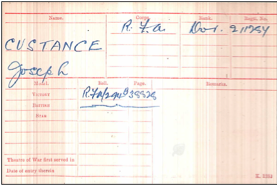
Sadly, that seems to be the case with Joseph. Without a surviving service record showing exactly which Royal Field Artillery brigade or battery he served with, it is not possible to trace his movements across the war with confidence. His medal record does, however, show that he was awarded the British War Medal and the Victory Medal. This confirms that he served overseas.
After the war, Joseph returned to Kingston. In the 1921 Census he was living with his parents and working as a cowman. That return must have carried a particular weight. He came back to a family in which two brothers had not returned: William, buried in France after the Somme, and Charles, killed in the final months of the war.
In April 1926, Joseph married Catherine Mary Fordham. Their daughter, Pearl Custance, was born in June 1926. Around 1965, Joseph and Catherine moved to Tadlow. Joseph died in Biggleswade in 1981, aged 83.
Joseph Custance’s story is quieter than those of William and Charles, partly because the surviving records tell us less. Yet it completes the story of the three Custance brothers. William’s war can be tied to the 2nd Suffolks at Serre. Charles’s can be traced with the 11th Suffolks to the Lys Canal sector in June 1918. Joseph’s is harder to follow, hidden within the vast machinery of the Royal Field Artillery. What can be said is that he served overseas as a horse driver in the artillery, survived, and returned to Kingston as the only one of the three soldier brothers to rebuild a civilian life after the war.