
[This article first appeared in the Kingston Parish magazine in the summer of 2026 as a ‘warm-up’ to the launch of the web pages]
As the individual biographies of Kingston’s First World War servicemen are prepared for publication, one question comes up repeatedly: how and why did these men join the Army? The answer is not as simple as “they volunteered” or “they were conscripted”. The war lasted long enough, and changed so much, that Kingston men entered military service through several different routes. Some were pre-war soldiers or reservists. Many joined in the great patriotic rush of 1914. Others came in through the Derby Scheme of late 1915, or through conscription from 1916 onwards. A few were too young, too old, or served in unusual circumstances that do not fit neatly into any single category.
Before the war, Britain was unusual among the major European powers because it did not have mass conscription. France and Germany had large armies built around compulsory national service; Britain had a small professional Army, supported by reserves and part-time forces. Since the Haldane reforms of 1908, a man could join the Regular Army, the Special Reserve, the Territorial Force, or the National Reserve.
The Regular Army was the professional force. A recruit normally enlisted for twelve years, often seven years serving full-time “with the colours”, followed by five years in the Army Reserve. These details varied by branch: the artillery, for example, used slightly different terms. A regular infantry recruit was supposed to be at least 18, over 5 feet 3 inches tall, and fit enough to pass the Army medical. He could not normally be sent overseas until he was 19. Men who had already completed their service but remained in the Army Reserve were civilians in peacetime but could be recalled immediately when war came. In August 1914, this reserve of trained former soldiers was vital and was immediately deployed. A few Kingston men took this route and particularly in the period from about 1880 to 1910 it seems there were usually 2 or 3 Kingston men serving in the Regular Army. Jack Payne was recalled from Canada under his reserve liability. William Allgood had also completed a 12 year term in the Regulars and was recalled in 1915 under his reserve liability. Albert Jackson had joined the Regular Army in 1913.
The Territorial Force was different again. It was a part-time force, recruited locally, and its members trained at evenings, weekends and annual camp. Territorial units were often deeply rooted in their county or town. Men joined their local battalion or battery, and the unit became part of local civic pride. Territorials could already be embodied for full-time service in wartime, but before the war they were not automatically obliged to serve overseas. After August 1914, many signed the Imperial Service Obligation, allowing them to be sent abroad. Again, there were often 2 or 3 Kingston men serving in the Territorial Force, Bertie Rayner was in the Cambridgeshire Regiment immediately before the war.
When Britain declared war on Germany on 4 August 1914, the Army was much too small to sustain a long continental war. Lord Kitchener, appointed Secretary of State for War, famously believed that the conflict would not be over quickly. He called for vast numbers of volunteers to create new armies. His first appeal, issued on 7 August 1914, asked for 100,000 men. The response was extraordinary: within eight weeks, nearly 750,000 men had enlisted. On 3 September 1914 alone, over 33,000 recruits joined in the United Kingdom.
This is the recruiting phase most people remember: Kitchener’s face, pointing finger, and the idea that “Your Country Needs You”. The exact wording varied from poster to poster. Some said “Lord Kitchener Wants You”; others used “Your King and Country Need You” or “Britons! Join Your Country’s Army!” But the message was unmistakable. The campaign appealed to patriotism, duty, masculinity, local pride, and social pressure. It was not legally compulsory, but the pressure to join could be intense.
One powerful feature of this period was the creation of “Pals” battalions, where friends, workmates, club members or men from the same town enlisted together. The idea was emotionally compelling: men could serve alongside people they knew. The terrible consequence came later, when a single disastrous action could wound or kill a whole group from the same community. Many Kingston men responded to Kitchener’s call and joined the 11th Suffolks (Cambridgeshire) a newly formed unit, a Pal’s Battalion, specifically for the men of Cambridgeshire.
Looking at the Kingston evidence – ages, service numbers, units and surviving records – it is clear that many joined in this Kitchener wave of 1914. Early volunteers include Frank Custerson, Frederick Newman, Walter Rayner, Arthur Jacklin, Ernest Jacklin, William Custance, Frank Allgood, Joseph Chapman, William Custerson, Charles Custance, Motto Allgood, Frank Jacklin, Motto Allgood, John Wayman and Simon Jacklin.
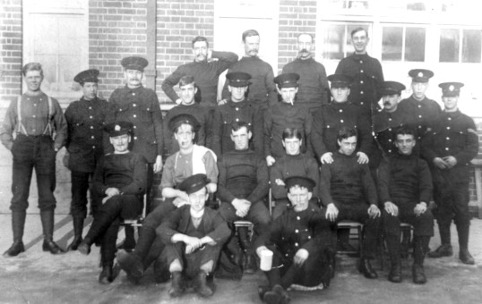
The speed of recruiting in 1914 was astonishing, but it also created serious practical problems. There were not enough trained officers, uniforms, weapons, billets or instructors for the men who came forward. New armies and new divisions had to be created at speed. Some formations existed briefly and were then reorganised as the Army struggled to turn patriotic enthusiasm into trained military strength. Samuel Clear, and Samuel Blows were all serving by early 2015.
By mid-1915, however, voluntary recruiting was no longer enough. The war was consuming men faster than Britain could replace them through volunteers. In July 1915 the government passed the National Registration Act, gathering information about men, ages and occupations. In October 1915 Lord Derby became Director-General of Recruiting and introduced what became known as the Group Scheme, or Derby Scheme.
The Derby Scheme was a halfway house between volunteering and conscription. Men of military age were asked to “attest”, meaning that they formally agreed to serve, but they could then return home until their group was called up. In law, it was still voluntary. In practice, it carried a strong warning: volunteer now, or compulsory service may follow. Men were canvassed, sometimes at home, and the social pressure could be considerable. Among Kingston men, Fred Lindsay, William Allgood, and Frederick Driver likely fall into this category, though the evidence is less certain. It is also about the time James Allgood enlisted when over-age, and perhaps why a blind-eye was turned.
But compulsion did indeed follow. The Military Service Act was passed in January 1916 and came into force in March. At first, it applied to unmarried men and widowers aged 18 to 41, though only men aged 19 and above were initially liable for overseas service. In May 1916 the Act was extended to married men. From this point, a man no longer chose whether to serve, and he had far less say over where he served. He might prefer a particular regiment, but the Army increasingly sent men wherever manpower was most urgently needed.
The system was not quite as simple as a single call-up order. Age, marital status, medical grading, occupation and exemptions all mattered. Some jobs were considered essential to the war economy and were protected as “starred” occupations (including farming and agricultural work). Men could appeal to tribunals on grounds such as ill health, essential civilian work or conscientious objection. The tribunals were busy, controversial and often deeply personal. Conscription also made it harder for men to conceal their age or identity, something that had been much easier during the early voluntary phase, when proof of age was not always required.
Late-war soldiers were not sent only to infantry battalions, although the infantry suffered the heaviest casualties and always needed replacements. The expanding war machine also needed drivers, mechanics, fitters, horsemen, carpenters, blacksmiths, clerks and labourers. Men with useful civilian skills could be directed into the Army Service Corps, Army Ordnance Corps, Labour Corps, Royal Engineers or artillery, as well as into the infantry. Again, several Kingston men seem to have been conscripted at the phase of the war. Among the Kingston men, Richard Jacklin, Payne Custerson, George Ward, Percy Chamberlain and John Clear seem to fall into this category – they were of an age to enlist long before they did. Whereas David Custerson, Simeon Johnson, Joseph Custance, and Robert Custerson seem to have come of age to serve so may have waited until their conscription papers arrived, or have volunteered.
The rules changed again in 1918, when the manpower crisis became acute after the German spring offensives. The upper age limit was raised to 50, although this does not appear to have brought any additional Kingston men into scope. More importantly for young men, the minimum age for overseas service was reduced. Earlier in the war a soldier could enlist at 18 but not be sent abroad until 19. In 1918, men aged 18 years and 6 months could be sent overseas, provided they had completed six months’ training. This mattered for young Kingston men such as Joseph Read, Albert Wayman, Sidney Chapman and Thomas Driver whose service needs to be understood against the changing age rules.
There were also men who do not sit neatly in the British recruiting system. Israel “Jack” Custerson volunteered in Australia, where there was no conscription for overseas service. Jack Payne kept his reserve obligations despite having emigrated to Canada several years before the war. And Bertie Rayner went to particularly extreme lengths to enlist as early as possible, as his story will detail.
So, when reading the Kingston biographies, it is worth remembering that “joined the Army” can mean several different things. A man who volunteered with patriotic enthusiasm in August 1914, a Derby attester waiting at home for the call to come, a conscript forcibly called up in 1917, and an under-age boy accepted by a recruiting sergeant all had very different experiences before they ever reached a training camp, a depot or a ship for France.
The individual stories will put names, families, and faces back into this wider picture. Together, they show not just that Kingston men served, but how the machinery of war reached into our small village: first through patriotic appeal, then through pressure, and finally through the compulsory claims of the state.