
11th Battalion, Suffolk Regiment
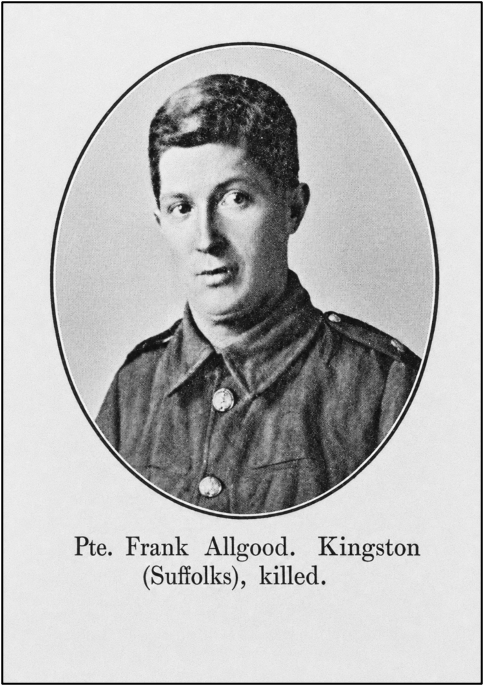
Frank Allgood was born in Kingston in 1894. His mother was Sarah Chapman nee Allgood. In the 1911 Census, Frank was living in Great Lane, Kingston, with Joseph and Sarah Chapman and his brother, Sidney Chapman.
The evidence indicates that Sarah had Frank about eighteen months before she married Joseph Chapman. Frank did not change his surname, but he appears to have grown up and lived as part of the Chapman family. Before the war he worked as a farm labourer.
Frank enlisted in the 11th (Cambridgeshire) battalion of the Suffolk Regiment, as many Kingston men did.
The Cambridge Independent Press regularly published lists of men who had enlisted, and all too soon, list of men who had been injured, were missing, or killed. On 23 October 1914 they published their Roll of Honour noting that the following had joined the Second Army in the past fortnight.
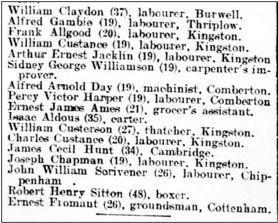
Frank’s service number was 15763, and he was posted to the 11th Battalion. This battalion was closely associated with Cambridge and the surrounding area and was often known as the Cambridge Battalion (not to be confused with the Cambridge Regiment which was a Territorial Force unit).
It is likely that Frank began his training in Cambridge in late 1914. On 18 June 1915 the battalion moved to Ripon in Yorkshire, where training continued joining other units as part of 101 Brigade. For probably the first time in their lives, Frank and the other men from Kingston found themselves working with the 15th and 16thBattalions of the Royal Scots, and the 10th Battalion the Lincolnshire Regiment, known as the Grimsby Chums. Reports suggest the rolling landscape of Yorkshire did not find favour to the men from the Fens!
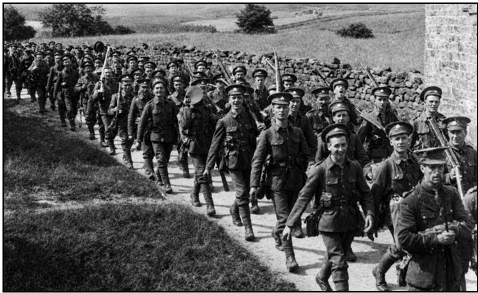
The whole 101st Brigade moved to Salisbury Plain in late August 1915. Here they joined up with two other Brigades, the 102nd Tyneside Scottish and 103rd Tyneside Irish to create the 34th Division. Training now became about the co-ordination of such large units, and ensuring that services like transport, food, first aid, were co-ordinated between all these previously disparate units. It seems there was some frustration about the length of time the men spent in training – they were keen to get to France. However, in December 1915 news came that the Division was to be sent to Egypt. This seemed to have been the plan throughout December, and it was only with a week or so’s notice that the orders were changed, and the Division was sent to France
The 11th Suffolks crossed to France as part of 101 Brigade, 34 Division, landing at Boulogne on 9 January 1916. The early months of the war were spent rotating through time in the frontline trenches and time behind the frontline in further training. There were no big battles, but there were deaths, most frequently from random sniping and mortar fire when in the trenches.
By June 1916, the men knew that a major attack was coming. For days beforehand, British artillery had bombarded the German lines. Senior commanders believed that the German barbed wire had been cut and that their trenches and defensive positions had been destroyed by this bombardment. In places, this was true. In many others, it was not. The result was that thousands of men advanced on 1 July into defences that were damaged but still deadly.
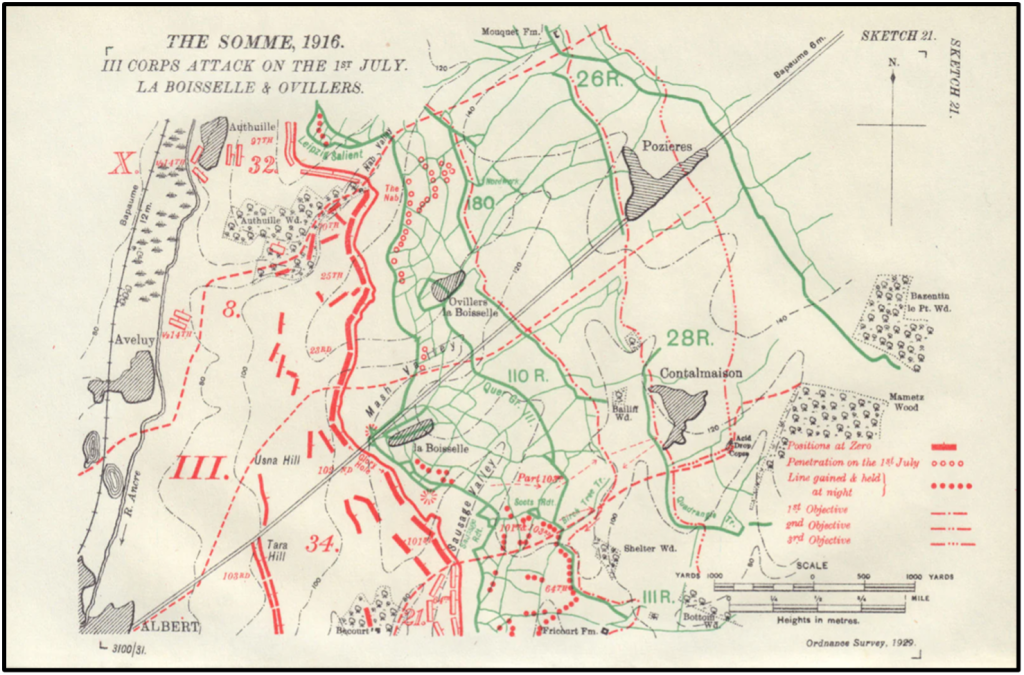
Frank’s battalion was part of the attack near La Boisselle, a village on the Somme battlefield. La Boisselle mattered because it stood close to the road towards Bapaume. If the village and the surrounding German positions could be taken, the road beyond would begin to open towards Pozières and then Thiepval.
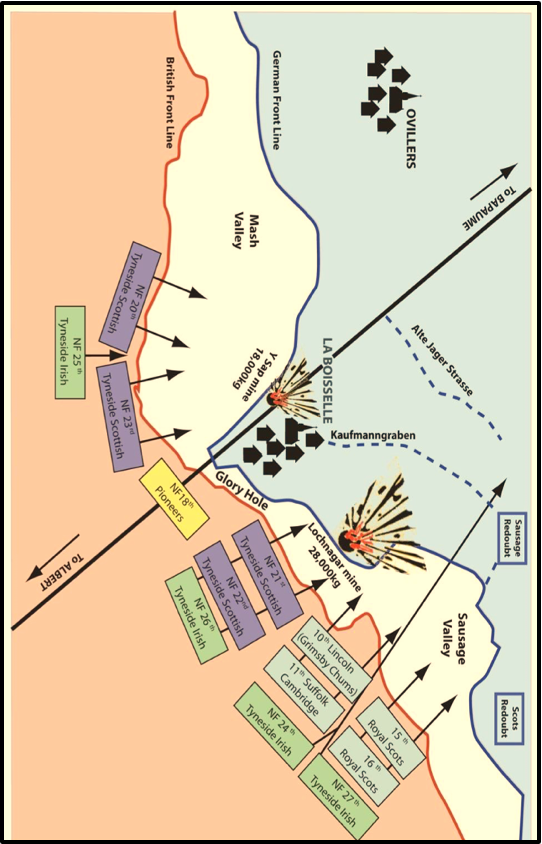
The German defenders held strong positions overlooking two valleys. To the left of La Boisselle was a valley the British called “Sausage Valley”, apparently because a sausage-shaped German observation balloon was often seen above it. Here, No Man’s Land — the dangerous ground between the opposing front lines — varied from about 200 to 500 yards wide. On the other side of the road was “Mash Valley”. This was the widest stretch of No Man’s Land on the Somme front, about 700 metres across.
Rather than attack La Boisselle directly, the British plan was to assault the German positions on either side of it. As part of this plan, two huge underground mines were exploded just before the infantry advanced. One was the Y Sap mine, between La Boisselle and Mash Valley, containing about 18,000 kilograms of explosive. The other was the Lochnagar mine, between La Boisselle and Sausage Valley, containing about 28,000 kilograms. It was the largest mine exploded that day.
At 7.28 am on 1 July 1916, the British bombardment stopped and the mines were detonated. The explosion at Lochnagar threw earth and debris high into the air. The shock wave was so powerful that soldiers who had not taken sufficient cover were reported to have had limbs broken as far as 250 metres away. At 7.30 am, the infantry attack began.
Three battalions were involved in the attack towards the eastern lip of the Lochnagar crater and the eastern side of Sausage Valley: the 10th Lincolns, the 11th Suffolk Regiment, and the 24th Tyneside Irish. The 11th Suffolks were in the second-line trenches opposite the Lochnagar crater. Because no one knew exactly what would happen when such a large mine exploded, they had been ordered to wait an additional five minutes before advancing, to allow the debris to clear. In reality, the debris cleared more quickly. The delay gave the German defenders time to recover and return to their damaged trenches and strong points.
When the Suffolks advanced, they came under intense machine-gun fire from German positions at Sausage Redoubt, Scots Redoubt and positions to the rear of La Boisselle. The Lincolns reached the eastern lip of the crater, while the Suffolks pushed on towards the German line. One especially terrible episode involved Suffolk soldiers trying to fight their way into Sausage Redoubt, only to be burnt by flamethrowers as they reached the parapet.
Some of the remaining Suffolks joined with the 27th Tyneside Irish on their right and helped attack and seize Scots Redoubt. In the circumstances, this was a considerable achievement. British observers then saw that Sausage Redoubt had not been taken and sent an order for the supporting battalion of the 24th Tyneside Irish to halt. The message arrived too late. The men were already moving down towards the British front line and were exposed to German machine-gun fire. Many were killed within minutes.
The surviving Tyneside Irish continued to fight, merging with other units and pushing far behind the German line. Some reached the outskirts of Contalmaison, a village beyond the German positions. This was among the deepest advances made anywhere on 1 July, but those men were not seen again.
One soldier later recalled:
“The long line of men came forward, rifles at the port as ordered. Now Gerry started and his machine guns let fly. Down they all went. I could see them dropping one after the other as the gun swept along them. The officer went down at exactly the same time as the man behind him. Another minute or so and another wave came forward. Gerry was ready this time and this lot did not get as far as the others.“
Private W. J. Senescall, 11th Battalion, Suffolk Regiment, recalling 1 July 1916; reproduced by the Friends of the Suffolk Regiment, 1 July 2016.
The official history estimated that 80 per cent of the men of the Lincolns and Suffolks were killed or wounded in the first ten minutes of the advance. Officers and non-commissioned officers were especially vulnerable, because they were expected to lead from the front and were more easily identified.
Frank was killed in this action on 1 July 1916, what we now know as the first day of the Battle of the Somme. Sergeant Simon Jacklin, another Kingston man, was involved in the same attack and was also killed. It is quite likely that Jacklin, as a sergeant, was among those leading Frank forward that morning. Fred Lindsay was also wounded in this action. Joseph Chapman, Frank’s brother would have been involved in the fighting on this day but seems to have survived uninjured. Charles Custance, Motto Allgood, Frank Jacklin, John Wayman and Ernest Jacklin were also in the 11th Suffolks and likely fighting in the same action.
The losses suffered by the 34th Division on 1 July were the heaviest of any division that day: 6,380 casualties. Within that, the 11th Suffolks suffered particularly badly. Their casualties were the highest of any battalion in the division. During the Battle of the Somme, 691 men of all ranks from the battalion were killed, including 19 officers. Of these, 190 were killed on the first day alone, and 337 were wounded. More men died later from wounds received during the attack. It would surely have been a very significant event for Kingston families, as the news would have slowly come back that there had been a battle with such losses among the Suffolks. There were 9 men from the village serving in the 11th, one had already been hospitalised, two were killed in the fighting, another wounded.
Of the 190 men of the 11th Suffolks killed on 1 July, 148 have no known grave. Frank Allgood was one of them. He is commemorated on the Thiepval Memorial to the Missing, on Pier and Face 1 C and 2 A.
Later in July 1916, Brigadier-General R. C. Gore, commanding 101 Brigade, wrote to Colonel Somerset, commanding the 11th Battalion:
“Will you please express to your Battalion my admiration for their gallant conduct in the attack on July 1st. Theirs was the hardest task of any, having the farthest to advance before crossing our own front line in the face of deadly fire, their courage was magnificent as in spite of wave after wave being mown down, they fearlessly pressed forward towards their objective and got well into the German line but unfortunately their numbers were too few in the end to gain it. No troops could have done better, and I am sure that their advance in this battle will go down to posterity as one of the most gallant actions of the War.“
Brigadier-General R. C. Gore, commanding 101st Infantry Brigade, letter to Colonel Somerset, 5 July 1916; reproduced in the 11th Battalion Suffolk Regiment war diary.
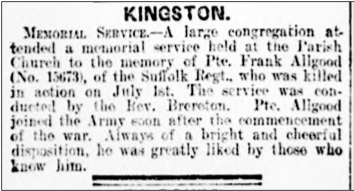
The newspaper extract below reports Franks memorial service. It was one of many in the local papers of the time, just a few column inches below is a similar report of a service for Wilfred Bester from Great Eversden who was also killed on the Somme.
Frank Allgood’s story is short in personal detail but immense in consequence. He was a young farm labourer from Kingston, brought up in the Chapman household but carrying the Allgood name. Like many local men, he joined the Suffolk Regiment and served with the Cambridge Battalion. He reached France in January 1916 and was dead less than six months later, killed in one of the most devastating attacks in British military history. His grave, like those of so many men killed that morning, was never identified. What remains is his name: in Kingston, and at Thiepval, among the missing of the Somme.