
The Queen’s (Royal West Surrey) Regiment
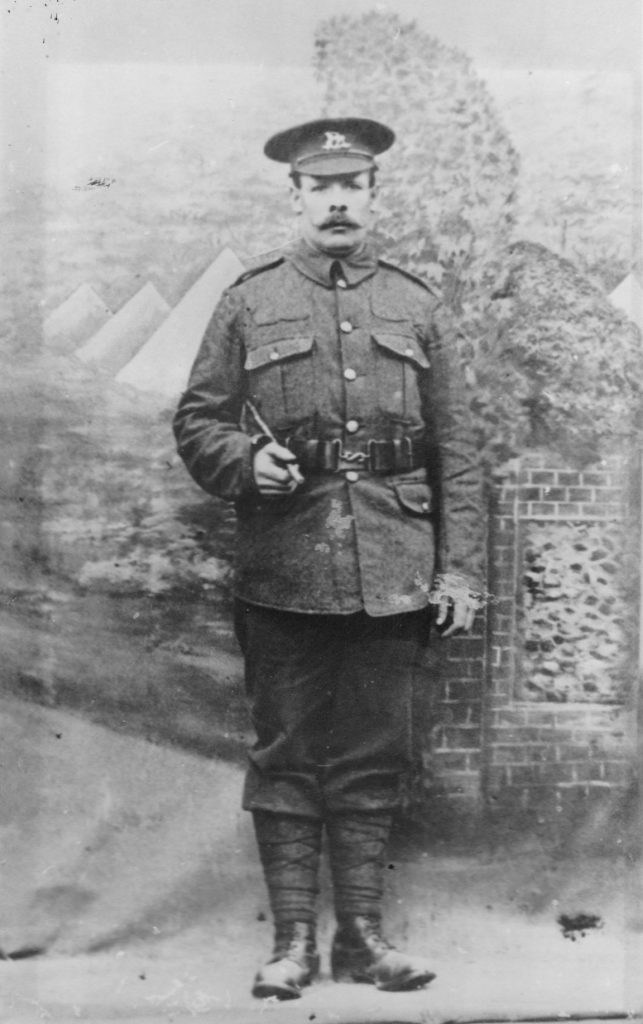
The identity of this man remains elusive.
From village memories, the original picture was collected, mounted and put in the church shortly after the war. But in this first incarnation names were not written on the pictures, there was a wooden memorial board that accompanied it. This memorial board still in the church. By the late 1990s the picture collection was deteriorating, so Peter Reynolds led a project to redo the frame in the format we had until now. It was only at this point, around 80 years later, that Peter asked some older residents to try and put names to the pictures.
This explains why, having researched the men with the advantage of the internet, we have found various errors in naming, and many missing men. The naming comes from memories that were not proximate to events. The men most accurately recorded were those who both returned from the war and continued to live in the village, and who therefore had strong associations with villagers. Those whose families had left Kingston, before, or in the decade after, the war were the ones less well recorded, or absent from our record.
Which brings us to this man. How come his picture was in the collection? Presumably, when the board was being put together, we think in about 1919, the call went out to villagers – “Please give us photos of men from Kingston who served in the war”. Someone was certain enough that this man served to convince the original creators to put his picture in the frame, but by the 1990s no one could remember his name.
By going through the 1901 and 1911 Censuses, we have a list of all men in the village who would have been aged between 16 and 50 during First World War. This doesn’t make an absolutely complete list, a man could have been out of the village on census night, or have moved in after 1911, but the list is as comprehensive as we can get.
We’ve then gone through those names and tried to ascertain who did serve, and those who had died by the time of the war, leaving a list of men who might have been eligible to serve. Unfortunately, that left 46 possible names, and given the Kingston propensity for reusing names, the Allgoods, Custances, Custersons, Jacklins and Waymans all feature multiple times, as do the first names Frederick, Joseph, John, William, Walter – it is extremely difficult to just bash through searches by name and expect to identify this man. This process did however turn up John Clear, Jack Payne, Motto Allgood and Payne Custerson.
Note that John Clear had been brought up in Kingston, but had already moved to Bedford before the war, and returned to Bedford after the war. Jack Payne had lived in Kingston, but after his first period of service in the army, had emigrated to Canada and returned to Canada after the war. Motto Allgood lived in Kingston, one of an enormous clan of Allgoods, but he returned to live in Toft after the war, and the Allgoods seem to have dispersed from Kingston after the war. Payne Custerson emigrated to Australia after the war. So this pattern of missing men loosely supports the evidence that the names came a long time after the war, at a time where these men where no longer remembered.
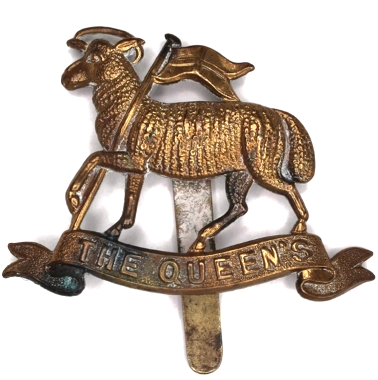
So that leaves us looking for clues in what we have, the photo. While uniforms in First World War were often unhelpful because they were generally plain and unadorned. However, the cap badge is relatively clear and distinctive, even in this old photograph. There is only one Regiment that has a cap badge that fits the shape in this image, The Queen’s (Royal West Surrey) Regiment. The badge is quite distinctive among British army badges being a figure of the Paschal lamb with ‘The Queen’s’ written underneath.
The Queen’s (Royal West Surrey) Regiment was somewhat unusual in its structure during First World War. It was both enormous and diverse. It had 3 Regular Battalions two of which served in France, one remained in the UK as a training unit. It had 9 Territorial Battalions who served across a variety of locations in India, Greece, Egypt and Palestine, France and in England. There were 7 New Army Battalions, primarily recruited from London who served in France. There were 5 Labour Battalions, one Home Service Battalion for men who had been medically downgraded, two Battalions for Training Reserve and one Young Soldiers Battalion.
So, we’ve read through over 500 pages of recruitment rolls, about 5,000 men, and none seem to have one of our Kingston names – but a search of that dullness cannot claim to be perfect. It was made especially difficult as the regiment’s primary headquarters was at Kingston upon Thames, so the word Kingston occurs against at least 30% of all entries.
But the structure of the unit meant there were multiple ways a man could transfer in, and there does not seem to be a single record of all transfers into the Regiment, presumably because it was so diverse and came under so many different parent Divisions etc.
Coming back to the picture, and he doesn’t look a young soldier, he looks like a man approximately in his 30s. So, the men not on the board, living in Kingston in 1901 or 1911, and aged between 30 and 40 during the war were –
- Ernest Charles Curtis
- William Jeakins
- William Henry Peirce
- Levi Jacklin
- Edward Chapman
- Benjamin Allgood
- Joseph Jeakes Wayman
- William James Curtis
- William Payne
- Joseph Custerson
- Robert John Wayman
- Henry Payne
- George Montgomery
- William Rayner
- Weston Johnston
- Norman Henry Johnston
- Joseph John Chapman
- Thomas H Jakins
Of this list, there are four William Payne’s who served in The Queen’s
- William Payne G/24600
- William Payne G/72331 – this WP was also awarded a Silver War Badge (list reference E/1568/1), indicating he was wounded and invalided out of service. This WP was a Corporal. He had a middle name – Thomas.
- William Payne 47190, who then transferred to the Labour Corps 76500, also listed as MNK16736 – came from Dalston/Hackney so can probably be discounted.
- William Payne 39710 who then transferred to the Duke of Cambridge’s Own (Middlesex) Regiment G/57086
None of them fit with any William Payne recorded as living in Kingston, in other words, none of them has any remaining documentation that indicates they come from Kingston or Cambridgeshire. Of course, William Payne could have temporarily moved out of Kingston post 1911.
Then there’s another obscure possibility. The 22nd and the 24th (County of London) Battalions of the London Regiment wore the Queens cap badge because of historical affiliations. Don’t ask, it’s an army thing! There was an Ernest C Curtis in the London Regiment, SN 1494 and 550102, but he seems to have served in the 16th Battalion.
Other names for future research:
Frederick Charles Driver
5th (Royal Irish) Lancers, 7th Battalion, The Queen’s (Royal West Surrey Regiment)
As recorded in his individual biography, Frederick Driver’s connection with Kingston belonged to his childhood rather than his adult life. He spent part of his early childhood in Green Lane while his father managed one of the village farms, and two of his younger brothers were born in the village. His subsequent life took him from agricultural work in rural Suffolk to the cavalry in Ireland, the streets of Dublin during the Easter Rising, the infantry battlefields of the Somme and finally captivity in Germany.
If Frederick is a qualifying Kingston man who clearly served in the same Regiment as the unknown soldier, you might wonder why we haven’t made the connection, as we have with William Allgood or the Custerson twins. The first reason is that Frederick was 20 to 24 years old through his service and this man looks considerably older. The second is more practical – how did his picture get into the collection? The Drivers lived in Kingston for perhaps 6 years at the very start of the century but had left before the war started. However, when our picture collection was originally created, men and families with much stronger and more recent connections with Kingston and the surrounding villages were missed out, or mis-remembered. It seems highly unlikely that Frederick Driver’s photos made its way back to the village in 1919 and was un-named.
This is where the limitations of documentary records really hit. The Attestation paperwork, either the first two pages, or the discharge papers are the only real way to connect, with any confidence, the name, the service number, the place of birth or residence and or the next of kin. About 75% of all Service Records were destroyed by fire in bombing during Second World War so finding a full, readable service record is not possible, often. Many more Medal Record cards survive, but these very rarely contain more information than surname, first name and service number. They can’t tie a specific name and number to Kingston.
So far, therefore, the unidentified soldier remains unnamed. We trust that the villagers who originally made this memorial were sure enough of this man’s service to put him on the board. And on that basis, we continue to record his service, even if we cannot yet give him a name.