
11th Battalion, Suffolk Regiment
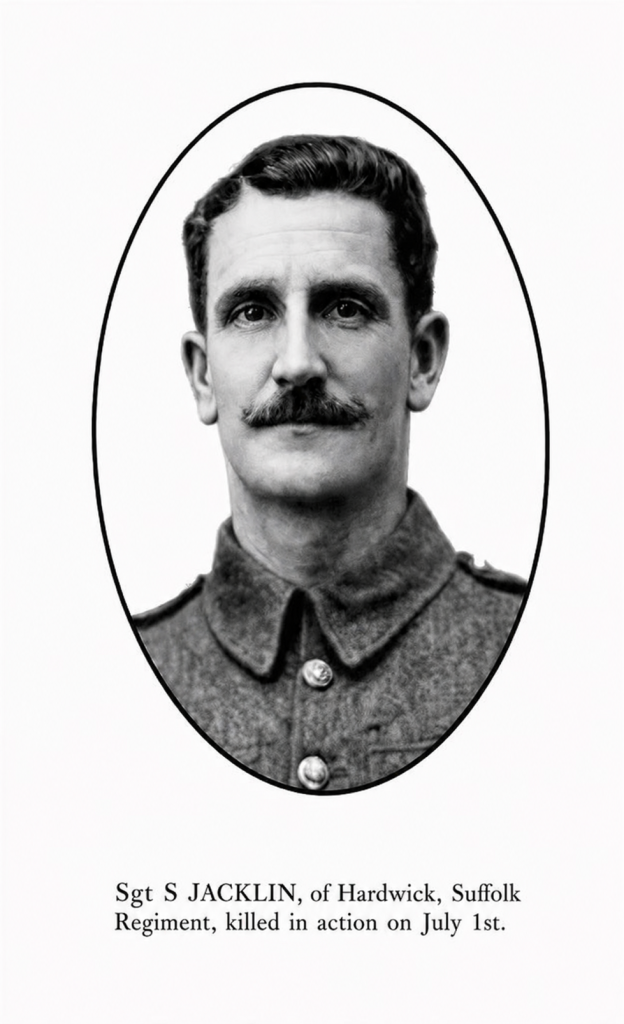
Simon Jacklin was born on 20 March 1880 and baptised in Kingston on 5 March 1885. His parents were Andrew and Phoebe Jacklin.
The 1891 Census shows the Jacklins living in Tinkers Lane. It was a large household: Joseph, aged 19; Henry, aged 18; Amos, aged 16; William, aged 14; Annie, aged 12; Simon, aged 11; Jane, aged 8; Sarah, aged 6; Richard, aged 4; Elizabeth, aged 1; and Frank, aged just one month.
Simon appears to have had military experience long before the First World War. There is an attestation record for a Simon Jacklin from Kingston taking a short service engagement with the Army, aged 18 years and 8 months, with the service number 5254. The papers do not give a clear date, but if the recorded age is correct, the enlistment would have been around November 1898.
A short service engagement at that period usually meant seven years of service, followed by five years in the Army Reserve. This may explain Simon’s absence from the 1901 Census in Kingston. If he enlisted in about 1898, he would still have been serving when the census was taken. He would then have left regular service around 1905, while remaining liable for recall as a reservist until about 1910.
In June 1905, Simon married Ruth Randall of Hardwick at Kingston church. By the time of the 1911 Census, Simon was 31. He and Ruth were living at Scotland Farm, Dry Drayton, with their three children: Daisy, Phyllis Hannah, and Simon Jonah Andrew. Their fourth child, Jack Jacklin, was born in 1913.
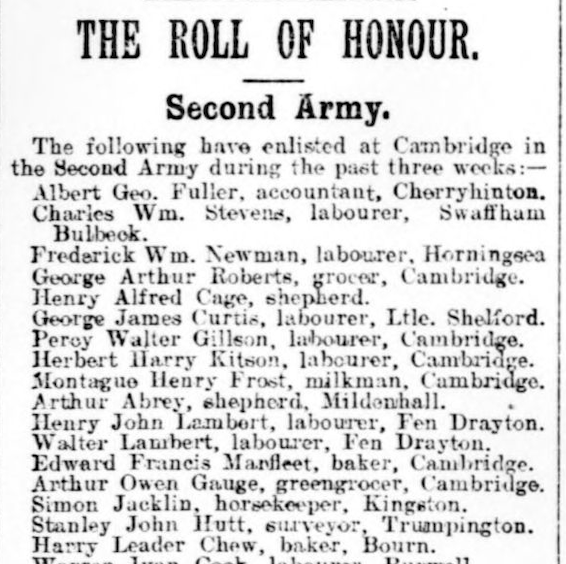
Simon’s First World War service number, 17353, indicates that he was one of the late 1914 recruits into the rapidly expanding wartime Army. In fact, the Cambridge Independent Press Roll of Honour says he enlisted in the three weeks prior to 1 January 1915, part of Kitchener’s Second Army – he was recorded as a horsekeeper from Kingston. By then his earlier reserve liability had ended, so he was not simply being recalled, he chose, or felt compelled, to enlist again. The fact that he became a Sergeant supports the likelihood that he had previous military experience. The Army needed men who already understood discipline, drill, field routine and the leadership of other soldiers.
Simon served with the 11th Battalion, Suffolk Regiment, the Cambridgeshire Battalion. This was the same battalion in which many Kingston men served, including Frank Allgood and Joseph Chapman. It had been raised in Cambridge in 1914 as part of Kitchener’s New Army and trained first around Cambridge, then at Ripon, and finally on Salisbury Plain before going to France in January 1916.
As a non-commissioned officer, Simon’s role was more than that of an ordinary infantryman. A Sergeant would be responsible for helping lead and coordinate a platoon, which could include several sections and roughly forty men. Officers gave orders and set objectives, but Sergeants helped turn those orders into action. They kept the men together, passed instructions, maintained discipline, and tried to preserve order when noise, fear, smoke, shellfire and casualties made order almost impossible. If an Officer was killed, a Sergeant might have to take over immediately. In an attack, that made men like Simon both essential and very exposed.
The 11th Suffolks entered the front line early in 1916. A vivid account survives from Lance Corporal G. W. Graves of D Company, 11th Suffolk Regiment, writing from the front on 3 March 1916:
“As I have seen so many letters from soldiers at the front I thought I would just send a few experiences of D Company of the 11th Suffolks. Our first entrance to the trenches was very quiet, and I have very little to say about that, as we were in with another regiment to see how to go on. Our second entrance was a bit livelier. We went in for four days, and on our third day we experienced our baptism of shell fire. Just after dinner the Germans began shelling our trenches; whizz came the shells, then off with a band, enough to deafen anyone. I can tell you some of us were scared, as we had never experienced shell fire before, but, like the Suffolks, we soon got over the scare and took it as a matter of course. Of course, we had to keep our heads down as the shrapnel flew so far about. As you might guess, our artillery was not asleep when they heard the shells falling but commenced to shell the enemy lines. To see the dirt fly about was quite exciting to us, but I daresay to others who had witnessed it before, it was quite a common sight. The Germans fire, I should say about 50 shells but the casualty list on our side only counted 1, although lots had very near escapes. Some of the fellows, thinking the shelling had finished, went hunting for nose-caps from the shells, when a German Taube came over and seeing those 8 or 9 men digging for nose caps, signalled back to their artillery. 8 or 9 shells came whizzing over but luckily no one was hurt. We have been told the 11thSuffolks are a lucky lot. That was the most exciting time D Company had. These 4 days we are in the reserve with no firing to do unless attacked. We hope to come out with as few casualties as possible”.
Lance Corporal G. W. Graves, D Company, 11th Battalion, Suffolk Regiment, letter from the front, 3 March 1916; original publication unidentified.
The letter captures the battalion at an early stage of front-line experience: frightened, curious, still learning what shellfire meant, still able to find a kind of excitement in the spectacle of artillery. The detail of men searching for shell nose-caps after a bombardment is painfully human. They were new enough to war to collect souvenirs, and lucky enough, that time, to survive the enemy’s response.
Four months later, on 1 July 1916, the 11th Suffolks took part in the attack near La Boisselle on the first day of the Battle of the Somme. Simon Jacklin was killed that day, almost certainly in the same attack as Private Frank Allgood.
The battalion’s task was part of the wider assault around the Lochnagar crater and Sausage Valley. The great mine at Lochnagar was exploded at 7.28 am, and the infantry attack began two minutes later. The 11th Suffolks had been ordered to wait an additional five minutes before advancing, because no one was quite sure how long the debris from such a huge explosion would take to clear. In practice, the delay gave the German defenders time to recover and return to their positions. When the Suffolks advanced, they were met by machine-gun fire from Sausage Redoubt, Scots Redoubt and positions around La Boisselle.
The losses were severe. The 34th Division suffered more casualties on 1 July than any other division that day, and the 11th Suffolks suffered the heaviest battalion losses within the division. Officers and non-commissioned officers were particularly vulnerable because they were expected to lead. Simon, as a Sergeant, would almost certainly have been towards the front of the action, trying to keep men moving and organised under fire.
Initially, Simon’s wife Ruth was told that he had been wounded. However, a few weeks later his officer wrote to her saying
“I am deeply grieved to have to tell you certain news of your husband’s death. I have not heard officially that it is so. No words of mine I know can make any difference to you but I hope that in time it will be a comfort to you to think that your husband died nobly for his country and that his loss is felt by the company he was in and by the officers who were left we all thought very highly of him and can sympathise with you though we cannot comfort you in your loss”
Pg 127, Joanne Costin, Cambridgeshire Kitcheners, Pen and Sword
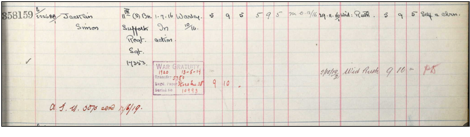
The Army Register of Soldiers’ Effects shows the financial aftermath of Simon’s death. In November 1916, his widow Ruth received £5 9 shillings and 5 pence for herself and the children. In October 1919, she received a further £9 and 10 shillings. These sums were not compensation in any modern sense. They were the balance of pay and later war gratuity owed from the Army’s accounts. Still, they are a stark administrative trace of a family loss: a widow and four children, receiving what the system calculated was due.
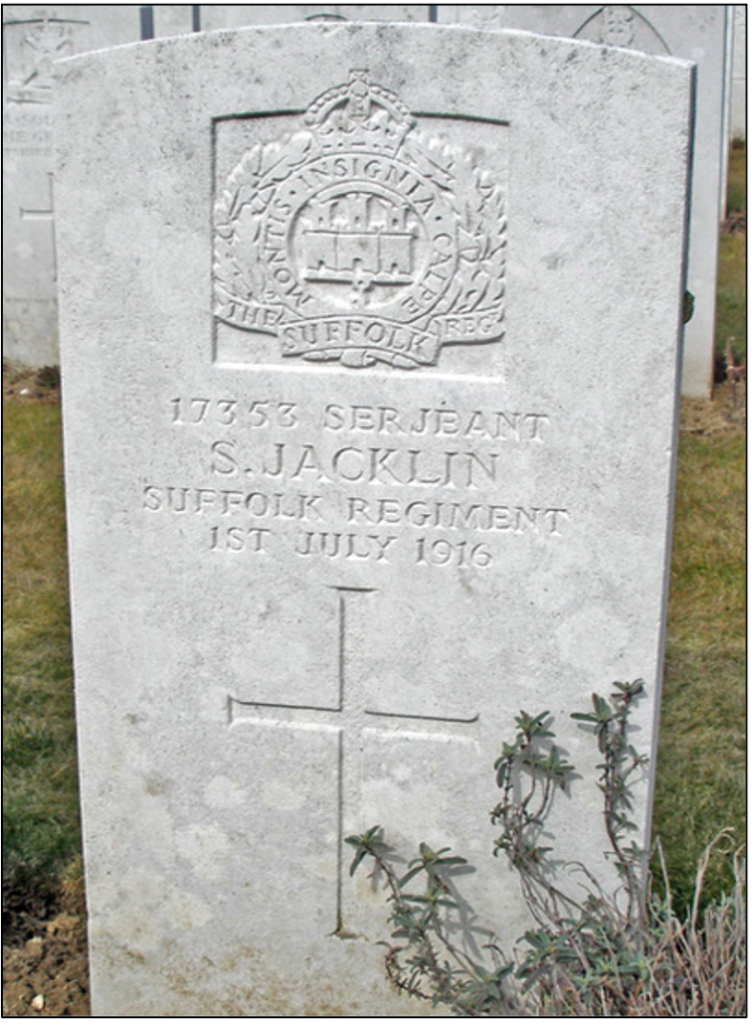
Unlike Frank Allgood, whose body was not identified and whose name is commemorated on the Thiepval Memorial, Simon Jacklin’s body was recovered. He was buried at Ovillers Military Cemetery, in grave V.A.4.
Simon Jacklin’s story has a different shape from that of the youngest Kingston recruits. He was not a boy swept into the Army for the first time. He was a married man in his mid-thirties, with previous military experience, a wife and four children. He had served before, built a civilian life, and then returned to the Army in 1914. That earlier service probably helped him become a Sergeant, but it also placed him in a position of responsibility and danger. On 1 July 1916, at La Boisselle, the Army needed men like Simon to lead. That is almost certainly where and why he died.