
Royal Air Force
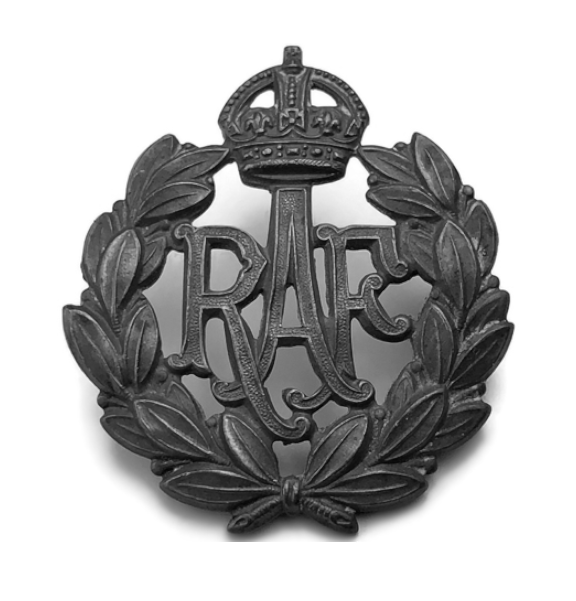
Thomas Edward Driver was born in Kingston on 14 January 1901. His father, Charles Henry Driver, was recorded in the 1901 Census as a farmer. The Drivers had several children, and their birthplaces suggest that the family frequently moved around Cambridgeshire and Essex. They were in Kingston for several years: Thomas was born here, and so was another sibling. By 1904, however, the family seems to have moved to Little Sampford in Essex, where the next child was born. Frederick Driver was Thomas’s eldest brother.
Thomas joined the Royal Air Force on 19 October 1918, little more than three weeks before the Armistice. His service number was 307901.
With hindsight, that looks like very late and therefore risk-free service. We know now that the Allied Hundred Days Offensive had already begun at Amiens on 8 August 1918 and that the Armistice would follow on 11 November. But Thomas did not know that when he joined. Nobody enlisting in the late summer or autumn of 1918 could be certain that the war was nearly over.
The previous months had been alarming. In spring 1918, the German offensives had come close to breaking the Allied line. Britain responded with urgent manpower measures. In April 1918, military service legislation was tightened: the upper age limit was raised, and men as young as 18 years and 6 months could be sent overseas after six months’ training. That was not the behaviour of a state winding down the war. It was the behaviour of one still expecting to need men.
Thomas was only 17 when he joined, so he was too young for immediate overseas service. By the autumn of 1918, there was also growing unease about sending boys under nineteen to the front. The government had stated that from the end of August 1918 no soldier under nineteen should be sent overseas, though men already at the front were not necessarily withdrawn. The distinction matters. A recruit such as Thomas was unlikely to reach active service before the end of the war, but that was not the same as knowing, in October, that he would never be needed.
The Royal Air Force itself was still new. It had been formed on 1 April 1918 by merging the Royal Flying Corps and the Royal Naval Air Service. Although the popular image of the RAF centres on pilots, the new service depended just as much on technical ground staff. Aircraft needed constant maintenance. Engines, frames, wires, wings, fabric, metal fittings, instruments and stores all required trained men to keep the system working.
Thomas’s civilian occupation explains why he was useful. On entry, he was listed as a fitter at Cambridge Gas Company. This was exactly the sort of practical engineering background the RAF needed. Gas works required men who understood metalwork, machinery, pressure systems, repair, fitting and workshop discipline. In a young technical service, such skills were valuable.
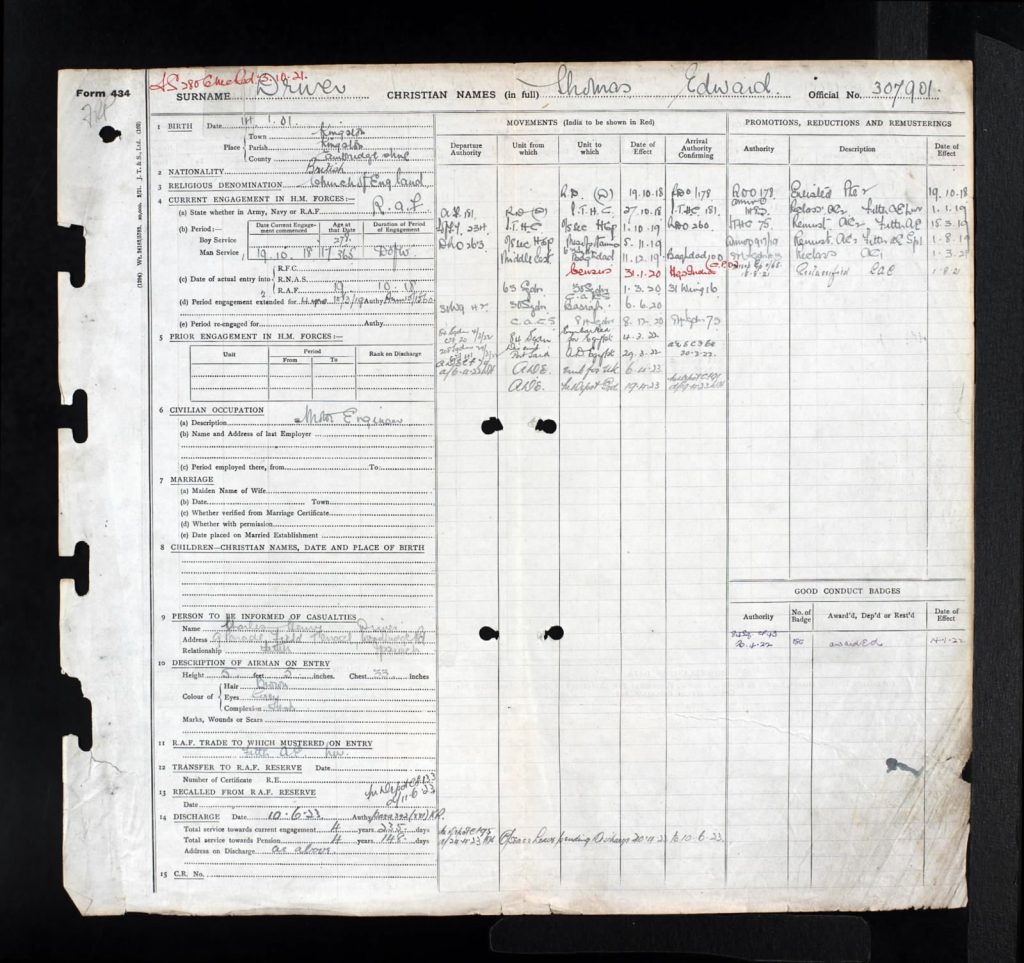
Thomas began as an Air Mechanic 2nd Class. He was qualified as a general fitter, engine fitter, metal worker and rigger. Those categories show the breadth of the RAF’s need. A general fitter worked with mechanical parts and assemblies. An engine fitter worked on aircraft engines. A metal worker dealt with metal components and repairs. A rigger worked on the structure and alignment of aircraft, including wings, wires and control surfaces. In early aviation, rigging was not a minor task. A badly adjusted aircraft could be dangerous before it ever met an enemy.
In March 1919, Thomas was promoted to Air Mechanic 1st Class, indicating that he had completed his basic training and was considered more proficient. On 19 April 1919, he was demobilised “on termination of engagement”. In plainer language, the war was over, the RAF no longer needed him in the same way, and he was released from service.
Thomas’s military career was therefore brief, but it still belongs in the Kingston story. He represents the final intake of the war: young, technically skilled, and drawn into a new kind of armed service just as the conflict was nearing its end. He did not serve in the trenches, and there is no evidence here that he went overseas. His war was one of preparation, training and technical potential rather than combat. Yet in October 1918 that distinction was not guaranteed. He entered a system still designed to fight.
After the war, Thomas continued in skilled technical work. On 19 August 1933 he married Eva Hume in Ipswich. His trade was given as fitter, and he was living on Belvedere Road. Eva lived only a few doors away in the same street. In the 1939 Register, Thomas’s employment was recorded as works foreman, and he was also noted as an Air Raid Warden.
That later civil defence role gives his story a small but telling echo. In 1918, Thomas had joined the RAF as a teenage fitter in the final weeks of one war. In 1939, as another war began, he was again part of the national emergency, this time at home, helping prepare and protect civilians from air raids.
Thomas and Eva appear to have had two children, whose records remain closed, probably because they may still be living. Thomas died in Ipswich in 1979.
Thomas Edward Driver’s story is a late-war story, and for that reason it is easy to underestimate. He was not a Somme soldier, nor a veteran of the long infantry war. He was a seventeen-year-old, Kingston-born, fitter brought into the newly created Royal Air Force because modern war increasingly depended on technical skills. His service shows how, by 1918, the war was drawing not only on men’s bodies, but on their trades, tools and workshop knowledge.