
11th Hussars; 18th Hussars; Machine Gun Corps
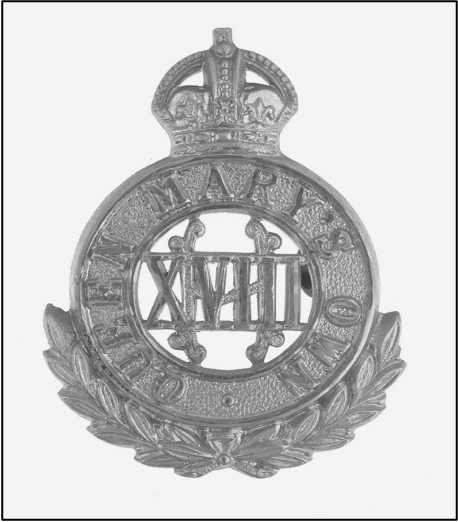
Jack Payne was born in Longstowe, his baptism record records his date of birth as 1 August 1887, and he was baptised on 30 September 1888. The Paynes were still living in Longstowe, or more accurately they seemed to live in Clopton, in the Longstowe ward, in 1891.
By 1901 the family had moved to Kingston. Jack’s father, Osborn Payne worked for Henry Pearce as a stockman on Pastures Farm, and lived at Pastures Farm, along with his wife Sarah and their five children, Henry, 21, William, 19, Lucy, 15, Jack 13 and James, 11. So, we know that Jack spent much of his childhood and early teenage years in Kingston. But something led him make the decision to leave in 1904 and join the army.
Incredibly, Jack’s full service history is available online – there are 100 images that tell us in unusual detail the movements of Jack’s life. Jack enlisted at the Curragh in Ireland on 7 May 1904, his attestation papers gave his age as 18 years and 8 months. In fact, he appears to have been only 16 years and 9 months old. This was not unusual. Young men who wanted to enlist sometimes added a year or two to their age, and the Army, particularly in peacetime, did not always press too hard if the recruit was physically acceptable and otherwise suitable. Jack took his medical for the Army in Cambridge, on 3 May 1904, and specifically asked to serve in the Hussars.
Henry Pearce of Kingston Pastures stood as a reference for Jack when he enlisted. That link is important, because it ties a man born in Longstowe to Kingston and Kingston Pastures. His next of kin was later given as Osborn Payne of Kingston Pastures, Kingston.
Jack successfully joined the Corps of Hussars of the Line and was posted to the 11th Hussars, with the service number 5377. The Hussars were cavalry: mounted soldiers trained for reconnaissance, screening, rapid movement and, at least in theory, mounted combat. In 1904 this was still a prestigious and practical branch of the Army. Horses were not decorative, they were central to the way the Army moved, observed and communicated.
Jack had enlisted for a three-year term. On 4 May 1907, after almost exactly three years with the colours, he was transferred to the Army Reserve. His discharge notes were very favourable. His conduct was recorded as “Very good, No offences in whole service of 3 years”. Under qualifications for civilian employment, the Army described him as “Reliable, hardworking and sober. Understands care of horses”. These are brief phrases, but they say quite a lot. They suggest a steady young man, trusted with animals, disciplined enough to complete his service without offence, and thought employable outside the Army.
The transfer to the Reserve did not mean that Jack’s military obligation had ended. He still had a reserve liability of nine years. In ordinary times this might have made little difference. He could live and work as a civilian, but if war came, he could be recalled.
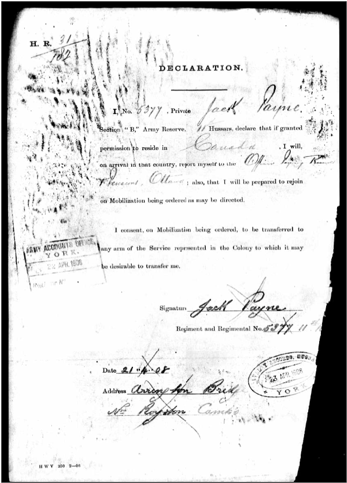
Sadly, Jack’s mother died at about the time he returned from the Army, in March 1907. It’s unknown whether this influenced his thinking, but the next piece of evidence we have from his service record is a letter he sent back to his old Regiment, by then based in York. In March 1908, Jack wrote to ask whether he could emigrate to Canada. His letter asked for “permission to proceed to Canada on 9 April next as I want to reside there”. He needed to know whether his Reserve liability prevented him from leaving Britain. The answer was not that he could simply disappear into civilian life abroad, that he was still bound to his reserve liability, so later in 1908 he signed paperwork stating that, if recalled to service, he would report for recall in Ottawa and be mobilised as required.
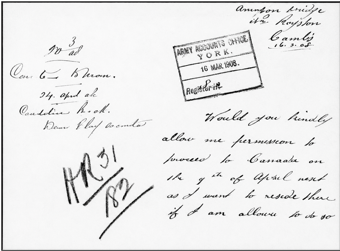
This is one of the most striking parts of Jack Payne’s story. He did emigrate, but he remained tied to the British Army by his reserve obligation.
On 21 March 1910 Jack married Sarah J Lynn in Carlyle, Saskatoon, Canada. On 22 February 1911 they had a son, William James. A daughter Eva (date of birth illegible) followed.
When war came in August 1914, the obligation Jack signed became real. A note on his service record states: “This man left Canada, as a Reservist, on Aug 25th, 1914, and rejoined the 11th Hussars in Dublin Sep 1st, 1914”. The meaning is clear enough: Jack kept his word and returned rapidly from Canada to rejoin the Army.
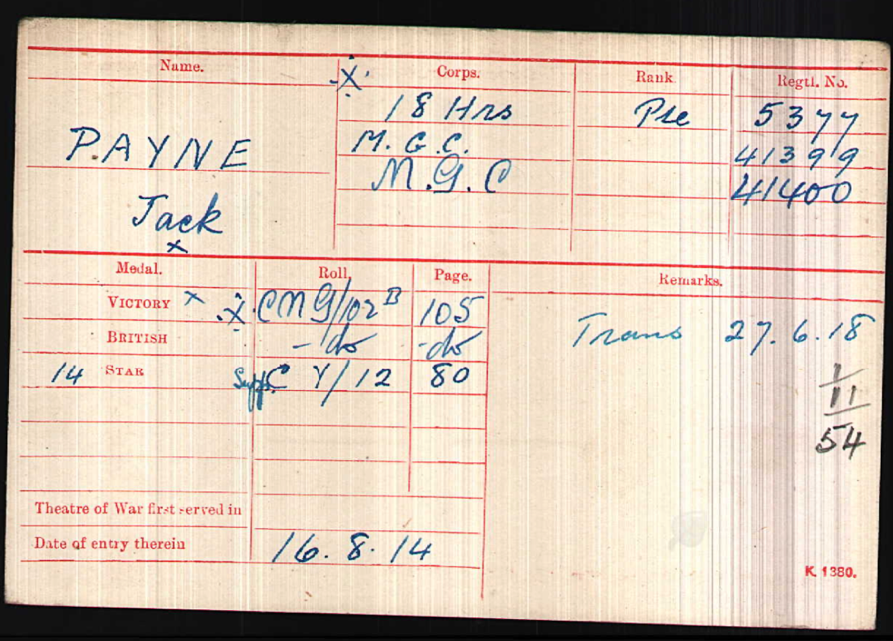
He was mobilised in Dublin on 4 September 1914 and posted the next day to the 12th Reserve Regiment. Reserve cavalry regiments were not usually front-line fighting units in themselves. Their role was to receive, organise and prepare men before they were sent on to active units. Jack was then posted to the 18th Hussars and seems to have retained his original service number 5377 and went to France with the British Expeditionary Force on 16 September 1914. There seems to be an anomaly on his Medal record which indicates he arrived in France on 16 August 1914, but it seems highly unlikely given the date he arrived back in Ireland. It would have taken more than 2 weeks to equip and train even someone with prior military service. The medal record card would have been written many years after the event, likely in 1919 or 1920 and quite likely an assumption was made about dates for a unit that might have moved to France in several phases.
The 18th Hussars were part of the cavalry arm of the British Expeditionary Force. The regiment had landed at Boulogne on 16 August 1914 and was part of the Cavalry Division, which was renamed the 1st Cavalry Division on 16 September. Jack therefore joined the cavalry in France at a very early stage of the war, just as the British Army was adjusting from the mobile battles of August and September 1914 towards the more static and heavily defended warfare that would follow.
For a modern reader, it is worth pausing over what cavalry meant on the Western Front. The First World War did not immediately abolish cavalry, but it changed its usefulness. The firepower and fixed defences of trench warfare made traditional mass cavalry charges on horseback far less viable, yet cavalry still had important mounted and dismounted roles, including reconnaissance, guarding flanks and helping protect the rear of the Army. Jack’s pre-war experience therefore remained relevant, even as the war around him became increasingly dominated by machine guns, artillery, wire and trenches.
On 26 March 1916, Jack transferred to the 2nd Machine Gun Squadron. This was a significant shift, though initially, not a move entirely away from cavalry. The 2nd Cavalry Machine Gun Squadron was formed from the machine-gun sections of the 4th Dragoon Guards, the 9th Royal Lancers and the 18th Hussars. It was attached to the 2nd Cavalry Brigade in the 1st Cavalry Division. This fits Jack’s transfer exactly: he had been serving with the 18th Hussars and was moved into the specialised machine-gun organisation created from cavalry machine-gun sections. His service number changed to 41399.
Machine-gun work required discipline, technical skill and steadiness under fire. It was not simply a matter of firing fast. Guns had to be positioned, supplied with ammunition, kept working, cooled, repaired, moved and protected. A machine-gun team could deliver devastating fire, but it was also a conspicuous and dangerous target. Jack’s earlier Army description — reliable, hard-working, sober, and good with horses — reads very naturally alongside this later role. The Army seems to have continued to use him where steadiness and practical competence mattered.
On 27 June 1918 he was formally transferred to the Machine Gun Corps, 3rd Echelon. The Machine Gun Corps had been formed in 1915 because the Army needed specialist machine-gun units for the conditions of modern war. Before that, machine guns had been held in small sections within infantry battalions and cavalry regiments, as Jack had been part of since March. The new Corps brought these men and weapons into a more specialised structure.
His service record also shows the ordinary bodily attrition of war. On 26 April 1916 he went to hospital with psoriasis, returning to his unit on 12 May. On 3 June 1916 he was admitted to hospital with a wounded knee and returned to his unit on 9 June. He had another bout of psoriasis in 1917.
These details may look minor beside the great battles, but they are part of the real history of service. Men did not experience war only as named battles. They endured weather, skin disease, exhaustion, wounds, infection, poor sleep, horse work, machinery, mud, discipline and waiting. Psoriasis could be made worse by stress, cold, dirt and prolonged discomfort. The record does not tell us how severely Jack suffered, but it does show that his body was repeatedly brought into the medical system and then returned to service.
Jack’s own record says that he served with the British Expeditionary Force in France from 16 September 1914 until 11 March 1919. That is a very long period of overseas service: from the opening months of the war almost to the final demobilisation.
Jack was demobilised to the Reserve on 9 April 1919. On 16 July 1919 he was discharged to Calgary, Canada. He travelled from Bristol on the Royal George, still apparently giving an inaccurate date of birth. His pension documentation gave his address as 7431, 21st East, Ogden, Alberta.
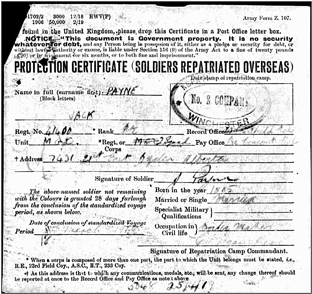
The return to Canada gives Jack’s story a circular shape. He had left Britain before the war to make a life overseas, got married and had children. But as a reservist he was recalled from Canada in 1914 and returned to serve. He then spent more than four years with the British Army in France before going back across the Atlantic in 1919. His war was therefore not only a military journey, but a migration story interrupted by obligation.
Jack Payne’s surviving record is unusually revealing in some respects and frustratingly thin in others. It gives us his enlistment, his age discrepancy, his reference from Kingston Pastures, his good conduct, his emigration to Canada, his recall, his units, his illnesses and wound, and his return overseas after the war. It does not tell us what he made of any of it. We cannot know whether he returned from Canada willingly, dutifully, reluctantly, or with some mixture of all three. Nor can we know what he remembered most: horses, Dublin, the voyage, France, the machine guns, the hospitals, or the long-delayed journey back to Calgary.
What can be said is that Jack Payne was not a wartime volunteer swept up in 1914 enthusiasm. He was a trained pre-war cavalryman, a reservist and an emigrant. He had already served three years before the war began, and the Army had recorded him as reliable, hard-working and sober. When recalled, he left his wife and two children, returned from Canada, rejoined the Hussars, served in France from September 1914 to March 1919, and moved with the changing Army from horse cavalry into the specialist machine-gun arm. His story shows the First World War drawing men back across oceans, not only out of villages.