
Essex Regiment; Army Cyclist Corps; Royal West Kent Regiment; Royal Engineers
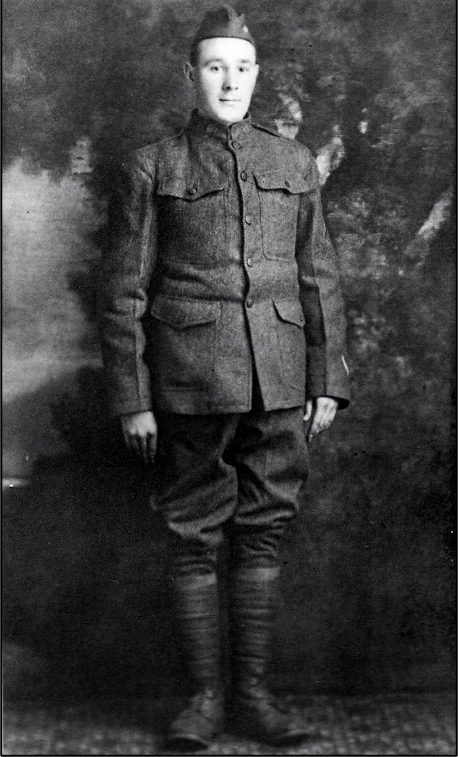
Frederick Newman was born in Kingston on 22 March 1893, the son of Alfred Abraham Newman and Christiana Newman. He was christened later that year, in October.
By the time of the 1901 Census, Frederick was living with his family in Tinkers Lane. His older siblings were Alice, aged 14; Grace, aged 12; and Tom, aged 9. The younger children that followed Frederick into the family were Caroline, aged 5; Ruth, aged 3; and Edith, aged 1.
In the 1911 Census, Frederick was 18 and the oldest child still living at home. The family had grown again, with Rose, aged 8, and May, aged 5. Frederick was working as a ploughman on a farm. Like many Kingston men, he came to the war with practical rural skills and physical stamina rather than an obvious military trade.
When we don’t have a man’s service record, but we do have a service number, it is sometimes possible to search the records for nearby service numbers, which then ‘brackets’ likely dates. From his Essex Regiment number 13868, we know that number was issued sometime between 24 August and 30 September 1914. So, Frederick clearly joined up in that early recruitment drive as a so-called Kitchener volunteer.
However, his Army Cyclist Corps number 3240 is also a relatively early number indicating he was transferred into the Corps either soon after its formation on 7 November 1914 or early in 1915.
The Army Cyclist Corps can sound faintly comic to a modern ear, because bicycles now seem so ordinary. In the First World War, however, cyclists had real military uses. They were mobile, quiet, did not need fodder like horses, and could move more quickly than infantry over roads and tracks. Cyclist units were used for reconnaissance and message carrying, but once trench warfare became more static, they were also used for trench-holding duties and manual work.
A transfer to the Cyclist Corps suggests that Frederick was considered fit, reliable and useful. A cyclist soldier needed endurance, road sense, and the ability to move independently with messages or orders. Literacy mattered too. Misreading or misdelivering an order could have serious consequences. What isn’t clear is where Frederick was serving, the Corps were heavily used in Britain for military communications, as well as in France, so he may not have been overseas during this period.
However, in May and June 1916 the Army was reconsidering the usefulness of divisional cyclist companies as the war became dominated by static trench warfare. These cyclists could be put to more use in the trenches. So, the units were disbanded and men often reallocated to frontline infantry units.
Frederick seems to have been part of this manpower reorganisation and was transferred again, this time to the Queen’s Own (Royal West Kent) Regiment. His transfer date is harder to narrow down but his service number 16350 was issued in 1916. This probably reflects the Army’s increasing need for experienced men in infantry units that had suffered heavy losses. By 1916, the Western Front was consuming trained soldiers faster than local or regimental identities could sensibly be preserved. Men were moved across regiments because the Army needed bodies, but especially because it needed men who had already been tested by service.
The Royal West Kents served in several theatres during the war, including the Western Front, Gallipoli, Mesopotamia and Italy. Frederick’s medal record suggests he likely transferred in a batch transfer, possibly into the 10th Battalion and went to France with the Royal West Kents on 4 May 1916. We also have a reference point supporting this conclusion, in that the service details of the soldier with the next consecutive service number are available, and he was killed at Ypres on 21 September 1917. Frederick has no 1914 or 1915 Star, so he did not serve in France before 31 December 1915. However, he was awarded the Victory Medal and British War medal, so must have served overseas at some point.
Finally, likely sometime in 1917, Frederick was transferred to the Royal Engineers and renumbered 245037. This is an interesting move. The Royal Engineers were one of the most technically important parts of the wartime Army. They were responsible for roads, bridges, railways, water supply, camps, fortifications, signalling, telephones, wireless and many other forms of infrastructure.
For Frederick, the Royal Engineers transfer may have reflected a useful civilian skill, or simply military aptitude recognised during service. He had been a ploughman before the war, not an obvious technical tradesman, but rural work could still involve practical competence with tools, horses, carts, ditches, tracks, timber, fencing and field drainage. Engineers did not consist only of highly educated specialists. They also needed strong, adaptable men for road work, transport, construction, wiring, stores, labour, field works and repair.
Frederick’s pattern of service is therefore rather revealing, even without a full service record. He began in the infantry with the Essex Regiment, moved into the more mobile and semi-specialist Army Cyclist Corps, was later drawn back into infantry service with the Royal West Kent Regiment, and finally ended in the Royal Engineers. That was not unusual in a period of mass recruitment. Men were often recruited with little more than a basic medical examination, and only later did the Army begin to discover who was steady, literate, adaptable, technically useful, or physically suited to particular kinds of work. Frederick seems to have been one of those men whom the Army kept moving to where he could be most useful.
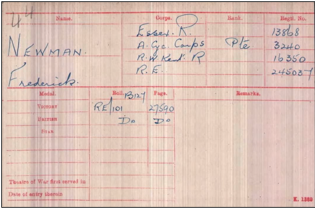
Frederick Newman’s war, as far as it can currently be traced, was not a single-regiment story. It was a story of movement through the wartime Army’s machinery: Essex Regiment, Cyclist Corps, Royal West Kent Regiment, Royal Engineers. It also suggests a man whom the Army considered useful in specific roles; he seems to have twice been selected for roles that required particular skills and aptitudes. That movement makes him harder to follow, but also rather representative of the later war. By then, the Army was less interested in keeping men neatly within their first unit and more interested in using them wherever the next shortage appeared. Frederick, the Kingston ploughman from Tinkers Lane, was absorbed into that shifting system and carried through it.
Note for future researchers: Many online Family trees propose that Fred moved to Colfax, Boone County Idaho, and died in Des Moines in about 1951. However, none of those sites offer any evidence that the Frederick Newman in Idaho is the same Frederick Newman who was born in Kingston. If you dig around (MyHeritage) it looks as though the Idaho FN came from Sheffield. It’s tempting to think Fred did go overseas after the war, as there seems to be no further record of him after the war, but then he has a common enough name for the period so it’s difficult to research. But without a convincing passenger record showing a Kingston birthplace, the Idaho theory is at best, unproven.