
Cambridgeshire Regiment; 26th Battalion, CEF
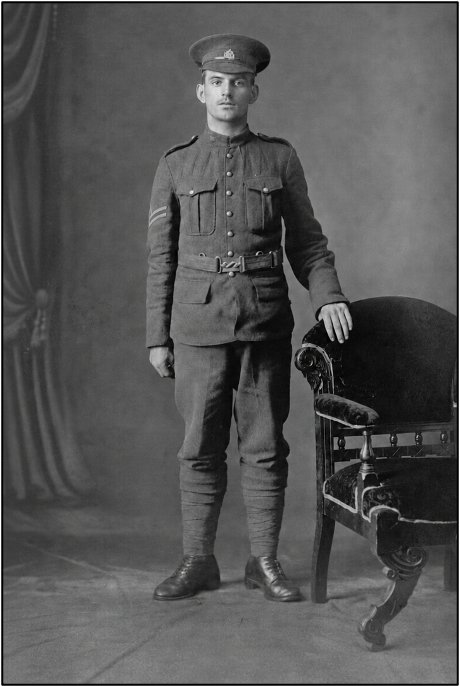
Bertie Rayner was born on 3 February 1894. The census returns record his birthplace as Barton, and he was baptised there on 1 April 1894. The Rayner family must have moved to Kingston soon afterwards, because by the 1901 Census Bertie was living at Church Farm, Kingston, with his parents, William and Rebecca Rayner. Also in the household were his older brother Walter, aged 8, and his younger brother Albert, aged 4.
By 1911, the family was still at Church Farm. Alice and Ernest had been added to the family, and Bertie was still part of the household. The earlier photo-board had recorded him simply as “Bert Rayner”, which caused a little difficulty, because the family included both Bertie and Albert. To modern ears, Bert and Albert may sound like variants of the same name, but in this family, they were two different boys. Albert was too young for early wartime service, so the serviceman must be Bertie.
Bertie’s attestation papers survive. They show that he joined the 1st Battalion, Cambridgeshire Regiment, on 27 November 1912, with the service number W/1427. His occupation at enlistment was given as coal merchant. He was 5 feet 7 inches tall, with a 35-inch chest measurement, and his vision was recorded as “Good”. He was formally appointed on 24 January 1913, so the process of joining took about two months.
This was not a wartime enlistment. Bertie joined the Territorial Force before the First World War. The Territorial Force was a part-time military reserve, intended for home defence and made up of men who had ordinary civilian jobs but trained regularly. Bertie’s engagement was for four years. He would probably have attended drill nights during the week, some weekend training, and an annual summer camp. For a young man, it could provide extra income, structure, comradeship and a measure of local status.
When war broke out in August 1914, Territorial Force units were “embodied”, meaning called up for full-time service. The Cambridgeshire Regiment was sent to Shorncliffe, an Army base in Kent, and Bertie’s record shows that he was embodied i.e. ‘called up’ there with the rest of his unit. In ordinary circumstances, this would have marked the beginning of full-time wartime service.
Here, however, was the start of our research challenge, because it is quite clear from his service record that Bertie failed the medical. In fact, he didn’t just fail the Regular Army standards, he failed the Territorial Regulations and was discharged immediately.
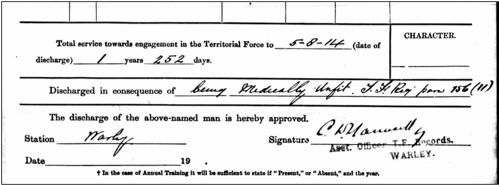
Unfortunately, there is no record of what the medical issue was. This would explain why Bertie did not seem to have any wartime service record or medal entitlement. If he was discharged before serving overseas, he would not have received the usual campaign medals.
The photograph still raised questions though. We have a man who lived in Kingston after the war, so was likely known to villagers by the time the original picture board was made, and in the photo, Bertie is wearing Corporal’s stripes. His Territorial record makes no mention of a promotion, so the photo suggests some form of later service, and he is referred to as the Company Sergeant Major in other documents, a rank which can only be attained by long and excellent service.
After months of puzzling over this, and searching every conceivable version of Bert, Bertie, B, Albert and Rayner, Rainer, Reyner, of checking out all Cambridge and Suffolk Regiment Records, any Regiment with a similar name, newspaper references and eliminating all the likely answers, we searched the unlikely answers and found him!
Not content with being called up for active service and then being rejected even for Territorial service, Bertie seems to have hopped on a boat, sailed over to Canada, and joined the Canadian Army.
He has a very comprehensive service record, courtesy of the Canadian Army, although it is still hard to decipher at times, because of the handwriting and Army shorthand.
It’s not clear exactly when Bertie sailed to Canada, but it seems that immediately on arrival he joined the 62ndRegiment St John Fusiliers, the local territorial force in New Brunswick. We then know that the 26th Battalion of the Canadian Overseas Expeditionary Force started recruiting in St John on 4 November 1914 and that it took the bulk of its recruit directly from the 62nd. Indeed, the 26th first Commanding officer Lt Col McAvity came from the 62nd. They set up their HQ and recruiting centre in the St John Armoury, the home of the 62nd. So, Bertie seems to have slipped almost seamlessly from a territorial unit, into a unit destined to send him to France.
Bertie’s Attestation paperwork shows he specifically signed up to the Canadian Overseas Expeditionary Force in St John, on 10 November 1914. He gives his place of birth as Cambridge, England and his father as William Rayner of Rectory Farm, Caldecote. His date of birth is given as 3 Feb 1894 and occupation, farmer. He confirms that he served in the Territorials for 2 years and in the 62nd Regiment. There are a few inconsistencies in dates, it seems as though the recruiters, eager to sign up experienced men to a newly forming battalion, credited Bertie’s Territorials service in the Cambridgeshires as service in the local equivalent of the 62nd.
His medical records say he was 20 years and 8 months old, 5’ 7 ½”, had a 38” chest, his complexion was light, eyes light brown, hair light brown, and his religion was CofE. He had no distinctive marks. He was found fit for the Canadian Overseas Expeditionary Force and was posted to the 26th Battalion on 28 November 1914, just 3 months after failing the medical in England. His service number was 69815.
On the same date, presumably based on his prior service, Bertie was promoted to Corporal. This finally explains the Cpl stripes in the photo we have of him. This is a picture taken, presumably in St John, of Bertie in the Canadian Army.
The 26th battalion embarked for Britain on 13 June 1915 on the SS Caledonia. They then sailed from Folkestone for France on 15 September and arrived on 16th. The Regiment fought as part of the 5th Canadian Infantry Brigade, 2nd Canadian Division in France and Flanders until the end of the war. Bertie landed in France, via Canada, only about 7 weeks after his brother Walter who enlisted in Cambridge.
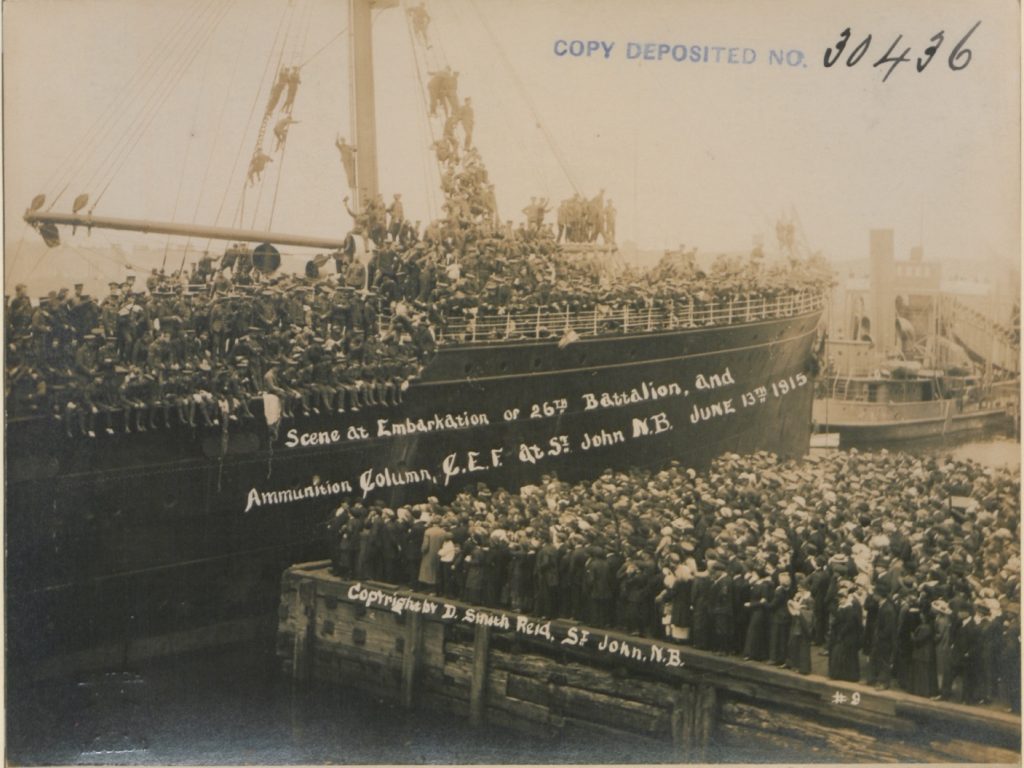
On 6 November 1915 Bertie was promoted to Sergeant. He would now be expected to physically lead soldiers into battle, controlling the rate of movement forwards, and ensuring his platoon played the part allocated in the overall Regimental plan. He was also granted 8 days leave in early February 1916.
The first major action he saw, one that became a Battle Honour, was Mount Sorrel in June 1916. This battle was notable for heavy Canadian losses, an initial damaging retreat from the high ground of Mount Sorrel, and its eventual recovery. In this action, the 26th was tasked with holding a defensive position at St Eloi and then the Railway Dugouts holding those areas in the face of heavy shelling.
On 6 September 1916 Bertie was treated by No 6 Canadian Field Ambulance for a flat foot, and he transferred to 5th Canadian Field Ambulance District Rest Station on the 8th, from where he was discharged on 11 September back to duty. He then almost immediately went back into the medical process with a bout of influenza, and then promptly sprained his right ankle. A busy 11 day period that saw 3 separate hospital admissions.
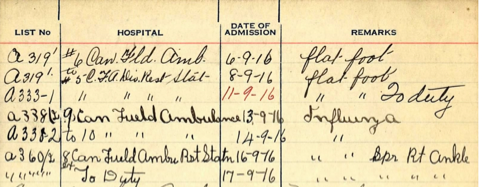
One could leave the interpretation of a record card at that, an unlucky month health-wise. But when you compare it to his unit location and the actions of the time, a very different perspective emerges.
From 1-5 September 1916, Bertie’s unit, was moving into the Pozieres-Albert-Contalmaison sector of the Somme, in preparation for a battle.
On 6 September, the 5th Brigade were moved to the rear/reserve area, while the other Canadian Brigades held the frontline. Bertie was admitted to the 6th Canadian Field Ambulance, quite possibly as a precautionary measure. One can easily imagine the order coming down ‘While we are here, get all the men with medical issues sorted before the battle’. As a Sergeant, Bertie would have been particularly important to the Regiment’s battle plans. The move between medical units here is likely part of their own preparations and positioning for the up-coming battle. Medical units needed to be positioned exactly where the fighting was predicted to be worse.
Bertie got his feet sorted and returned to his unit from 11th to 13th to continue preparations behind the lines, but caught influenza, widespread in the cramped conditions of the trenches, even behind the frontlines. The 9th Canadian Field Ambulance was positioned at Albert on the 13th, and on the 14th, he was transferred to the 10th Field ambulance, with his unit still in reserve.
What is unclear is whether Bertie returned to his unit on the 14th or 15th, there is no record such as “to Duty’ or ‘discharged’, but this was an exceptionally busy period for all units, literally the eve of battle. It seems quite possible that he did, otherwise, how does one sprain an ankle while in hospital with flu? There is no note clarifying ‘To Duty’, but there is also no notation ‘to’ showing a transfer between medical units as there is on 6-8th and 13-14th so someone’s record keeping was inaccurate. But in trying to piece together Bertie’s experience, this moment is key – where was he on the 15th?
The battle of Flers-Courcelette began at 0620 on the morning of the 15 September. The 5th Brigade initially remained in reserve in the trenches roughly between La Boiselle and Contalmaison, but during the afternoon it was suddenly ordered forward to capture Courcelette.
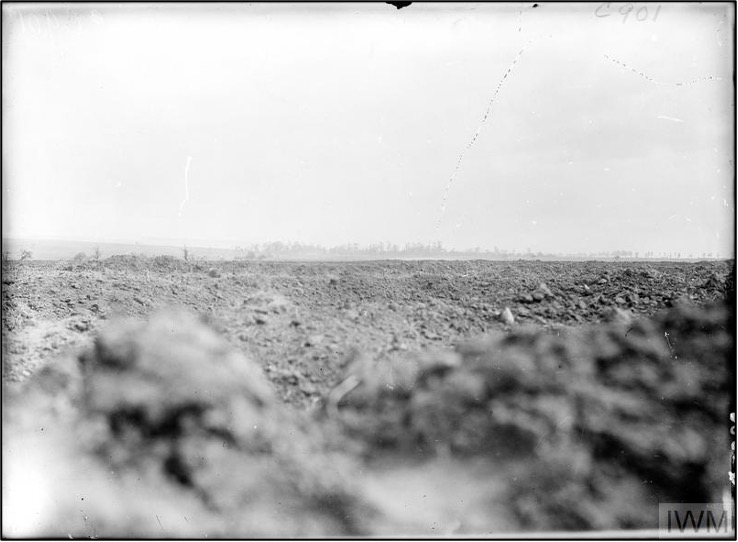
The terrain was appalling. Contemporary descriptions of the brigade’s approach speak of ground that was a confusion of shell holes and destroyed trenches. The 5th Brigade had to move forward rapidly over more than two miles of this ground before attacking in broad daylight.
Bertie’s unit, the 26th Battalion, advanced behind the 22nd and 25th Battalions. 2 companies from the 26th supported each attacking battalion. The 22nd attacked on the right and the 25th on the left, and the rest of the 26th followed about 150 yards behind. On the evening of the 15th, Courcelette was taken. The 22nd of the 25th pushed through the village, while the 26th was specifically tasked with clearing the village of remaining German troops.
Clearing a battleground is a very specific and rather nasty job. German soldiers were still occupying hidden dugouts, Cellars and shelters beneath the ruins. The official history says that clearing them out took the best part of two days, during which the 26th suffered 224 casualties between the 15th and the 18th. A twisted ankle in those circumstances requires no elaborate explanation.
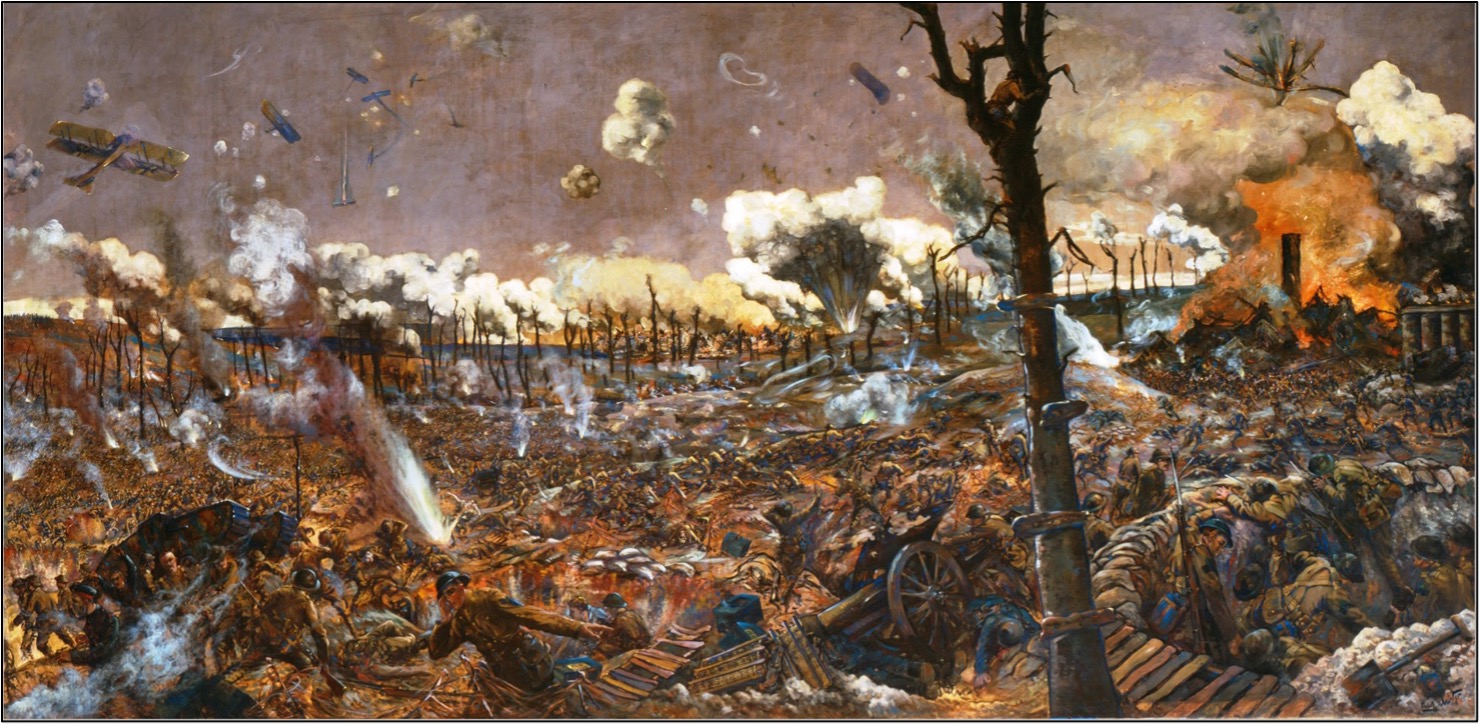
Weirter witnessed the battle as a soldier, though this image was created from memory in 1918. It contains many key references to the battle – the destruction of the sugar factory in the far right, and the disabled tank. This was the first battle in which tanks were used.
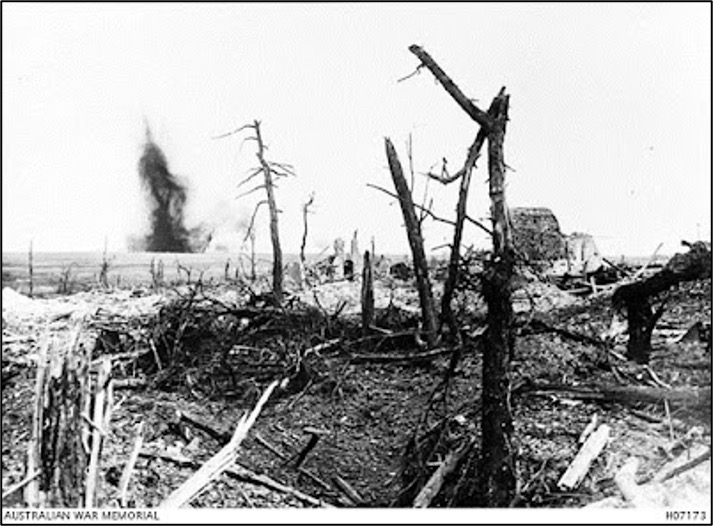
Bertie was promoted to Warrant Officer Class II or Colour Sergeant Major as the 26th called the rank, on 23 December 1916. This promotion is, in part, indicative of the highly attritional nature of warfare and the good fortune of survival. Indeed, the paperwork for his recommendation for promotion to Warrant Officer explains the vacancy was caused by “CSM Corey JW (69124) being struck off and invalided to England”.
Whether Bertie actually fought at Courcelette in September remains unclear. What is clear from his records is that as a Sergeant, he was the 59th in seniority in the Regiment. Given the number of Sergeants in the Regiment, about 80, that’s one of the more junior. Yet CSM Corey was one of the most senior and respected CSMs in the Regiment, indeed, after he was evacuation back to Canada, he was commissioned, a very rare promotion in this period. Bertie was selected for rapid promotion, and even given the losses at Courcelette, this was a conscious decision by the Commanding Officer.
CSM was a key rank in the Regiment, and had Bertie not been fit for the role, then the Regiment would have transferred the necessary experience and leadership in from another unit. Bertie was 22 years old. Nowadays, a soldier might make CSM by the age of 38 if they were exceptional, early 40s more likely.
Unfortunately by May 1917 Bertie’s health began to deteriorate. The first sign was a hospitalisation in the 3rd Canadian General Hospital in Boulogne for myalgia, an unspecified pain and weakness, but what is clear from his records is this was the first sign of trench fever.
Trench fever was a louse-borne bacterial infection that became extremely common among troops in the First World War, especially on the Western Front. It was a recognised clinical diagnosis by the later war years; it was not simply a generic term for “fever caught in the trenches”.
It was caused by Bartonella quintana and spread mainly by body lice. The lice lived in soldiers’ clothing, and infection was usually passed when contaminated louse faeces were rubbed into broken or scratched skin. In trench conditions — overcrowding, infrequent washing, filthy uniforms and constant re-infestation — it was almost perfectly adapted to spread.
The classic symptoms were sudden fever, severe headache, weakness and, particularly characteristically, intense pain in the shins and legs. Men often described aching in the bones and muscles, and the fever could come and go in repeated bouts every few days. It was rarely fatal, but it could make a soldier completely unfit for duty for weeks, sometimes longer. That is why trench fever mattered militarily. It did not usually kill men, but it removed huge numbers from units. During the war it caused hundreds of thousands of cases among troops.
From the field hospital in Boulogne, the next administrative note is that Bertie was transferred to the Lord Derby War Hospital in Warrington with a diagnosis of Trench Fever in May 1917. He clearly didn’t go there directly though, presumably he was given some leave, because on 2 January 1917 he married Florence Maud Deller at St Philip’s Church in Cambridge. Bertie spent a month in Warrington and was then transferred to hospital in Epsom before being discharged from hospital on 16 July 1917.
Between July and December 1917 Bertie was sent to the Canadian Forces HQ in England at Seaford in Sussex and put through a recuperation and training package designed to return troops to the fitness required for front-line service. His medical assessment here recorded
Subjective symptoms –
1. Pain in legs and left side of back
2. Unable to walk any distance
Objective symptoms
1 Pressure along both tibia causes pain
2. Marked tenderness on left side from lower angle of scapula down to 12th vb. This pain is exaggerated by trunk movements
3. General condition poor
Board recommends:- B3 not likely to be raised to a higher in next 6 months
B3 is a medical grading, not quite sufficient to be discharged form the army, but not fit for frontline service. However, at the end of 1917 Bertie was appointed Regimental Quarter Master Sergeant at the Regimental Depot of the 26th at Seaford. The RQMS is the most senior soldier responsible for the entire regiment’s stores, equipment, clothing, accommodation, supplies and administration. Being RQMS at the Depot added the responsibility for managing recruits, training, and men returning from hospital or overseas.
Sadly, it seems that Bertie’s health continued to be a challenge and in March 1918 he began a process of discharge from the Army. On 9 April 1918 he embarked on a ship back to Canada.
On 3 May 1918 we have a Case History Sheet on Bertie’s medical record. It was made at the Armoury Convalescent Hospital, St John, New Brunswick. He was admitted for Trench Fever, originating in France.
The Medical Officer noted –
Gen appearance well ordered. Good
Heart lungs normal
Complains of weakness in both legs and occasional swelling therein also aching pains in both shins.
No obvious signs
Patient appears to be nervous
Symptoms seem to be mainly subjective
No evidence of swelling in leg presents now
Treatment 5 weeks elect bath. High frequency currents
Condition on discharge – Unchanged
On 25 June Bertie heard the outcome of a Medical Board that assessed his fitness to serve. It reported that he had weakness in both legs following Trench Fever. His medical Category was assessed as C3. He was recommended for return to service, but in the Special category – specifically “Duty as in Orderly room office-work or store work so as not to be too much on his feet for some time”.
The Canadian records are exceptionally detailed, and one interesting insight is some of Bertie’s pay records. In 1915 his basic pay was $1 10c per day, about $34 per month, on top of that he earnt an additional 10 cents per day for field living, i.e. being in France. But he clearly had little opportunity to spend his money, and the Army just built up the balance. So, from 1 July 1915 to 1 April 1916, we can see that Bertie earnt $336 but only spent $231.68 and built up savings on $104.32. By the time his last Pay Certificate was issued on 6 March 1918, he was owed $70.56. It was possible for a Soldier to ascribe his pay to someone else, and Bertie sent $27 every month back to Florence in Cambridge so most of his expenditure was actually just a transfer back home.
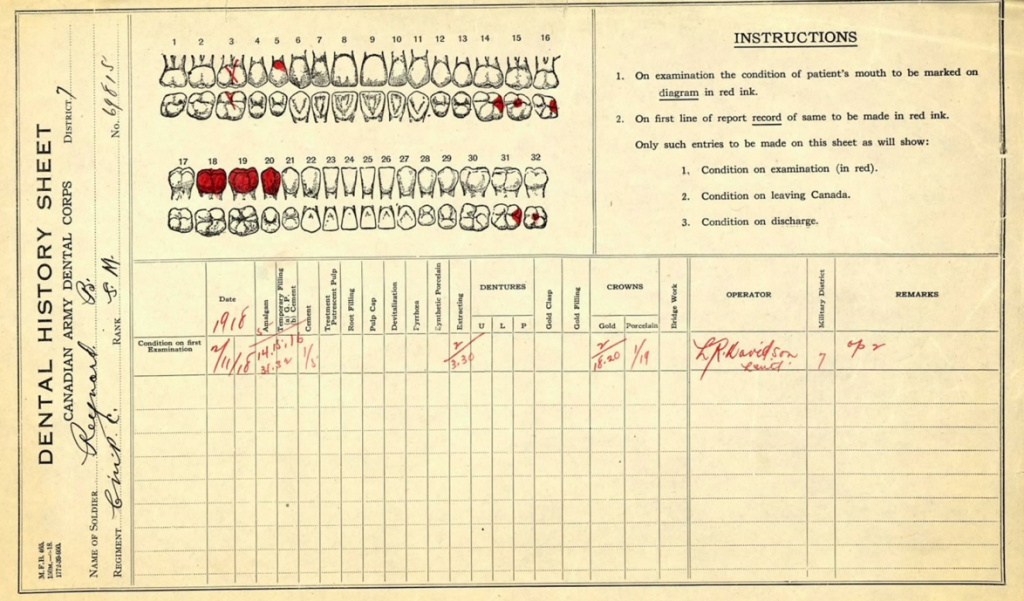
Less interesting, unless you spent 4 months searching for information on Bertie Rayner, his dental records are on file!
Also on record, his urine analysis while he was in the Lord Derby War Hospital in Warrington, taken on 9 May 1917, and several temperature, pulse, respiration and motion records from hospitalisations.
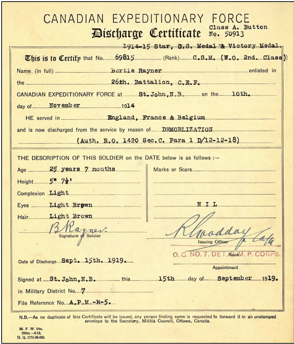
At some point, likely in April 1918, Bertie’s wife Florence sailed across to Canada and was living in the Royal Hotel, St John, we know because his pay records note the change in address for payments to his wife. Bertie continued to serve in Canada, despite his health issues. He was finally demobilized on 15 September 1919.
Bertie came back from Halifax, Canada to England in 1924, he sailed on the Andania of the Cunard line, with his wife Florence and their 2 children Harold 4 and Walter 2. Their destination address was given as Library Farm, Kingston.
He lived through both world wars and died in Cambridge in 1972, aged 77.
Bertie Rayner’s story is perhaps one of the most remarkable of the Kingston men because, at first sight, it looked as though he had barely served at all. He joined the Cambridgeshire Territorials before the war, was embodied in August 1914, and was then discharged on the spot after failing the medical. Instead of accepting that decision, he immediately went to Canada, enlisted in the Canadian Army in November 1914 and, within a year, was serving in France. He rose extraordinarily quickly, from Corporal to Sergeant and then, at only 22, to Company Sergeant Major, serving through some of the hardest fighting of the war, including Courcelette. His war was eventually curtailed not by wounds but by trench fever, which left him with persistent weakness and pain in his legs and made further front-line service impossible. He nevertheless remained valuable enough to be appointed Regimental Quartermaster Sergeant at the 26th Battalion Depot at Seaford, a striking outcome for a man whom the British Army had rejected as medically unfit less than four years earlier.