
Suffolk Regiment, Labour Corps
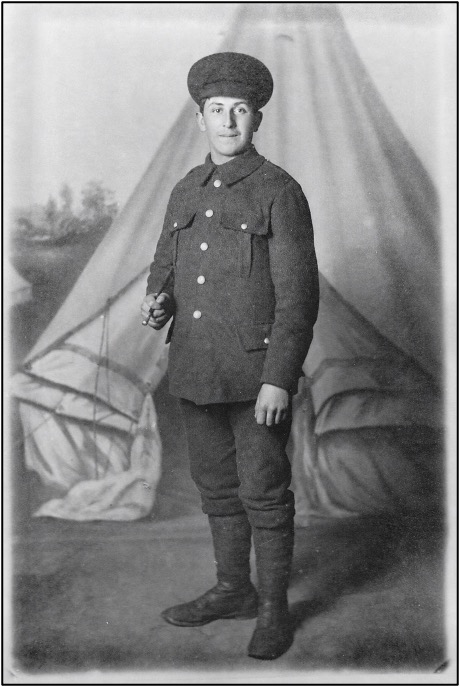
Arthur Ernest Jacklin was born on 30 October 1896, the son of John and Ruth Ann Jacklin, née Custerson, of Kingston Wood. He was born into a large and growing family. His older sisters Nellie and Frances had been born in 1893 and 1895 respectively, Arthur Ernest followed in 1896, and three younger children followed later: Topsy Nora in 1899, Hilda Violet in 1905, and Horace Sidney in 1907. He seems to have used the name Ernest; he is reported that way in a 1916 newspaper report.
The photograph of Ernest appears to have been taken very early in his Army career, quite possibly before he had joined his first unit for training. His uniform has no visible unit markings, and he is not wearing a cap badge, which suggests that the photograph may date from the very beginning of his service while he was still in training.
Ernest enlisted, like so many other Kingston men, into the Suffolk Regiment. His regimental number, 15757, places him among the group of Kingston men who appear to have enlisted at around the same time. This cluster of closely numbered men is one of the useful clues that helps link individual Kingston soldiers to a wider local pattern of recruitment.
Some of Ernest’s attestation records survive, but they are in very poor condition. This is frustrating, but not unusual. Around three quarters of First World War soldiers’ service records were destroyed during the bombing of London in the Second World War. Many of those that survived were damaged by fire and water. These are often known as the “Burnt Records”. In Ernest’s case, the edges of the pages have been badly damaged, leaving only parts of the centre of the documents legible.
What can still be made out is that Ernest began the attestation process on 19 October 1914. This fits with the wider pattern of Kingston men joining up in the early months of the war, after the initial rush of volunteers but still during the period when men were coming forward in significant numbers before conscription was introduced.
One separate page of Ernest’s record appears to refer to an injury. The entry is difficult to read but seems to say “Wounded VIII. 1”, followed by “Right forearm GSW”. GSW means gunshot wound. The “VIII. 1” may be a date, possibly 8 January, or it might refer to some classification of the injury.
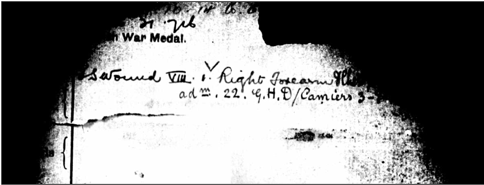
The same entry appears to refer to Ernest being admitted to 22 General Hospital at Dannes-Camiers, near Étaples on the French coast. Dannes-Camiers was a major base hospital area. A wounded soldier sent there would normally already have passed through several stages of the medical chain: from the regimental aid post near the front line, to an advanced or main dressing station, then to a casualty clearing station, and finally back to a hospital such as Dannes-Camiers.
There is also a note indicating that Ernest was in hospital from 21 July 1916 to 21 November 1916. This does not quite fit with the possible January date of the wound, so the record must be treated cautiously. The hospital dates may refer to a later stage of treatment or recovery, or the injury date may have been misread because of the damage to the form. What is clear is that Ernest suffered a wound to his right forearm serious enough to require hospital treatment.
It seems likely that this wound affected the course of Ernest’s later service. A gunshot wound to the arm might leave a man unfit for front-line infantry duties, even if he was still fit enough for useful military work elsewhere. This was one of the common routes by which men moved from infantry regiments into the Labour Corps. They were no longer considered suitable for the physical demands of the front line but could still serve in a rear-echelon or supporting role.
Another surviving page shows that Ernest had several postings between units, though much of the detail has been lost. It appears that around 15 May 1917 he left hospital or a medical posting and was transferred to the Labour Corps where he served under the number 240568.
There then seem to have been further moves over the next couple of months while the Labour Corps found a suitable role for him. This was a common situation as the war progressed. The Army had come to realise the enormous scale of the logistical effort needed to support the fighting in France and elsewhere. Men were needed not only in the front line, but also in the vast system behind it: road making, stores, transport, docks, camps, hospitals, forestry, salvage, agriculture and other essential labour. Injured men who were no longer fit for frontline service, but who understood that service and its needs, were invaluable in these logistic roles.
One small surviving snippet suggests that Ernest was sent to the 3rd Agricultural Unit of the Labour Corps. The Agricultural Companies of the Labour Corps were a distinctive part of the late-war manpower system. These were not ordinary fighting units. They were used to provide organised agricultural labour, mainly in Britain, at a time when the country was desperately short of men to manage food production.
Army Council Instruction 924 of 12 June 1917 authorised the transfer of existing Agricultural Companies into the Labour Corps. Apart from a small headquarters element, these companies did not really exist as formed military units in the usual sense. The men might live at home or be billeted near the farms and smallholdings where they were employed.
The men in these companies were often not fit for front-line infantry service. Some had been wounded; others had been found medically unsuitable for the demands of active infantry service from the start. Some had agricultural experience, but others were sent to farm work with little previous knowledge. Ernest, with a wound to his right forearm and no longer apparently suitable for front-line infantry work, would have been a natural candidate for this kind of posting.
It seems that Ernest was sent to Wisbech. This would prove significant not only for his Army service, but also for his personal life. After the war he returned to civilian life, and in July 1919 he married Bessie Green of Wisbech. It seems very likely that this was a match made during his time in the area while serving with, or attached to, agricultural labour work in the Labour Corps.
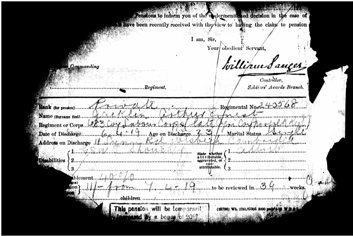
Ernest also had a pension assessment after the war. He was awarded a 40 per cent disability award, with 11 shillings added to his pension, to be reviewed after 39 weeks. This kind of temporary review was typical. The authorities often assessed a man’s disability after discharge, awarded a pension or allowance for a set period, and then reviewed the case to see whether the injury had improved, worsened or remained the same.
Ernest and Bessie’s first son, Ronald S. Jacklin, was born in Chesterton in 1922. Their second son, Brian, was born in 1932. Ernest lived for many years after the war and died in Wisbech in 1974.
Ernest’s story is not one of a single dramatic battle narrative, but it is a very typical and important First World War story. He was one of the Kingston men who enlisted early, served first in the infantry, was wounded, and then continued to serve in the less visible but essential labour system that kept the Army and the country functioning. His move from the Suffolk Regiment to the Labour Corps, and then apparently into agricultural work, shows how the war used men’s service in different ways as their health, fitness and the country’s needs changed.