
Queen’s Own Royal West Kent Regiment; Royal Sussex Regiment
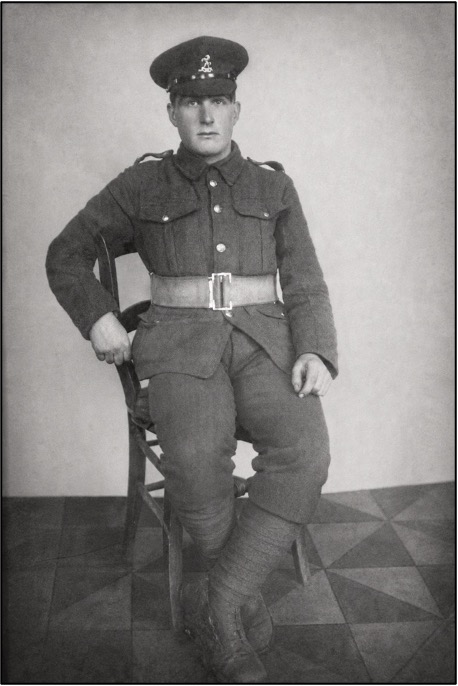
Albert Mark Wayman was born in Kingston on 26 August 1899. He was the younger brother of John Wayman, and one of the large Wayman family living on the Green. His parents were Mark Wayman and Julia Wayman, née Allen. In the 1911 Census, the household included Thomas, John, Albert Mark, William Edward, Sydney, Reginald and Charles.
Albert was one of the Kingston men whose age makes his military service difficult to interpret. He was only fourteen when war broke out in August 1914, and still only seventeen in late August 1916. Like Sidney Chapman, he may have joined underage, or he may have been drawn into the Army just as the rules around young soldiers were changing.
In the early years of the war, men were not supposed to serve overseas until they were nineteen. In practice, under-age enlistment was common, but the rule still mattered. In April 1918, during the manpower crisis caused by the German Spring Offensives, the rules were changed. Men could be sent overseas from the age of 18 years and 6 months, provided they had already completed six months’ service in Britain. Albert’s birth date placed him exactly within this shift. He turned eighteen on 26 August 1917 and eighteen and a half on 26 February 1918. The rule change therefore made him eligible for overseas service about four months earlier than he would previously have been.
Albert’s medal records are more informative than many, though not entirely straightforward, the key issue being they give no dates, so we cannot be sure when Albert joined up, and how long he spent at each unit. The dates would help indicate what he might be doing.
He first joined the 3rd Battalion, Queen’s Own Royal West Kent Regiment, with the service number 39308. This block of numbers seems to have been issued in June-July 1918. In the First World War, the 3rd battalions of line regiments were usually reserve or depot battalions based in Britain. They received recruits, trained them, processed drafts and supplied men to front-line battalions. Albert’s initial posting to the 3rd Royal West Kents therefore fits the normal pattern for a young recruit entering the Army.
He then moved to the 1st Battalion, this suggests that at some point in late 1918, Albert was posted to France. This explains how he qualified for both the Victory and British War medals.
He later transfers to the 10th Battalion, which was also serving in the final campaigns of the war in the autumn of 1918. His photograph supports the Royal West Kent service, because his cap badge shows the regiment’s distinctive rearing horse.
Then finally Albert was posted to the 53rd Battalion, Royal Sussex Regiment, with the service number G/32245. The final transfer, to the 53rd Royal Sussex Regiment, needs some explanation. The 53rd Royal Sussex was primarily a Young Soldier Battalion. These battalions were part of the Army’s age-graded training system. They were used for young men who had joined, or been called up, but were not yet old enough for ordinary overseas infantry service. However, after the Armistice, the Army used units for whatever task was required. The 53rd Royal Sussex were sent to Germany as part of a temporary occupation force through into 1919.
That gives a plausible shape to his service. Albert may have entered the Army while still too young for front-line service, or just as the age rules were being altered. From the general look of his photo, he is a far more credible candidate to be over 18 than Sidney Chapman. He was moved through reserve and training structures and was moved to France in the very last few weeks of the war. He was then retained, as many men were, in the machinery of transition from war to peace.
After the war, Albert returned to civilian life. On 8 November 1924 he married Amelia Elizabeth Uff, also from Kingston. Their son, Albert W Wayman, was born on 10 March 1926. In 1938, Albert and Amelia were recorded on the electoral roll as living in Crane’s Lane.
Albert died on 21 April 1984. He was living in Knapwell at the time of his death.
Albert Mark Wayman’s story is one of the awkward edge cases of First World War service. He was too young for the first years of the conflict, but old enough to be pulled into the Army as the war reached its final crisis. His movements through the Royal West Kents and the Royal Sussex suggest a young soldier being managed through training, reserve before front-line service at the very end of the conflict, and transitioning to peace-time operations.