
Essex Regiment
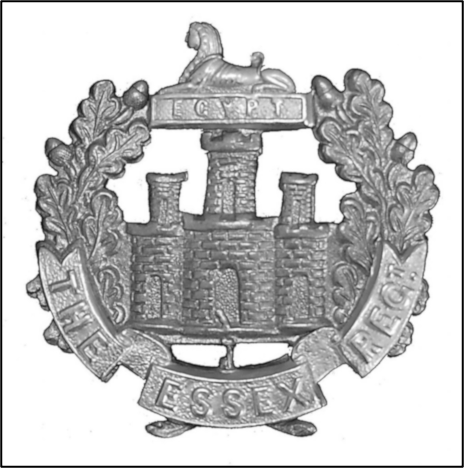
David Custerson was born in Kingston on 12 June 1898, the twin brother of Robert Custerson. He belonged to the same Kingston Custerson family as William Custerson.
The Custerson twins only turned 18 after the war had started, and the rules at the time were a man had to be 18 to enlist and serve for a minimum of 6 months before being sent overseas. David attested just a few days after his 18th birthday. It seems likely that David was called up under the Derby Scheme, and that although he technically attested on the summer of 1916, he was transferred to the Reserve (so unpaid) and sent back to Kingston and continued working for his father, as a hurdle-maker and thatcher, for a period.
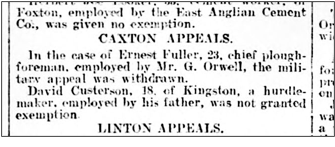
We know this because at some point either David himself, or his father, applied for an exemption to his service, but after his enlistment date . It was widely accepted that not all men, even if fit, should serve in the war and agriculture in particular was a reserved occupation and could get a man exemption from call up. It is clear from the newspaper cutting below that an appeal against enlistment failed. In most cases, the papers of the Exemptions Tribunals were all purposefully destroyed after the war, so there is no way to know who or on what ground the application was made. The only way to research is through newspaper articles of Tribunal outcomes. Unfortunately, the OCR readability of the local newspapers is so poor that searches are very hit and miss.
David is much less visible in the surviving records, but one important trace has been found. He appears in the War Office casualty lists as D. Custerson, Essex Regiment, service number 35676, of Kingston. The list was issued as Daily List No. 5459 on 7 January 1918 and appeared in the published weekly casualty lists on 15 January 1918. The National Library of Scotland’s digitised casualty list confirms the entry: “Custerson 35676 D. (Kingston)” under the Essex Regiment.
David was wounded, presumably in late 1917, perhaps during the aftermath of Third Ypres, the Cambrai period, or ordinary trench holding, depending on which Essex battalion he was with. That is the crucial missing piece: the battalion would determine the likely setting.
Charlie Richmond remembers his uncle, David Custerson, and hearing stories about his wartime service. Apparently, David was wounded by a German sniper who shot at him from a church tower. He was shot in the torso, and the bullet went straight through him. Apparently, when he was given first aid, put into an ambulance and driven to hospital, he was in such a state that he was unsure whether it was his own colleagues, or the Germans, who were saving him. David was also less than impressed by the standard of medical care he received, according to Charlie, David said his wounds were just plugged, front and back, and he was left to heal or otherwise. Fortunately, he healed, but his wound was sufficient to get him discharged from the Army and he was back in Kingston by the summer of 1918.
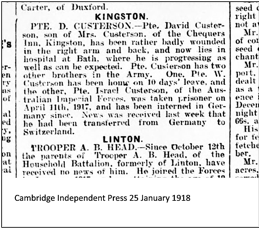
The Cambridge independent Press ran a short story about the Custerson men on 25 January 1918
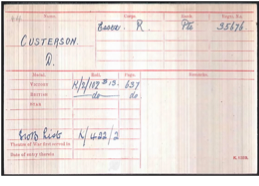
David’s Silver Badge Record (misfiled under the typo Custersonm) gives his service number as 35675 (one digit out, the clerk was clearly having a bad day), his Silver Badge as number 364703 and confirms his enlistment date as 20 June 1916 and his discharge date as 17 May 1918. His age was recorded as 19 ¾ and he had served overseas.
In 1939, David was still living in Kingston, but now with his older brother William. Neither brother seems to have married. David died in 1972, aged 73 and is buried in Kingston, alongside his sister Rose.
One remaining mystery is his photograph. We believe the village first produced the photographic collection immediately after the war, but this initial version did not name the men. What we do know is that the original picture board was kept in the church, but sometime in the 1990s it was reframed and moved to the village hall, where is now kept. At this point, Peter Reynolds who led the project, asked various older village residents for the names of the men. We know from Charlie’s recollections, that David would have seen the original picture – but the man in the picture is very clearly in the uniform of the Royal Field Artillery, pointing towards it being a picture of David’s twin brother Robert.
At present, David’s war story is therefore a fragment rather than a full narrative. What can be said is that he was a Kingston-born Custerson, twin brother of Robert. He joined the Essex Regiment in the summer of 1916, and was listed as a casualty in January 1918. He is one of very few Kingston men for whom we still have contemporary memories. Unlike his older brother William Custerson, whose medical and posting history can be followed in detail, David remains at the edge of the record: visible only when the Army listed him among its casualties.