
11th Battalion, Suffolk Regiment
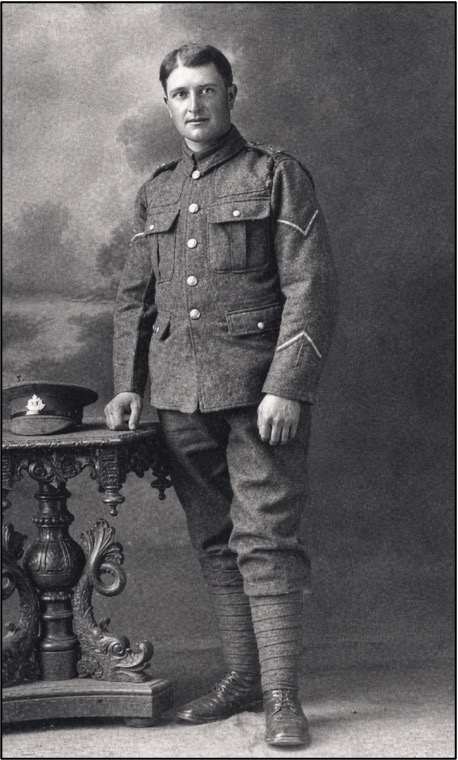
Frank Jacklin was born on 9 March 1891, the youngest son of Andrew and Phoebe Jacklin. He was the younger brother of Simon and Richard Jacklin, who also served during the First World War.
By the time Frank was born, his parents were already relatively old for new parents. Andrew was 54 and Phoebe was 43. Frank was the last child of a very large family. In the 1891 Census, taken when he was only about a month old, the Jacklins were living in Tinkers Lane. The household included Andrew (54), Phoebe (44) Joseph (19), Henry (18) Amos (16), William (14), Annie (12), Simon (11), Jane (8), Sarah (6), Richard (4), Elizabeth (1), and baby Frank. Even that long list does not include all the children Andrew and Phoebe had had. Between 1869 and 1891, Phoebe gave birth to thirteen children. Frank was the last of them.
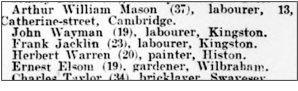
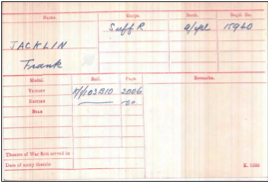
Frank was another Kingston man who served with the 11th Battalion, Suffolk Regiment. His service number was 15940. This places him a little later in the Suffolk sequence than the group of Kingston men with numbers around 15760 to 15770, but still among the early wartime recruits into the battalion, likely enlisting around November 1914.
Frank’s photograph is particularly useful. At the time it was taken, he was a Lance Corporal, shown by the single chevron on each upper arm. A Lance Corporal was the first step into the non-commissioned ranks. It was a junior appointment, but not an insignificant one. A Lance Corporal might command or assist with a small group of men, pass orders, help maintain discipline and provide steadiness in training or under fire.
On his lower left arm, Frank also wears an inverted chevron. This was a wound stripe, introduced during the war to show that a man had been wounded and had returned to service. It is a small mark in the photograph, but an important one. It tells us that Frank had already been through injury by the time this picture was taken, and had returned to service afterwards.
There is a record of admission for Lance Corporal Frank Jacklin of B Company, 11th Suffolks in the 18thGeneral Hospital on 11 April 1917. He was evacuated from the frontline near Arras on 9 April via No 1 Casualty Clearing Station and then via No 12 Ambulance Train to No 18 General Hospital. He was suffering from a gunshot wound to his left ankle. He spent 11 days on Ward O in the hospital. On 21 April he seems to have been sent on to a hospital ship, presumably to be returned to England for further treatment and recovery.

There is a further trace of this in the casualty lists. A Frank Jacklin appears in a Cambridgeshire Regiment casualty context in the weekly list of 17 September 1917, associated with the daily list of 13 September 1917. There are no records of a second hospitalisation, so it is not clear if Frank suffered a second injury, or if this was a delay in reporting. The Cambridgeshire Regiment was founded from the Cambridgeshire Territorial Force, for the period of the war, and was a standalone Regiment in its own right. It can be confusing as the 11th (Cambridgeshire) Suffolk Regiment had such a strong identity as a Pals Battalion that Clerk’s shorthand sometimes fails to make the difference clear.
The 1918 Absent Voters records him as 15940 Corporal with the 1st Cambridgeshire Regiment. The 1919 Absent Voters List records him as 15940 Lance Sergeant, 1st Suffolks. One of the challenges with interpreting the Absent Voters list is that they were prepared in advance and were often not ‘current’ nor necessarily compiled accurately. Even among the relatively small cohort of Kingston men, there are obvious errors in old service numbers being recorded against new units that had renumbered. He may have moved to the Cambridgeshire Regiment towards the end of the war, but it is highly unlikely Frank was in the 1st Suffolks as they were based in Greece. His medal record makes no mention of any unit other that the Suffolk Regiment.
A Lance Sergeant was usually a Corporal or Lance Corporal carrying out sergeant’s duties. It suggests that Frank had become a trusted and experienced soldier by the end of the war. His older brother Simon had also served as a Sergeant in the 11th Suffolks before being killed on 1 July 1916. One cannot know how Frank felt about following that path of responsibility in the same regiment, but the family echo is hard to miss.
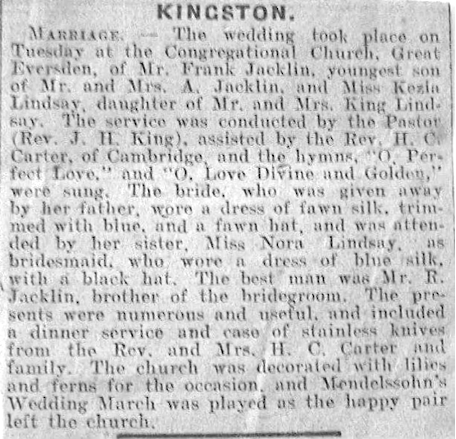
Frank survived the war. In 1926, he married Keziah Lindsay, also from Kingston. Their daughter Joyce had already been born on 26 March 1925, and their son Dennis Henry was born on 27 December 1934.
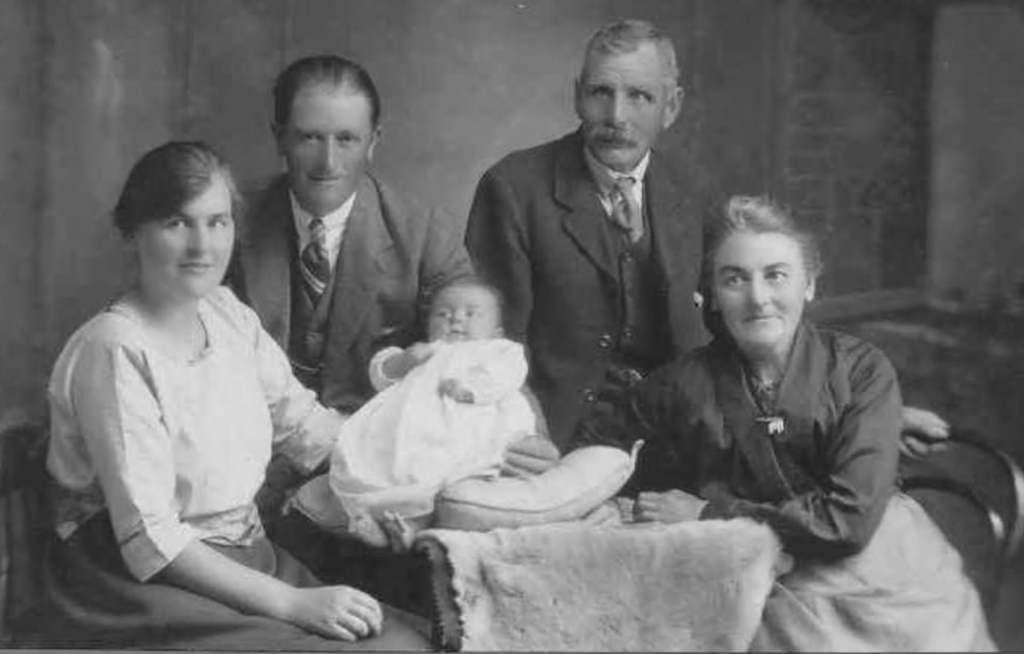
This family photograph from 1926 shows Keziah Jacklin, Frank Jacklin, baby Joyce, and Frank’s parents Andrew and Phoebe Jacklin. Andrew and Phoebe lived at White Cottage. It is a striking image because it brings together three generations: the elderly parents whose sons had served, Frank who had returned wounded but alive, and the baby daughter born into the post-war family.
By 1939, when the national register was compiled at the beginning of the Second World War, Frank was living at Button End in Harston and working as a cowman. He appears to have remained in Harston for the rest of his life. He died on 1 May 1977 at Chesterton Hospital. At the time of his death, he was living in Harston and was recorded as a retired farm worker.
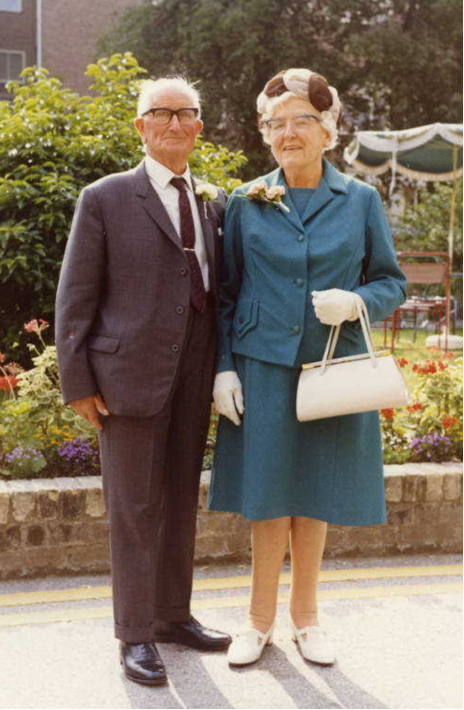
This photo is of Frank and his wife Keziah, taken on 7 July 1973 and the wedding of his grandson Keith Carter to Sylvia Murfett.
Frank Jacklin’s story completes the picture of the three Jacklin brothers who served. Simon, the older brother, was killed on the first day of the Somme while serving as a Sergeant with the 11th Suffolks. Richard served in the Army Ordnance Corps, part of the Army’s huge supply and equipment system. Frank served with the Suffolks, was wounded, returned to duty, and by 1919 was recorded as a Lance Sergeant. His surviving photograph, with its rank chevrons and wound stripe, carries much of the story: a young Kingston man who had gone to war, been hurt, come back into service, and lived long enough to become part of the village’s post-war memory.