
11th Battalion, Suffolk Regiment; Labour Corps
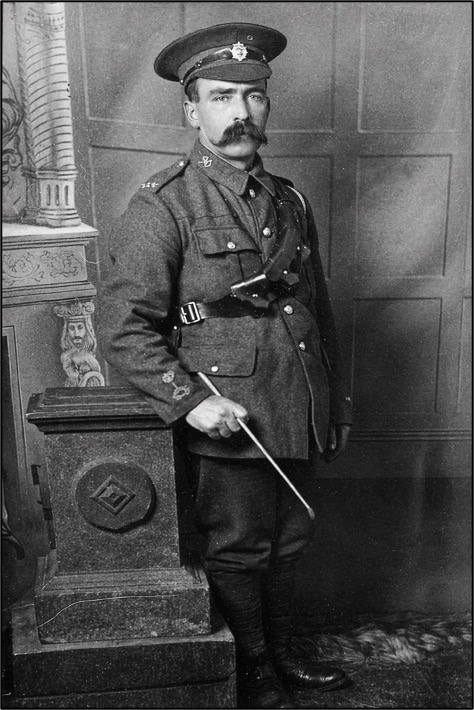
Fred Lindsay was born in Kingston on 24 July 1881 and baptised there on 5 March 1885. His parents were John and Harriet Lindsay.
The 1891 Census records the family living in Wayman’s Lane. John Lindsay was 48 and working as an agricultural labourer. Harriet was 46. The children then at home were Jim, aged 17; Dick, aged 14; Ted, aged 12; Fred, aged 9; Alice May, aged 6; Sally, aged 4; and Elizabeth Nellie, aged 2. Elsie was born the day after the census was taken. The family had its share of early loss. Dick died aged 16, Elizabeth Nellie died only a couple of months after the 1891 Census, and Elsie died aged 8. The Lindsays were Baptists.
By the 1911 Census, Fred was still living with his parents in Wayman’s Lane. He was then 29 and working as a farm labourer. By that stage, he appears to have been the only child still living at home, their house was almost certainly ‘tied accommodation’ and came as part of their terms of employment on the farm. Until he married, Fred would not have qualified for his own home, unless it suited his employer.
Fred’s military service initially proved difficult to trace through the usual Ancestry.co.uk records because there were so many variations of Fred/Frederick and Lindsay/Lindsey and none with an obvious connection to Kingston. However, eventually we found him, and fortunately with his full service history. So, we can be very clear on at least the administrative details of Fred’s wartime experiences.
Fred enlisted in Cambridge on 16 October 1915. Like so many Kingston men in the early years of the war, he joined the Suffolks; his service number was 22164. He had undergone his medical examination the day before, on 15 October. The records show that he was 34 years and 2 months old, his trade was navvy (groundworker), he was 5 ft 9¼ in tall and weighed 142 lb. His physical development was recorded as good; he had been vaccinated in his left arm in infancy, and his eyesight was 6/6. He seems to have been missing two teeth, but that was not sufficient for him to fail the medical.
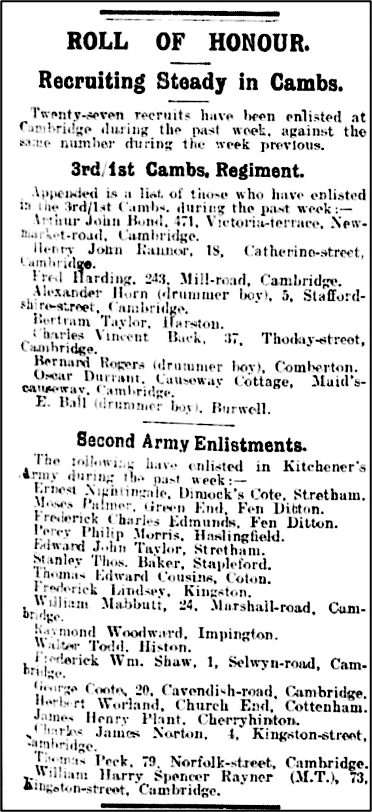
Fred was initially posted to the 13th Battalion of the Suffolks. He sailed for France from Folkestone on 31 May 1916 and transferred to the 11th Suffolks ‘in the field’ on the same day.
Next on his record we can see he was transferred to the 456th Casualty Clearing Station – admitted with a gunshot wound to his hand and knee, on 1 July 1916. This date is significant, because it puts him in the same action on the first day of the Somme, in which Frank Allgood and Simon Jacklin were killed. Fred was also involved in the ill-fated 11th Suffolks advance on La Boiselle.
On 3 July 1916 Fred moved by hospital ship Asturias, to England, because of the wound to his hand. He was treated in Mile End Road Hospital in London
On 4 October 1916 Fred embarked at Folkestone and had rejoined the 11thSuffolks by the end of the month.
Then, on 3 December 1916 the next note on file records Fred was suffering from deafness and he was sent to 102 Field Ambulance, seemingly transferred to the 104th for treatment, and returned to his unit on 7 December.
Just a few days later, on 17 December, Fred was again subject to some sort of medical intervention. The handwriting is frustratingly difficult to decipher, written, as it so often was, in Army abbreviations and a very stylised hand. It seems to show that Fred was admitted to the 1st Canadian General Hospital at Étaples and found to be unfit. The reason is not clear in this entry but becomes clearer on the next page. On 19 December Fred was sent for an ear report — and docked one day’s pay! On 25 January 1917 he was sent to Beaumarais and assessed as temporarily unfit for a fighting role because of deafness. On 1 February he was posted to the 1st Battalion, Suffolk Regiment; the key feature was that this was the garrison headquarters and not a front-line posting. After a series of further medicals, on 25 May 1917 Fred was declared permanently unfit for fighting service but fit for agricultural service. He was sent back to England via Calais on 30 July 1917.
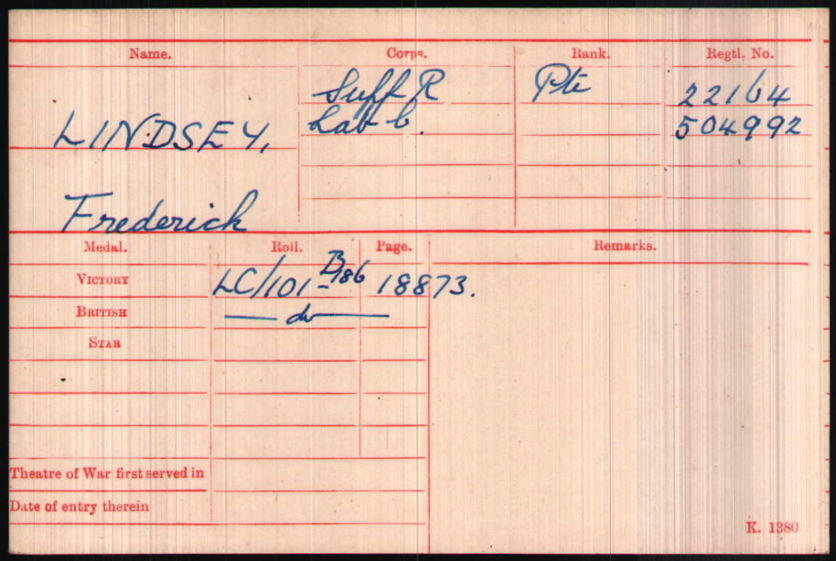
The next formal note in his record is a posting to the 45th Agricultural Company of the Labour Corps to do farm work, on 9 August 1917. He was then posted to the 431st Agricultural Company in Exeter on 2 January 1918 and had a new service number 504992. This was a common posting pattern for men who came from agricultural or labouring backgrounds and who were too injured to fight but fit enough to help with agricultural tasks. The interesting point is the transfer from the 45th Agricultural Company to the 431st, which was based in Devon, this was presumably to place him closer to his wife, who was in Devon at the time. Indeed, some Agricultural postings were directly back to farms, and the man was effectively a ‘placed’ agricultural laborer who worked directly for a local farmer. This was a way to compensate for the reduction in agricultural labour available because of the war.
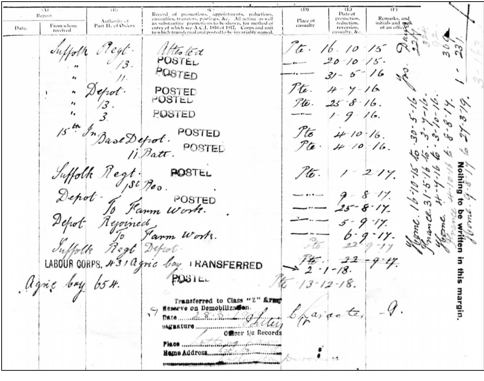
After his return, Fred was assessed 3 more times in 1918, and on each occasion given a B2 medical category. This limited both where he could serve and certain roles in which he could serve but found him fit to continue in the Army.
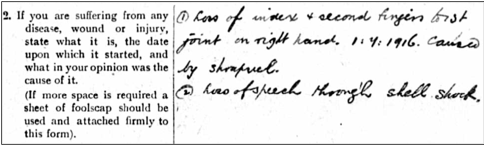
In his Statement as to Disability, effectively a claim for an additional pension or gratuity, Fred’s address was given as Cullompton, Devon. This is where his wife Beatrice had come from. Presumably she moved back to be with her family while Fred was off fighting, and after he was discharged, he went to stay with her, we can see he had already been moved to Unit in Devon. The reason may be more apparent because this document records –
- Loss of index and second fingers to 1st joint on right hand 1/7/1916 caused by shrapnel
- Loss of speech through shell shock
This stark line makes it clear that Fred was suffering from more than just the physical effects of war.
For the loss of his fingers, Fred was awarded a sum of £75 and a further £22 10s for his 3 years of service. Meaning he left the Army with a one-off Gratuity of £97 10s. Perhaps the most meaningful comparison is that it represented about 9 months of wages for someone who had been a Navvy before joining the Army. It wasn’t a life-changing sum, but it was perhaps enough to tide him over his recovery and look for work. There was no consideration for his mental health.
It is interesting to consider how Fred coped with both his physical and his mental injuries. At first glance, losing those two fingers on his right hand might seem a very severe injury for an infantry soldier — a Lee-Enfield rifle is designed for right-handed operation because of the position of the bolt and ejection. Without the first two fingers, how did he manage? Yet he served with the Suffolks and the Labour Corps for at least 18 months after his injury.
The war seems to have scattered the Lindsay family. By the time of the 1921 Census, three years after the fighting ended, Harriet Lindsay was living alone in Kingston. There were other Lindsays in the wider Caxton registration district, but none appears clearly to be one of her surviving children.
Fred himself was no longer in Kingston. In the 1921 Census he was living at Green End, Fen Ditton, with his wife Beatrice Mary. Fred was working as a labourer for the Portland Cement Company at Cherry Hinton. No children were recorded.
Fred died relatively young, in Cambridge, in January 1930. He was 48.
Fred Lindsay’s story is therefore of a man who joined up in the early days of the war but suffered both physically and mentally from the effects of front-line service. But despite those harms, the Army kept him on, using exactly the sort of rural skill Kingston men often possessed steadiness, labour and practical judgement. However, they do seem to have had the good sense to post him to an area where he was close to his family. However, he returned to Cambridgeshire and found new work, so looks to have made some recovery from his wartime experience, albeit dying in early middle age.
A final note
The picture allocated to Fred Lindsay does not fit with his service history at all. The cap badge is not that of the Suffolk Regiment, and the badges on his arm are not consistent with his rank or trade: they seem to show a Warrant Officer’s crown and a Rough Rider’s stirrup badge (meaning the soldier was trained to break in horses for army service). A close look also shows that this man has an index finger on his right hand beyond the first knuckle, though these pictures were often taken early in a man’s service, or on promotion, so could be before the injury. However, the badges are inconsistent with the Suffolk Regiment.