
Royal Field Artillery
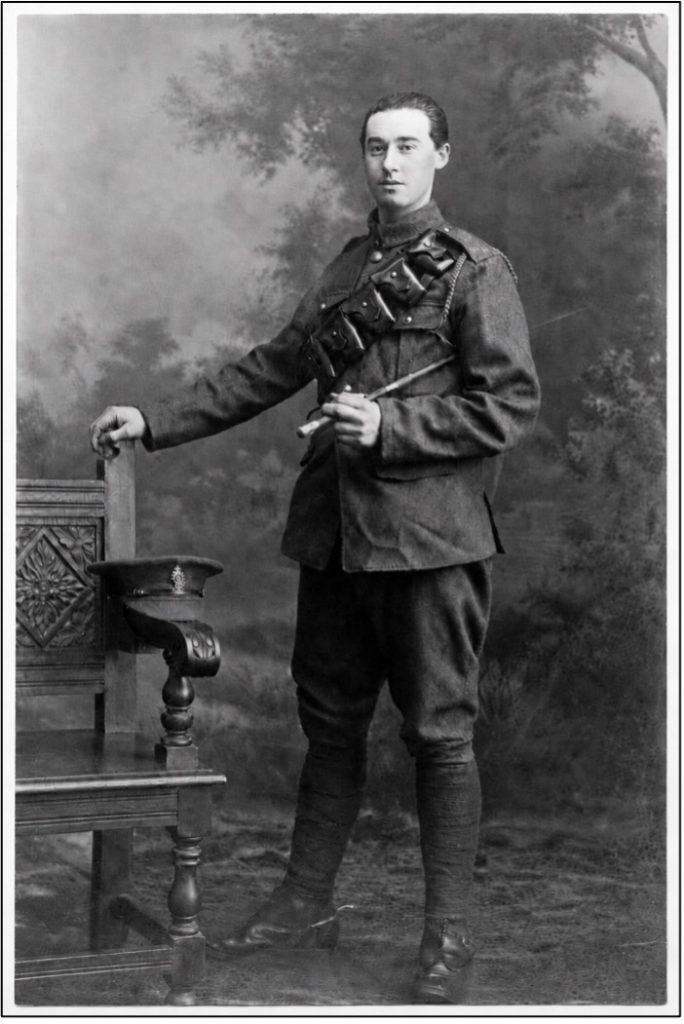
George David Thompson was born in Kingston on 6 June 1897 and baptised here on 15 August the same year. He seems to have been known in some records, or at least locally, as David, which is a useful reminder that official names and everyday names do not always match neatly.
At the time of the 1911 Census, David was living with his parents, George and Albertha Thompson, and his older sister Alice Eva, at the Post Office on Church Lane. This was the house later occupied by the Stokes family in 1926. David was then 13, and his employment was recorded as “boy on farm”. His mother was the postmistress, and his father was a gardener.
Unusually, David’s full-service record survives, from attestation to discharge. This allows his military service to be followed in much more detail than that of many Kingston men.
David enlisted in the Royal Field Artillery on 21 February 1916. He was 18 years and 260 days old.
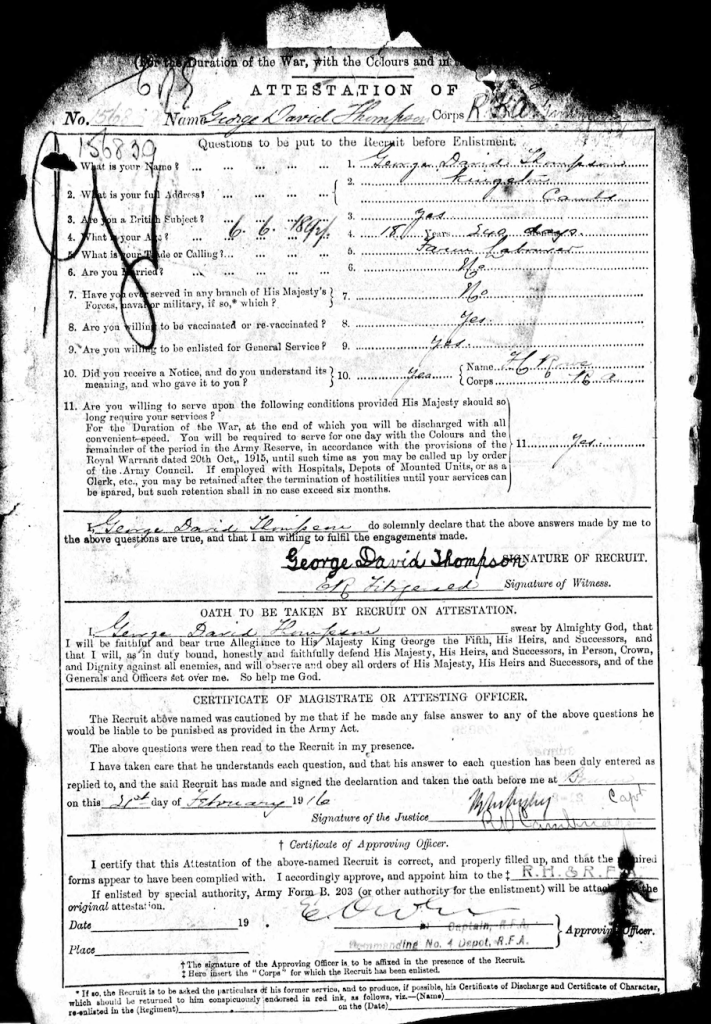
His occupation was recorded as farm labourer, and he had not previously served. His medical examination noted that he had been vaccinated, was 5 feet 7 inches tall, and had a chest measurement of 33½ inches. His eyes were grey and his complexion was described as “fresh”. He had slight flat foot and some stiffness in his right elbow, but these were not considered enough to prevent service. His father was listed as next of kin. His service number was 156839.
David’s war was very different from that of most of the Kingston men who served in France and Flanders. The next major entry in his record shows that he embarked on 23 January 1917 and disembarked on 3 February at Salonika, the old British name for Thessalonica, now Thessaloniki, in northern Greece.
Salonika was the base for the Allied campaign on the Macedonian front. This was a less familiar theatre of war than the Western Front, but it was still difficult, dangerous and strategically important. British, French, Serbian, Greek and other Allied forces were facing Bulgarian and other Central Powers troops across a mountainous and disease-ridden front. Heat, cold, malaria, poor roads and difficult supply routes all made service there exhausting.
In Salonika, David joined the artillery attached to the 60th Division, very likely D Battery, 303 Brigade, Royal Field Artillery. The 60th Division served on the Macedonian front and fought at the Battle of Doiran in April and May 1917.
The Battle of Doiran was a British-led attempt to break through strong Bulgarian positions around Lake Doiran, on what is now the border between Greece and North Macedonia. It was fought in two main phases, on 24–25 April and again on 8–9 May 1917. The attack failed, and the battle was a clear Bulgarian defensive success.
The Allied command hoped to punch a hole in the Bulgarian line as part of a wider offensive on the Macedonian front. Before the infantry attacked, there was a heavy artillery bombardment intended to destroy trenches, wire and strongpoints. But the Bulgarian defences were deep, well sited and skilfully organised. Their artillery response was also effective. When British infantry attacked, especially at night, they met positions that were still intact, with machine-gun fire and accurate counterfire. Some ground was briefly taken, but the attackers were driven back. A second major effort in May also failed with heavy losses.
For a Royal Field Artillery gunner like David, this would have meant sustained and exhausting work. His battery would probably have been involved in preliminary bombardments, timed fire to support infantry attacks, attempts to cut wire, suppression of Bulgarian guns, and continued firing during and after the assaults. Artillery service could look less exposed than infantry service, but it was physically punishing and dangerous. Guns had to be supplied, maintained, laid, fired, moved and protected. The work went on in heat, mud, dust and shellfire.
Doiran was one of those First World War battles in which the attacking side paid heavily for very little gain. British and Allied casualties were severe, while Bulgarian losses were much lower.
In June 1917, the 60th Division was reorganised. On 10 July, the division embarked for Egypt to join the Egyptian Expeditionary Force. David, however, appears to have been left behind in Salonika. The most likely explanation is that he was temporarily unfit to travel, though this cannot be stated with certainty unless the medical entry gives the reason. On 27 July 1917 he embarked from Salonika and disembarked at Alexandria on 29 July. On 27 August he was discharged “to base”, meaning that he was returned to his proper unit or administrative base. He joined a reserve battery on 12 October 1917.
It is quite possible that David never caught up with his previous unit, 303 Brigade, because by then it had moved into Palestine as part of the campaign against Ottoman forces. Instead, his record next places him elsewhere in the artillery system.
On 14 April 1918, David was posted to C Battery, 117 Brigade, Royal Field Artillery, though this seems immediately to have become D Battery. On 2 May 1918, he embarked from Alexandria and disembarked at Marseilles on 11 May. His war had now shifted again: from Britain to Salonika, from Salonika to Egypt, and then from Egypt to France.
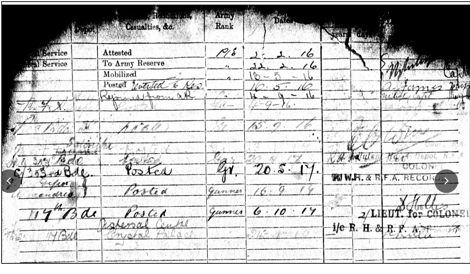
On 28 September 1918, David was granted fourteen days’ leave in the United Kingdom, travelling via Boulogne. This was during the final Allied offensives of the war, when the German Army was being pushed back but the fighting was not yet over.
David finally left the Army in January 1919, through a unit at Crystal Palace. His character was recorded as “Very Good”.
After the war, David initially returned to live with his parents in Kingston. In the 1921 Census, he was recorded as single and self-employed, working as a cycle agent from 3a Trumpington Street, Cambridge. That is an interesting post-war turn: from farm boy and artilleryman to a small-business or self-employed role connected with cycles, one of the important technologies of everyday mobility in the early twentieth century.
David later married Dorothy Edna Thompson. He died in 1951, aged 54, and is buried at St Mary’s, Guilden Morden.
George David Thompson’s story widens Kingston’s war beyond the Western Front. He served not only in France, but in Salonika and Egypt, passing through some of the lesser-known theatres of the conflict. His service record shows the Army as a vast imperial system, moving a young Kingston farm labourer to northern Greece, Alexandria, Marseilles and back through France before demobilisation. Because his papers survive, we can follow that movement unusually closely. What they cannot quite tell us is how those places felt to him: the heat and sickness of Salonika, the dislocation of Egypt, the return to France, or the journey back to Kingston and civilian life. But they do show a war that was much larger, geographically and administratively, than the trenches alone.