
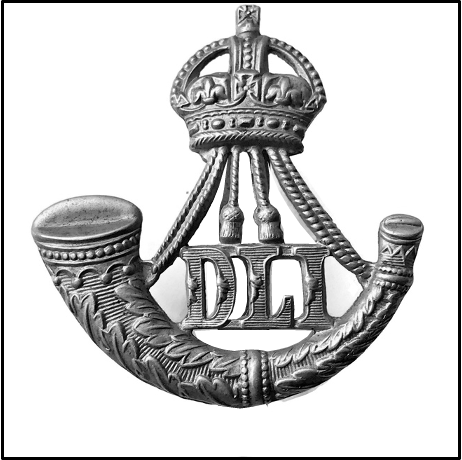
1/8th Durham Light Infantry
George William Ward was born in Kingston in about 1892. In the 1911 Census he is recorded as the eldest son of James Ward, a sewing machine agent, and Matilda Mary Anne Ward. The family by then, was then living in Leighton Buzzard.
The Ward family seems to have moved frequently. James Ward originally came from Henlow and Matilda from King’s Lynn. George was born in Kingston; the next child was born in Henlow; another in St Neots; three more in Hertford; and the youngest, Artemus, in Leighton Buzzard. George’s connection with Kingston was therefore by birth rather than long residence, but it is still a real one. He was one of those men whose early life touched the village before work and family movement carried him elsewhere.
By 1911, George was working as a machine minder in a printing works in Leighton Buzzard. This was skilled or semi-skilled industrial work, quite different from the farm labouring background of many other Kingston men.
George enlisted at Luton. At the time, he was living at Totternhoe, near Dunstable. He joined the Durham Light Infantry, with the service number 376440. This number comes from a Territorial Force block issued to the 27th DLI, consistent with the renumbering in early 1917. So again, this might mask prior service under an older service number. What we can say is that he was subsequently transferred to the 1/8th Battalion. The 1/8th was a Territorial battalion, part of the Northumbrian military tradition, but by this stage of the war men were often posted far from their home counties. The Army’s need for reinforcements had long since overridden the tidy local patterns of earlier recruiting.
We cannot therefore be sure whether George had been fighting in France with the 1/18th DLI for some time. What we do know from the Battalion records is that they had suffered severe losses in March 1918 and had been reinforced by 160 new soldiers on 5 April and another 105 on the 6 April. Many of these reinforcements were killed in action within a few days of their arrival in France.
George was killed on 9 April 1918, during the opening day of the Battle of the Lys. This was part of the German Spring Offensives, the last major attempt by Germany to break through on the Western Front. The attack began in Flanders, against a sector held in part by the Portuguese Expeditionary Corps. The Portuguese troops had been serving under British command and were holding a difficult part of the line after a long and exhausting period at the front.
Portugal had entered the war in 1916 and sent the Portuguese Expeditionary Corps to the Western Front. By 1917 and 1918, Portuguese troops were serving in Flanders under the British First Army. They were not incidental to the story. On 9 April 1918, they were in the path of a major German assault.
At 4 o’clock that morning, German forces opened their attack. The Portuguese sector was overwhelmed, and the breakthrough threatened to roll westwards towards Estaires and the crossings of the Rivers Lys and Lawe. The 151st Brigade of the 50th Northumbrian Division, including the 1/8th Durham Light Infantry, was moved rapidly into emergency defensive fighting.
The brigade had been in the Estaires–Merville area, preparing to relieve the Portuguese or move into the line, when the German assault began. Its task suddenly changed from routine movement to crisis response. Units were pushed forward under shellfire towards the river crossings and villages south of the Lys. The aim was simple and desperate: stop the German advance from breaking through Estaires and unhinging the wider British line.
George was very likely killed in the confused fighting around Estaires, La Gorgue, Lestrem, Pont Riqueul, Le Marais and the Lys and Lawe river crossings. Contemporary accounts of the 1/8th Durham Light Infantry place the battalion moving forward from billets under shellfire, first towards Lestrem on the River Lawe and then into the Pont Riqueul–Le Marais area as the situation worsened.
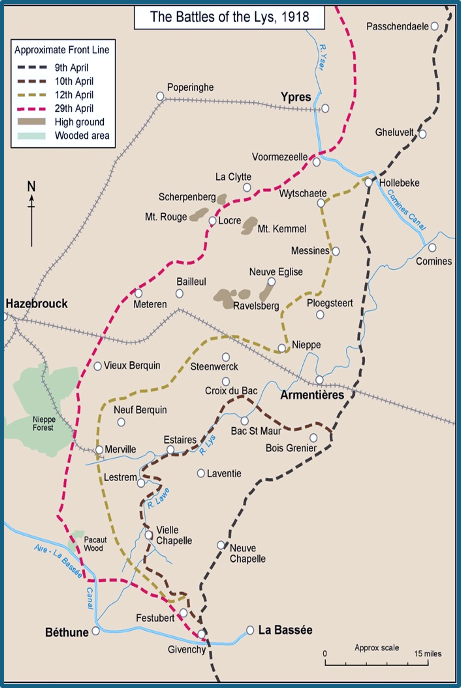
This was not a carefully staged attack with clear start lines and objectives. It was emergency defensive fighting, with units being fed into a collapsing front to slow or block the German advance.
For the men involved, the situation must have been bewildering. The spring fighting of 1918 was very different from the fixed trench warfare of earlier years. The front was moving. Messages were delayed or overtaken by events. Villages changed hands. Roads filled with troops, transport, refugees, guns and wounded men. Units found themselves defending improvised positions against German troops who had broken through elsewhere. In that sort of battle, a man could be killed without the record ever preserving exactly where he fell.
And perhaps that is the reason why George has no known grave. He is commemorated on the Ploegsteert Memorial, Addenda Panel 1, in Hainaut, Belgium. This means that his body was either not recovered or could not be identified. That is consistent with the nature of the fighting on 9 April 1918: rapid movement, heavy shellfire, German advance, British withdrawal and counter-positioning, and ground that could not always be searched afterwards.
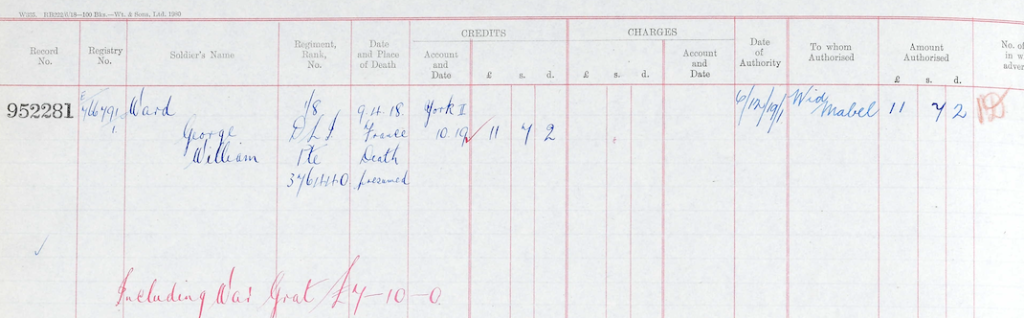
His effects record ‘death presumed’ and paid out his salary and gratuity to his widow, Mabel.
George William Ward’s Kingston story is brief, but his war story opens onto one of the most dangerous moments of 1918. Born in Kingston, raised through a family that moved across several counties, and later working in a printing works, he was eventually drawn into the Durham Light Infantry. He died not in a quiet local battalion, nor in one of the familiar early battles, but in the emergency fighting after the German attack on the Portuguese sector at the Lys. His name at Ploegsteert records both his death and the uncertainty around it: a man caught in a fast-moving battle, killed as British units tried to hold a line that was breaking under pressure.