
Royal Air Force
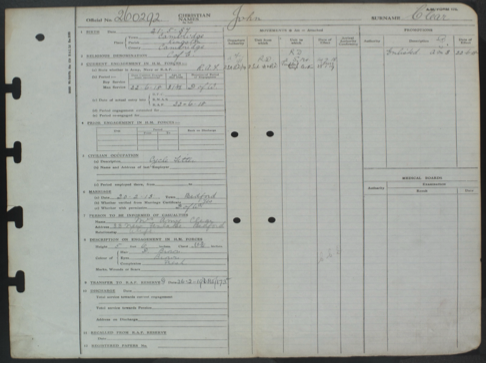
John Clear was born in Kingston on 21 May 1887. His parents were Samuel and Jane Clear, and he was the younger brother of Samuel Clear, who served with the Bedfordshire Yeomanry.
By the time of the 1911 Census, Samuel Clear senior had died, and the family had moved from Kingston to Bedford. John was recorded as 24 and working as a fitter for Raleigh bicycles. At first glance, that may sound like a peacetime trade far removed from the war. In fact, it was exactly the sort of practical mechanical skill that the armed forces increasingly needed. Many early aircraft manufacturers had connections with bicycle, motor or light engineering firms, and the new air services depended on men who understood metalwork, fitting, assembly, bearings, chains, wheels, tolerances and workshop discipline.
John joined the newly formed Royal Air Force on 22 June 1918, with the service number 260292. The date is striking. With hindsight, we know that the war had less than five months to run. The Allied Hundred Days Offensive would begin at Amiens on 8 August 1918, and the Armistice would follow on 11 November. From our distance, therefore, it might look as if John joined at a moment when the danger was already passing.
That was not how it would have appeared at the time. In the spring of 1918, Germany had launched a series of major offensives on the Western Front and had come alarmingly close to breaking through. Britain was still in a manpower crisis. In April 1918, the Military Service legislation had been tightened: the upper age limit for conscription was raised, and younger men could be sent overseas from the age of 18 years and 6 months if they had already had six months’ training. Those changes were not the actions of a country that believed the war was safely won. They were the actions of a country still urgently looking for men.
John was 31 in June 1918, so he was well within the military manpower net. It is therefore very likely that he was conscripted rather than a volunteer. And joining in the summer of 1918 still carried real uncertainty. A man enlisting then could not know that the war would be over by November. Training and posting took time, so the practical chance of a recruit reaching France before the Armistice was beginning to shrink, but that was not something John could rely on when he entered service.
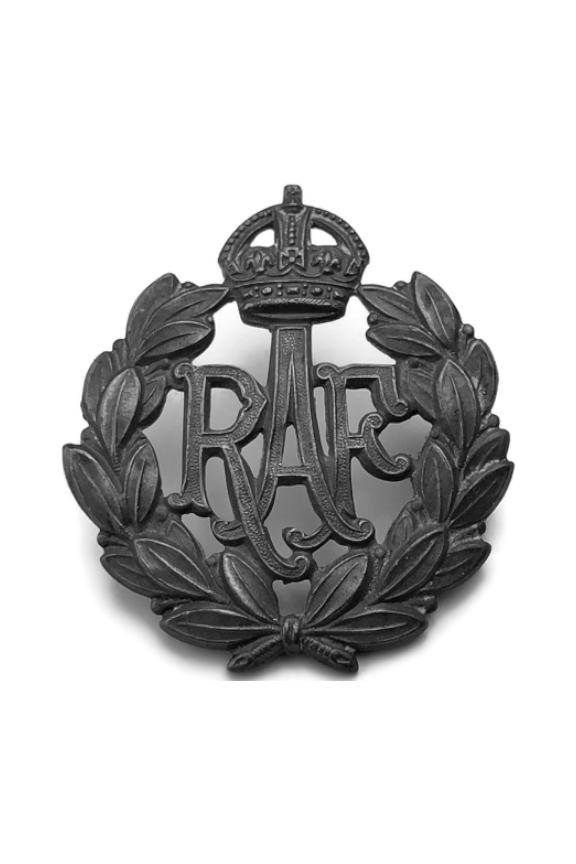
The Royal Air Force itself was only weeks old. It had been created on 1 April 1918 by merging the Royal Flying Corps and the Royal Naval Air Service. Although popular memory tends to picture early air war in terms of pilots, aircraft and aerial combat, the RAF depended just as heavily on ground staff. It needed fitters, mechanics, riggers, engine hands, armourers, clerks, drivers, storemen and many other trades. Aircraft were fragile, weather-sensitive machines, and keeping them flying required a large body of technically skilled men on the ground.
John’s civilian background therefore helps explain why he was taken into the RAF. “Fitter at Raleigh bicycles” sounds domestic only because bicycles now feel ordinary and unmilitary. In 1918 it meant engineering competence. Raleigh’s wartime work included military production, and the skills of a bicycle fitter sat close to those needed in aircraft maintenance and other mechanical work. John would have known how to assemble, adjust, repair and maintain machinery where small errors mattered.
There is no evidence that John served overseas, and his enlistment date makes it likely that he remained in Britain during the final months of the war. But that should not lead us to dismiss his service as somehow marginal. In 1918, the RAF was expanding rapidly, absorbing two earlier air services, and trying to build the administrative and technical systems of a modern air force while the war was still in progress. Men like John were part of that transformation and had no foresight that they were not going to serve in a war that had already cost so many lives.
John Clear’s story is therefore a quieter one than some of the Kingston men who served in the infantry or cavalry. He was not a teenage volunteer of 1914, nor a soldier sent to the Somme in 1916. He was a skilled working man in his early thirties, called into a new service at a moment when Britain still did not know how the war would end. Unusually for a Kingston man, his route into uniform ran through the workshop rather than the farm; from Kingston, to Bedford, to Raleigh bicycles, and then into the Royal Air Force in its first months of existence.