
11th Battalion, Suffolk Regiment
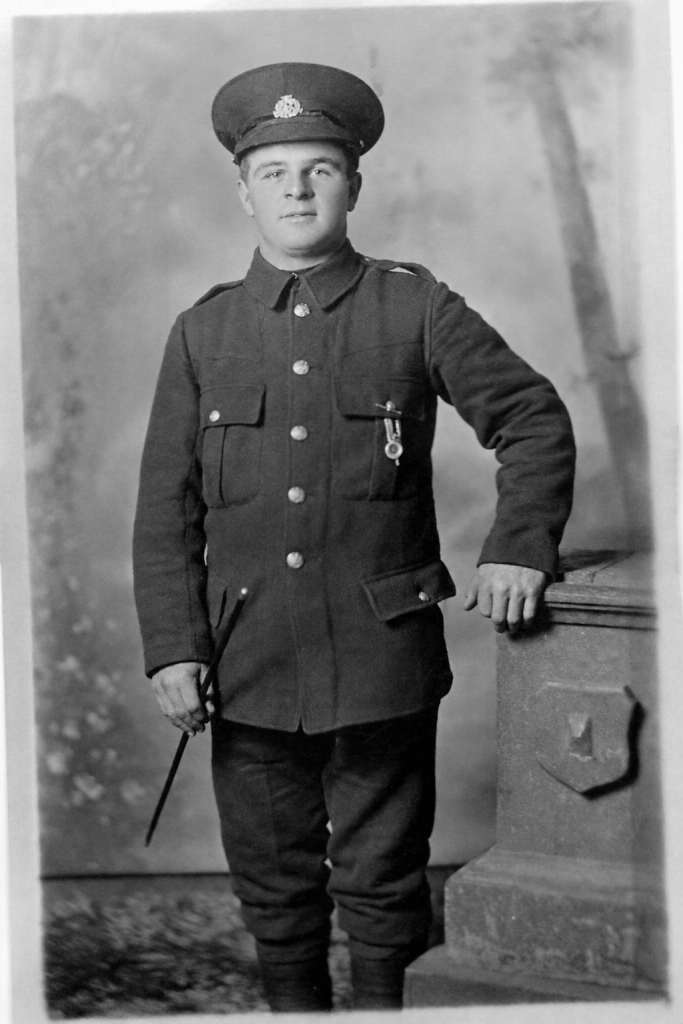
John Wayman was part of a large Kingston family living on the Green. He was born on 5 June 1896. By the time of the 1911 Census, the household included his father Mark Wayman, his mother Julia, née Allen, and several children: Thomas, aged 17; John, aged 14; Albert Mark, aged 11; William Edward, aged 10; Sydney, aged 8; Reginald, aged 5; and Charles, aged 2.
John was therefore 18 at the outbreak of war and just old enough to be drawn into the great recruiting wave of the autumn of 1914.
His service number, 15947, sits very close to Frank Jacklin’s 15940, and not far beyond the earlier group of Kingston recruits whose Suffolk Regiment numbers cluster between 15757 and 15770. This strongly suggests that Frank and John followed the others and enlisted together, probably in mid-November 1914.
The 11th (Service) Battalion, Suffolk Regiment was raised at Cambridge in September 1914 as part of Kitchener’s New Army. Often known as the Cambridge Suffolks, the battalion trained first in Cambridge, then at Ripon and finally on Salisbury Plain, before crossing to France in January 1916.
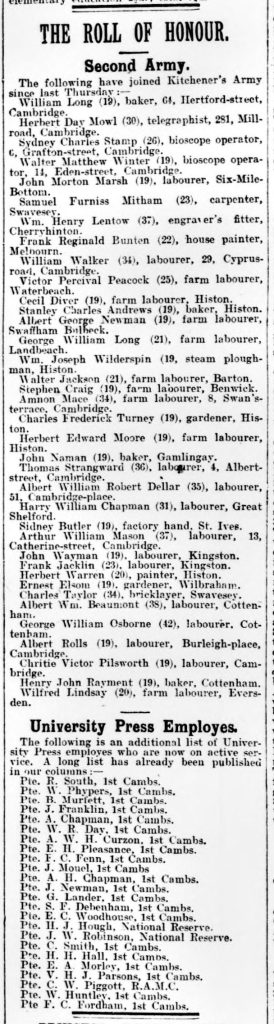
Very little of John’s individual service record survives. One of the few documents that can be attributed to him with certainty is the 1918 Absent Voters List, which records:
Wayman, John, The Green, 15947, Dvr, 11th Suffolks.
The description “Driver” initially appears surprising in an infantry battalion. In most First World War records, Driver is associated particularly with the Royal Field Artillery, Royal Horse Artillery, Army Service Corps and other mounted or transport units. However, infantry battalions also depended heavily upon horses and horse-drawn transport.
A battalion had to move ammunition, food, water, tools, baggage, medical equipment, travelling kitchens and other stores. Its establishment therefore included a Transport Officer and Transport Sergeant, together with men responsible for driving and caring for the battalion’s horses, carts and wagons. Battalion Headquarters had a substantial transport element, and individual companies also had drivers attached to them.
John was therefore probably serving with the 11th Suffolks’ transport unit rather than routinely as a rifleman in the front-line trenches. That did not place him outside the battle zone. Battalion transport operated between railheads, supply dumps, headquarters and forward positions, often under shellfire and sometimes very close to the fighting. What it probably did mean was that John was less likely than an infantry private to have been among the men routinely ordered over the top.
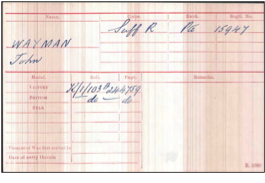
His medal records show that he received both the British War Medal and Victory Medal, confirming overseas service in a theatre of war after the end of 1915. This is entirely consistent with service in France with the 11th Suffolks from 1916 onwards.
The absence of a detailed surviving service record should not, however, be taken to mean that John had a quiet war. Potentially, quite the opposite.
Fourteen of the Kingston men identified in this research served in the Suffolk Regiment, 11 of them with the 11th Battalion. Their collective experience gives some indication of what John survived. Frank Allgood, Simon Jacklin, William Custance and Charles Custance were killed. William Custerson was hospitalised twice, as was Fred Lindsay. Motto Allgood, Ernest Jacklin, Joseph Chapman, Frank Jacklin and William Allgood were also wounded or injured. Apart from Frank Jacklin and Joseph Chapman, who were able to return to the Suffolks, and William Custerson, who later served with the Northamptonshire Regiment, these casualties generally set the men concerned on a path towards service with the Labour Corps or discharge through ill health or wounds. Payne Custerson and Joseph Chapman were both taken prisoner during the Battle of Estaires.
Against that background, John’s apparent continuity of service is striking. Of the Kingston Suffolk men identified so far, only Walter Rayner appears to have served uninterrupted through the war with the 8th and later 15th Battalions, while John Wayman appears to have remained with the 11th Suffolks throughout his active service.
The 11th Battalion suffered devastating losses during the war. A British infantry battalion at full establishment numbered roughly 1,000 men: about 30 officers and 970 other ranks, organised into a small Battalion Headquarters and four rifle companies.
Across the life of the 11th Suffolks, post-war figures suggest that 242 officers and 5,469 other ranks passed through the battalion. In other words, more than five complete battalion-strengths of other ranks passed through a unit which could contain only about 1,000 men at any one time. Of these, 43 officers and 915 other ranks died; a further 100 officers and 2,525 other ranks were wounded; and nine officers and 163 other ranks were taken prisoner.
No equivalent figure has yet been found identifying how many of the original 11th Battalion men remained with it throughout the war. However, the scale of attrition elsewhere in the regiment gives some indication of how unusual such continuity could be: the 2nd Battalion of the Suffolks only seven men who served continuously throughout the entire war. That makes John Wayman’s service remarkable even though we have lost the detail.
John returned to Kingston after the war. In 1921 he was again living with his family on the Green and was still working with horses, employed by Mr Ingle at Longstowe. He died in 1980.
John Wayman’s story remains, in documentary terms, little more than a sketch. Yet the very sparseness of his surviving record risks concealing what may be one of the most remarkable wartime experiences among the Kingston men. If, as the evidence suggests, he joined the 11th Suffolks with the early Kingston recruits and remained with the battalion throughout its wartime service, John experienced almost the whole fighting history of one of the hardest-used battalions of the Suffolk Regiment. Across nearly three years in France, the 11th Suffolks were involved in more than twenty significant actions and battles.
As a Driver he may not usually have been among the riflemen going over the top, but he lived and worked alongside them as the battalion moved from battle to battle. He would have experienced the disappearance of familiar faces through wounds, death and capture, the continual arrival of replacements, and the rebuilding of the battalion after each major loss.
For John, those losses were not merely names on a battalion casualty return. Among the men passing through the same unit were nine others from his own small village. Some were killed, some wounded, some captured and some eventually sent elsewhere. John Wayman appears to have been one of the very few who simply remained. His surviving paperwork tells us remarkably little about what he saw. The history of the battalion tells us rather more.