
Queen’s Own Royal West Kent Regiment; 20th London Regiment
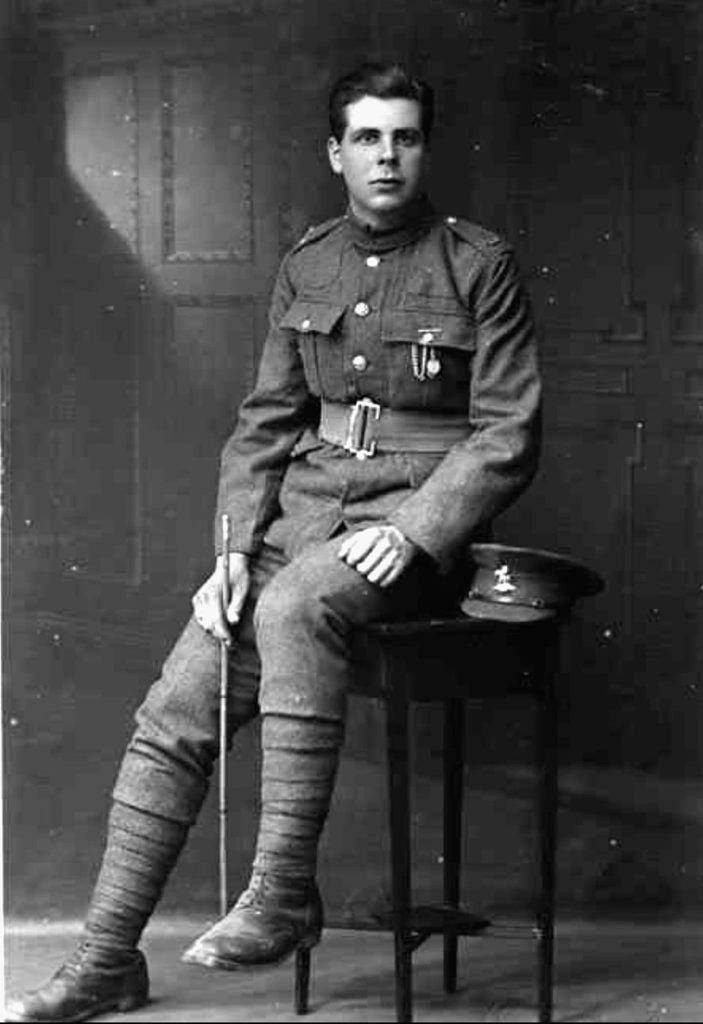
Joseph Charles Reed was born on 3 April 1899 at the Woodyard, Wimpole, and baptised at Wimpole on 27 August 1899. His parents were Alfred Charles Reed and Kitty Reed, née Wayman.
The Reed family moved around before settling in Kingston. Joseph’s older brother Henry John had been born in 1895, and Herbert followed in 1901. Eleanor, known as Nelly, was born in 1903; Alfred in 1906; and Kitty, known as Tots, in 1907. By the time Edward James was born in 1909, the family had moved to Kingston.
In the 1911 Census, Joseph was aged 11 and living with his family at Eversden Woods. This places the Reeds in the same rural working world as many of the other Kingston families: farm work, woodland, estate labour, and movement between villages and larger landholdings.
Joseph was too young to serve at the beginning of the war. When Britain entered the conflict in August 1914, he was only fifteen. His service therefore belongs to the later wartime intake, when boys who had been too young in 1914 were reaching military age and being drawn into the Army.
His attestation papers show that he enlisted at Bury St Edmunds on 11 June 1918, aged 19 years and 2 months. He asked to join the Royal Field Artillery, but the Army had other plans. Instead, he was posted to the 3rd Battalion, Queen’s Own Royal West Kent Regiment, with the service number G/41911.
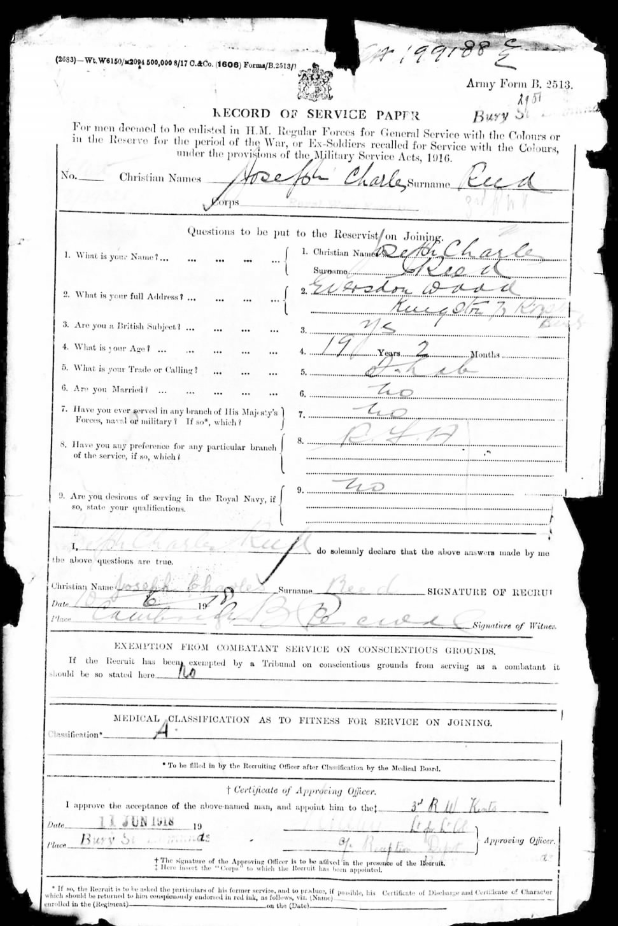
This was not unusual. Men could express a preference, but by 1918 the Army’s priority was to send recruits where they were needed. The war had become a vast system of replacement and redistribution. A young man might hope to serve in the artillery, but if infantry drafts were short, infantry was where he would go.
The 3rd Royal West Kents was a reserve battalion. This means Joseph was not first sent directly to a front-line fighting battalion. Reserve battalions trained men, held them while they were assessed, and supplied drafts to active units overseas. For a recruit in June 1918, this was the normal route into wartime service: enlistment, training, posting, and then, if the war still required it, overseas deployment.
Joseph was later transferred to the 20th London Regiment, with the service number 635127. The 20th London Regiment was a Territorial Force unit, formally the 20th Battalion, London Regiment, associated with Blackheath and Woolwich. The Army was less concerned with preserving a man’s original recruiting preference or county association, and more concerned with reinforcing units that needed men.
Joseph served with the British Expeditionary Force from 4 October 1918 to 6 November 1919. This means he reached France only in the final weeks of the war. The Armistice would come on 11 November 1918, barely five weeks after Joseph arrived overseas. But Joseph and his family could not have known that when he was sent. In October 1918, the Allied armies were advancing, but the fighting was not yet over. The German Army was retreating, but it was still dangerous. Men were still being killed and wounded in the final weeks of the war. For a young soldier newly arrived from training, the end of the conflict was not a certainty; it was only something later generations could see clearly.
Joseph’s overseas service continued for almost a year after the Armistice. He remained with the British Expeditionary Force until 6 November 1919 and returned to Britain on 7 November. He appears to have left the Army on or around 6 December 1919. This long post-Armistice service is a reminder that the war did not simply stop for soldiers when the guns fell silent. Men still had to be held, moved, administered, demobilised and brought home. Some units remained overseas for occupation duties, labour, guarding, transport, stores work and the gradual winding down of the military machine.
Joseph therefore belongs to a rather different group from the Kingston men who enlisted in 1914 and 1915. He was one of the youngest men drawn into service, old enough to be sent overseas only in the last months of the war. He did not experience the Somme or the long attrition of 1916 and 1917. His war was the war of 1918: hurried training, late reinforcement, the final advance, and then a prolonged wait for demobilisation.
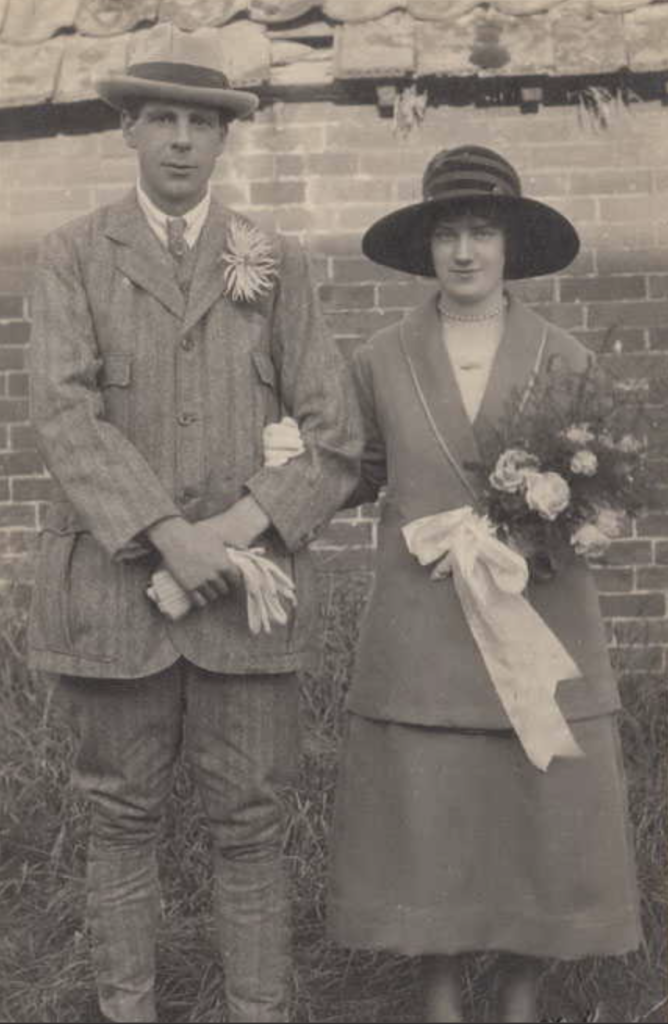
After the war, Joseph married Rose Hannah Beale on 27 September 1924 at St John the Baptist, Royston. Their family moved through several counties over the following years. Alfred John Reed was born at Oakham, Rutland on 23 July 1925. Peter William was born at Broxbourne, Hertfordshire, on 14 November 1926. Kathleen Mary followed at Oakham on 24 October 1928, Harold Desmond on 9 November 1930, and Jessie Violet on 12 July 1932. Albert was born on 28 September 1938 at Ownham, Berkshire.
Joseph died on 22 November 1974 at Eastfields, Blewbury, Berkshire. He was 75.
Joseph Charles Reed’s story is a late-war story, and for that reason it can seem less dramatic than some of the others. But it shows another edge of the same conflict. He was a Kingston boy, too young for the first years of war, who was finally taken into the Army in June 1918. He asked for the artillery, was sent first to the Royal West Kents, then to the 20th London Regiment, and reached France just weeks before the Armistice. His service reminds us that the war was still drawing in new nineteen-year-olds almost to the end, and that even after peace came, the Army held on to men for months before civilian life could properly resume.