
5th Rifles; Labour Corps
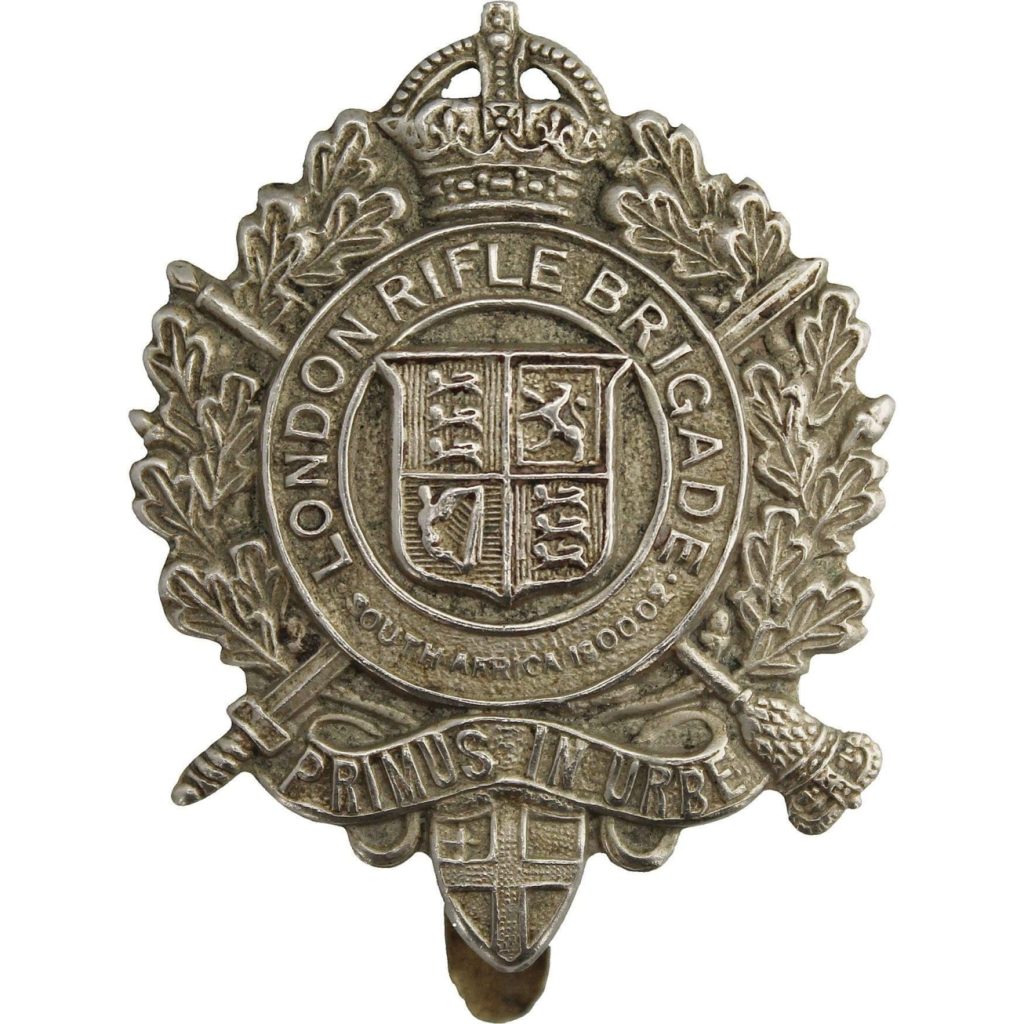
Percy John Chamberlain was born in Kingston on 23 June 1882, the son of John and Sarah Ann Chamberlain, née Wayman. He was christened in Kingston church in December of the same year. His father had been born in Stevenage, while his mother came from the Kingston Wayman family. They had married in Kingston on Christmas Day 1880.
By 1885, the Chamberlains had moved to Great Eversden, where their daughter Florence was born. Census records confirm that they were still living there in 1891.
Sometime between 1896 and 1901, the family moved to 3 Swan’s Yard in Trumpington. John was working as a horse keeper on a farm in Guilden Morden, while Percy, aged 18, and his older brother Alfred were both recorded as general labourers.

On 14 April 1906, Percy, aged 23, married Eliza Howard, aged 18, in Trumpington parish church. His occupation on the marriage certificate was given as gardener.
By the 1911 Census, Percy was 28 and Eliza 22. They had four children: Percy George, aged four; Richard Charles, two; Arthur Frederick, one; and Philip John, just one month old. The family lived in Mill Road, Trumpington, and Percy worked as a gas lighter, lighting the streetlamps each evening and extinguishing them afterwards. Another son, Henry Francis, was born in 1913.
Percy’s service record has not survived, but his discharge papers provide a fairly detailed account of his time in the Army. His experience appears to reflect the deferred service arrangements of the Derby Scheme. He attested on 11 December 1915 and was immediately placed in the Reserve, so he had committed himself to serve but returned home to continue his civilian life until called upon.
For Percy, that call did not come until May 1918, almost two and a half years later. At a medical examination in Cambridge on 16 May, the loss of several teeth was noted, but he was otherwise passed fit. A further examination on 17 June appears to have produced a more cautious assessment. The reason is not entirely clear, but he was assigned the medical category B1 which suggests he was not considered fit for frontline service. He was posted to the 5th Battalion, Rifle Brigade, with the service number 51784.
Percy was approaching his 36th birthday when he was called up. He was sent to Falmouth for training but soon began to experience physical difficulties. A later medical report, dated 9 September 1918, recorded
“At Falmouth felt pains in upper limbs (states was under canvas). Similar pain at time since. Never overseas or in hosp. C/o occ pain in elbow and shoulders. C/o Lumbago on entry. Exam. Urine shady, no albumin. No wasting of limbs, no grating in joints periventricular weakening L elbow: looks well. Disability and slight chr Rheumatism of L elbow”.
The report stated that he had never served overseas or been admitted to hospital.
On 25 August 1918, Percy was transferred from the Rifle Brigade to the 691st Agricultural Company of the Labour Corps, based at Bury St Edmunds. His military service thus moved from infantry training to agricultural work.
In November 1918, Eliza died, leaving five young sons and a daughter, all under the age of 13. Percy’s discharge paperwork lists the children and records that their mother was dead. It also suggests that Eliza’s sister, Miss A. V. Howard, stepped in to care for them in Trumpington while Percy remained in the army. However, being a widower with children was an exemption to military service and may have expedited Percy’s discharge.
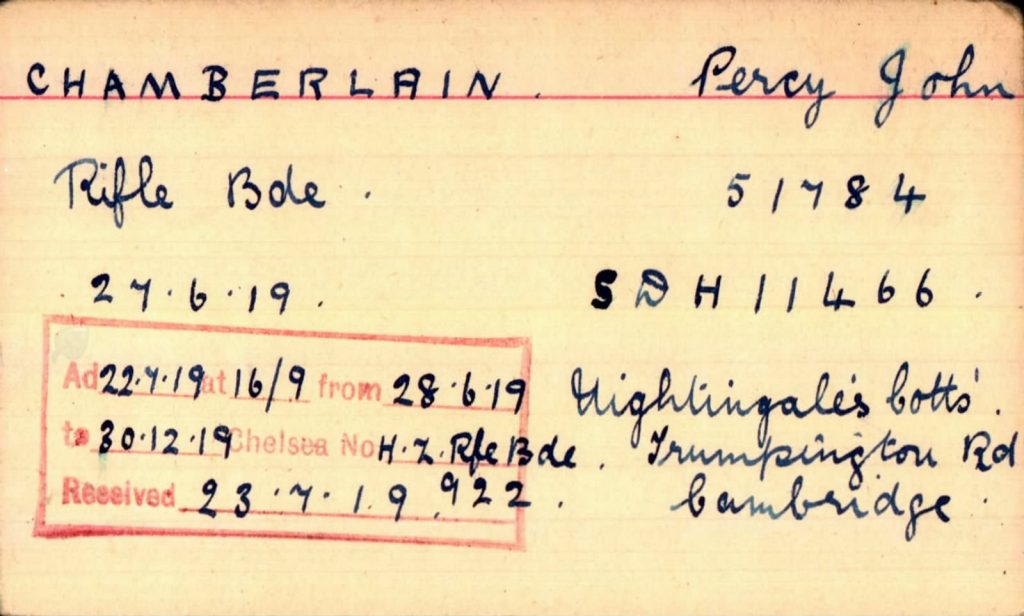
Percy was discharged from the Army on 26 June 1919. He received a gratuity of £5 and a small disability pension for one year.
On 17 May 1920, he married Mercy Metcalfe, née Gillett, herself a widow, in Trumpington church. They had a son, Peter Chamberlain, born on 1 January 1926.
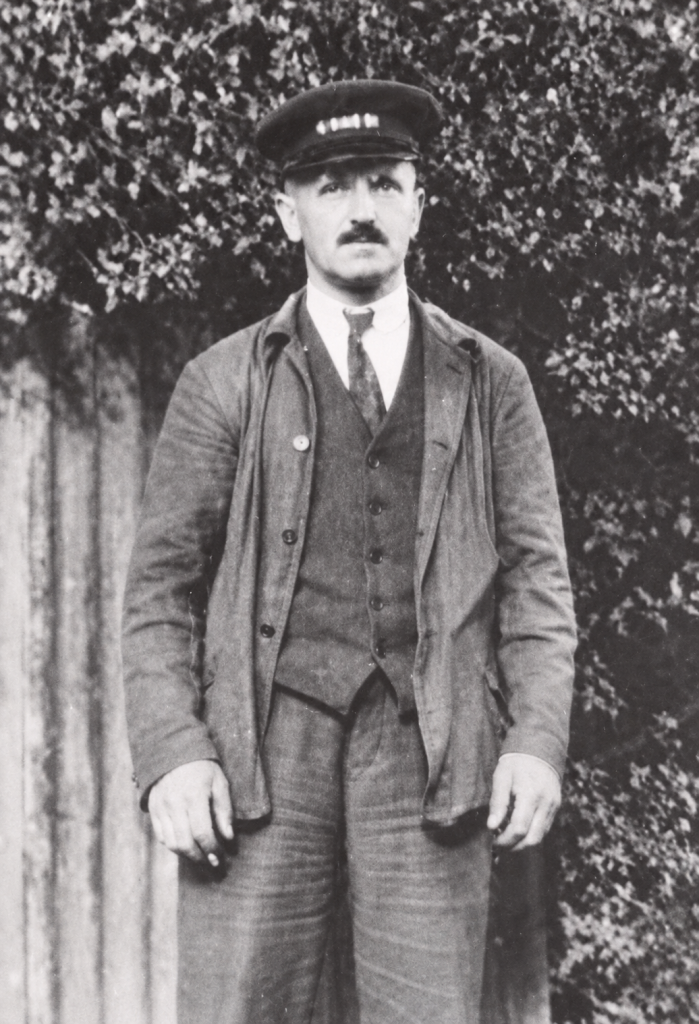
The 1939 Register still recorded Percy’s occupation as lamplighter. By then, he and Mercy were living at 6 North Cottages on Trumpington Road, where the accompanying photograph was taken.
Percy died in the spring of 1952, aged 69, just a few months after Mercy. He was still living at 6 North Cottages and is buried in Trumpington.
Percy Chamberlain attested in December 1915 but remained in the Reserve until he was called up in May 1918. He served first with the 5th Battalion, Rifle Brigade, under the number 51784, before transferring to the 691st Agricultural Company of the Labour Corps in August 1918. His surviving papers record service at home, with no overseas service, and persistent pain that was assessed as rheumatism of the left elbow. He left the army in June 1919 and received a temporary disability pension. His story shows another side of wartime service: a man called from civilian work late in the conflict, whose health limited his military duties and whose family suffered a profound loss while he was still serving.