
Army Ordnance Corps
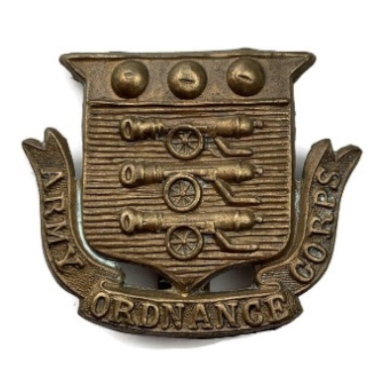
Richard Jacklin was born in Kingston on 18 September 1886. He was one of three Jacklin brothers who served during the First World War: the younger brother of Simon Jacklin and the older brother of Frank Jacklin.
The Jacklins were a large Kingston family. In the 1891 Census they were living in Tinkers Lane, where Richard was recorded as a child of four. His older brothers included Simon, who would later serve as a Sergeant in the 11th Suffolks and be killed on the first day of the Battle of the Somme. Frank, the youngest of the three soldier brothers, was only one month old at the time of that census.
Richard’s own military record is much thinner than Simon’s, but his service number gives an important clue. He served in the Army Ordnance Corps with the number O/24871. The “O” prefix was used by the Army Ordnance Corps, and in this context points towards ordnance service rather than more routine stores and supplies work, though, as with so much First World War numbering, it was not always applied with perfect consistency.
The Army Ordnance Corps was one of the less visible but essential parts of the wartime Army. Its work concerned the supply, storage, inspection, maintenance and issue of weapons, ammunition, equipment and military stores. In a war dominated by artillery, machine guns, rifles, shells, grenades, tools, spare parts, transport equipment and repair systems, this was not background work in any trivial sense.
The Army Ordnance Corps was part of the great hidden machinery of war. Infantry battalions appear more often in village histories because their war diaries, battles and casualty lists are easier to report and follow. Ordnance men are much harder to trace. They were often serving in depots, workshops, store sections and lines-of-communication units rather than in named battalions with a strong identity. But without them, the army could not fight. Rifles needed ammunition. Guns needed shells. Units needed tools, spare parts, wagons, harness, signalling equipment, clothing, repair materials and replacements for almost everything that wore out, broke, exploded, sank into mud or was lost in retreat.
The First World War massively expanded Britain’s ordnance system. The Western Front consumed material on an almost unimaginable scale, and that meant building vast storage and distribution networks in Britain and overseas. Ammunition and stores had to be received, checked, accounted for, stored safely, moved by rail, road, ship and horse transport, and delivered forward in quantities no pre-war Army had been designed to handle.
Richard may well have served in Britain at an army supply or ordnance depot, helping maintain the flow of weapons and ammunition to the army overseas. But his medal card awards him both the Victory and British War medals, indicates overseas service, though not prior to 1916.
The Corps was not yet “Royal” when Richard first served. The Army Ordnance Corps and Army Ordnance Department were reorganised at the end of the war, and the Royal Logistic Corps’ own history records that the “Royal” prefix was granted in recognition of First World War service, creating the Royal Army Ordnance Corps. Medal cards could later use the Royal title because medals were often issued or administratively processed after the change. That can make a man appear to have served in the Royal Army Ordnance Corps even when, during the war itself, he would have known it as the Army Ordnance Corps.
Before the war, Richard had married Sarah Mills Randall in Kingston on 25 September 1913. Their family life had already begun by the time war came. Their first daughter, Joyce Mary, was born in 1912. Thora followed on 19 July 1914 in Kingston, only weeks before Britain entered the war. A third daughter, Joan, was born on 6 February 1917, while Richard was of military age and probably already in, or soon to be drawn into, wartime service. Richard left the Army and moved to the Reserve on 12 June 1919.
In the 1921 Census, Richard was back in Kingston and working as a farm foreman for R. Ingle Ltd. That post-war occupation is worth noting. A farm foreman was not simply a labourer; he carried responsibility for organising work, supervising others and keeping the practical rhythm of a farm going. Whether or not his ordnance service developed those habits, the two roles sit naturally together: careful handling of supplies, tools, men, timings and responsibilities.
Richard died in 1964.
Richard Jacklin’s war is harder to narrate than Simon’s, because it does not attach itself to one famous day or a battlefield or Regiment. But that should not make it disappear. He served in the Army Ordnance Corps; part of the immense supply and equipment system that made the British Army function. His work was probably concerned with weapons, ammunition or equipment rather than direct front-line infantry fighting. It was the sort of service that rarely produces dramatic stories, but without which the dramatic stories could not have happened. For Kingston, Richard’s entry also completes the picture of the three Jacklin brothers: Simon killed at the Somme, Richard serving in the Army’s ordnance system, and Frank on the front line, working his way through promotions in the 11th Suffolks.