
Cambridgeshire Regiment; Labour Corps; Royal Fusiliers
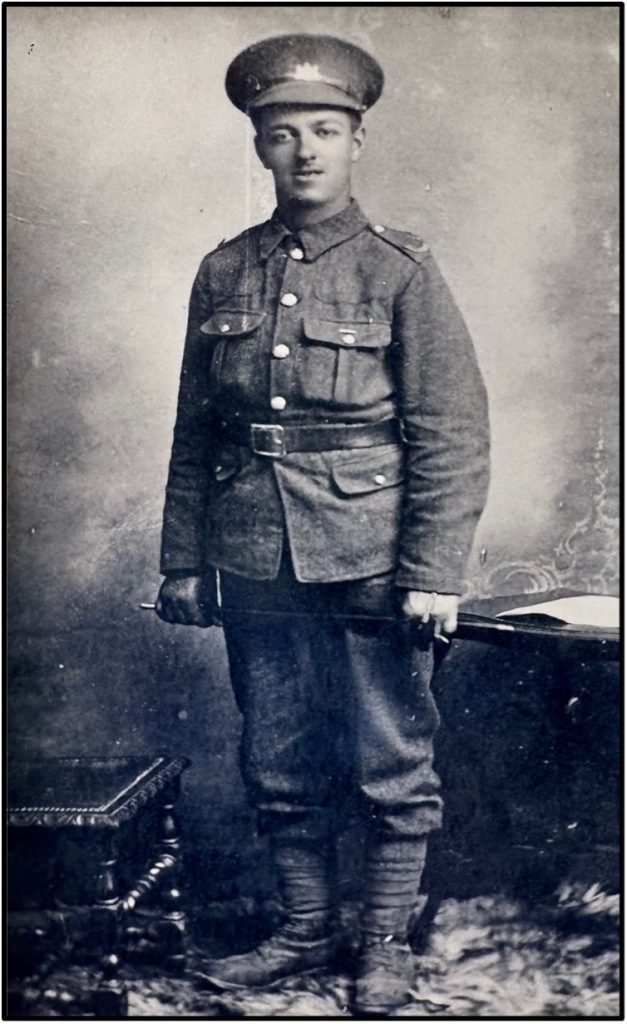
Samuel Amos Jacklin Blows was born on 23 September 1894 and christened on 27 February 1895. At the time of the 1901 Census, Samuel was six years old and living with his grandparents, James and Emily Blows, on the Green in Kingston. James Blows was recorded as a self-employed rag and bone dealer. Samuel’s mother was not listed in the household, and no other immediate family members were recorded there.
The family arrangements are not entirely clear. Samuel’s father was Amos Jacklin, and his mother was Charlotte Blows. Samuel was their eldest child, but Amos and Charlotte did not marry until January 1896, around 16 months after Samuel’s birth. They went on to have six more children together: Ernest, born in 1899; William, born in 1902; Sarah Emily, born around 1906; Winefrid, born around 1907; Sidney, born around 1910; and Primrose, born on 23 April 1916. The family lived first in Knapwell and later in Toft. Samuel, however, seems to have remained with his grandparents in Kingston.
By the 1911 Census, Samuel was still living with his grandparents. He was then sixteen and working as a stockman.
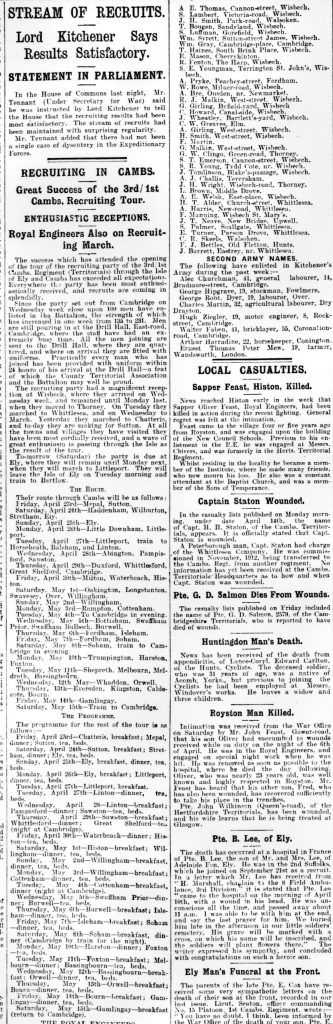
Samuel first served as a private in the Cambridgeshire Regiment, with the service number 3558. That number suggests that he enlisted in the first few weeks of April 1915, during the rapid expansion of the Army under Lord Kitchener’s recruitment programme. Like many local men, he entered a county regiment whose identity would have been familiar and close to home. However, the Cambridgeshire Regiment was not the same until as the 11th (Cambridgeshire) Battalion of the Suffolks, which many other village men joined.
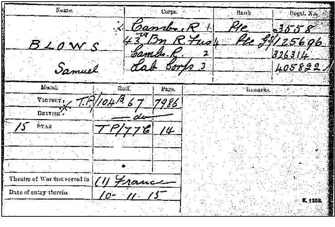
Only the 1/1st Battalion of the Cambridgeshire Regiment served overseas during the war. The other Cambridgeshire battalions remained in Britain as reserve and training units. Samuel probably spent most of 1915 training in Britain before being sent to France. His medal record shows that he arrived in France on 10 November 1915. This entitled him to the 1914–15 Star, as well as the British War Medal and the Victory Medal. The award of the 1914–15 Star confirms that he saw active overseas service before the end of 1915.
Samuel’s arrival in France coincided with a period when the 1/1st Cambridgeshire’s were briefly used away from the front line. The battalion was transferred to VII Corps and became a training battalion at the Third Army School at Flixecourt. This was not, however, a permanent move into a rear-area role. By 29 February 1916 the battalion had returned to the fighting order of battle, joining 118th Brigade in the 39th Division.
During 1916, the 1/1st Cambridgeshire’s served on the Somme with the 39th Division. The division’s engagements included Thiepval, the Ancre Heights, the capture of Schwaben Redoubt and Stuff Trench, and the Battle of the Ancre. The Cambridgeshire’s are particularly associated with the fighting around Schwaben Redoubt in October 1916. One account records that troops of the 4th/5th Black Watch, the 1/1st Cambridgeshire’s and the 17th King’s Royal Rifle Corps helped capture the redoubt, and the German counterattacks, including flamethrower detachments, were beaten off.
The Battalion was also involved in the Battle of the Ancre on 13–14 November 1916. In that attack, 118th Brigade formed up outside Schwaben Redoubt. The Hertfordshire Regiment advanced on the right. Two companies of the Cambridgeshire’s initially lost direction, but reorganised and helped take parts of Mill Trench, the station crossing and Beaucourt Mill early in the day. Samuel’s service was likely to have brought him into these actions.
In 1917, still with 118th Brigade in the 39th Division, the battalion served during the Third Battle of Ypres. The division’s listed engagements that year included Pilckem Ridge, Langemarck, Menin Road Ridge, Polygon Wood and Second Passchendaele. The best-known Cambridgeshire episode from 1917 appears to have been at Passchendaele, where C Company was credited with an important part in capturing a boiler house and then refusing to fall back under counterattack.
This is where the limits of surviving records begin to matter. Without a personal diary, letters, a surviving service record, or a first-hand account, it is impossible to know exactly what Samuel himself saw or did in these actions. The surviving evidence is mostly administrative: service numbers, unit transfers, medal entitlement and later records. Such records tell us where the army placed him, but not what he felt, feared, endured or remembered. Even so, they place him in a battalion that was heavily engaged during some of the most severe fighting of 1916 and 1917.
In 1917, Samuel was renumbered as 326314 during the army-wide change in Territorial Force service numbers. This took effect around March and April 1917. At some point after that, he transferred to the Labour Corps and was given a new service number, 405822.
The Labour Corps was created to provide the Army with organised labour for the vast physical work required behind the lines and in support of the front. It included many men who had been medically downgraded: soldiers recovering from wounds or illness, or no longer considered fit for front-line infantry service, but still fit enough for military work. Samuel’s Labour Corps number comes from a block issued between September and November 1917. That timing suggests, though it does not prove, that he may have been wounded or become ill in late spring or summer 1917 and was then reclassified as unfit for front-line infantry duty.
Samuel later moved again, this time to the 43rd Battalion of the Royal Fusiliers, with the service number GS/125696. The “GS” stood for General Service and was used for men renumbered when they changed units. The 43rd Battalion was formed only at the end of May 1918, which gives a further marker in Samuel’s wartime chronology. It was created from Nos. 1 and 46 Garrison Guard Companies, which had previously been Labour Corps units. Samuel may already have been serving in one of these units before the transfer.
The 43rd Royal Fusiliers was used for guard duties at Army headquarters and along key lines of communication. This was not front-line infantry work in the same sense as the Somme or Ypres, but it was still part of the military system that held the British Army together in France: headquarters, supply routes, railways, stores, roads, depots and communications.
In July 1918, while still serving, Samuel married Maggie Lindsay. Maggie had been born in Kingston on 14 October 1896.
Samuel survived the war. By the time of the 1921 Census, Samuel and Maggie were living in Kingston. Samuel was then a private in the 5th Huntingdon Battalion of the Defence Force. He was stationed at Huntingdon but was home on leave when the census was taken.
In late 1923, Samuel and Maggie left England and emigrated to Australia. A passenger record lists Mr S. A. J. Blows and Mrs M. J. Blows, of Little Chadacre, Shimpling, Suffolk, travelling third class on the Ormuz, a ship of the Orient Steamship Line. Samuel was described as a farm labourer, aged 28, and Maggie. as a housewife, aged 26. They landed at Fremantle, Western Australia, on 5 January 1924. There is a slight discrepancy in their recorded ages, one year younger on the ship’s records, but the combination of initials and the uncommon surname strongly suggest that this is the same couple.
Samuel Blows appears in electoral registers in Western Australia in the 1930s. His surname appears there in the hyphenated or altered form “Jacklin-Blowes”, which may reflect a later personal choice, a clerical variation, or an attempt to preserve both sides of his parentage. On 30 January 1943, Kevin Blows was born in Perth, Western Australia. Kevin’s mother was recorded as Mabel Christina Mary Jones, also known as McPherson.
Samuel died on 13 August 1968, aged 73, and was buried in Karrakatta Cemetery, Karrakatta, in the City of Nedlands, Western Australia.
Samuel Blows’s story is one of movement: between households, between names, between units, and eventually between continents. He was born in Kingston and raised by his grandparents on the Green, while his parents built another family elsewhere. He entered the Cambridgeshire Regiment as a young man and served overseas from November 1915. His battalion was involved in some of the hardest fighting on the Somme and at Ypres, though the surviving records do not allow us to place Samuel in any one trench, attack or company with certainty. Later, his transfer to the Labour Corps and then to the Royal Fusiliers suggests a soldier whose usefulness to the Army continued after he was no longer serving as a front-line infantryman. After the war, he returned briefly to Kingston life before beginning again in Western Australia.
Research note
The 1918 and 1919 Absent Voters records list Samuel under his Royal Fusiliers service number but appear to place him in the RGA, the Royal Garrison Artillery. The recorded service number is not compatible with the numbering format used by the Royal Garrison Artillery, but it does fit the Royal Fusiliers. The most likely explanation is a clerical error during the electoral roll process, or a misunderstanding in how his family reported his unit to the authorities collecting parish data. Given Samuel’s wartime movements, and the difficulty of communication between soldiers overseas and families at home, such a mistake would be unsurprising. It is also possible that he was guarding an RGA headquarters or installation, which may have contributed to the confusion.