
Possibly the Volunteer Training Corps
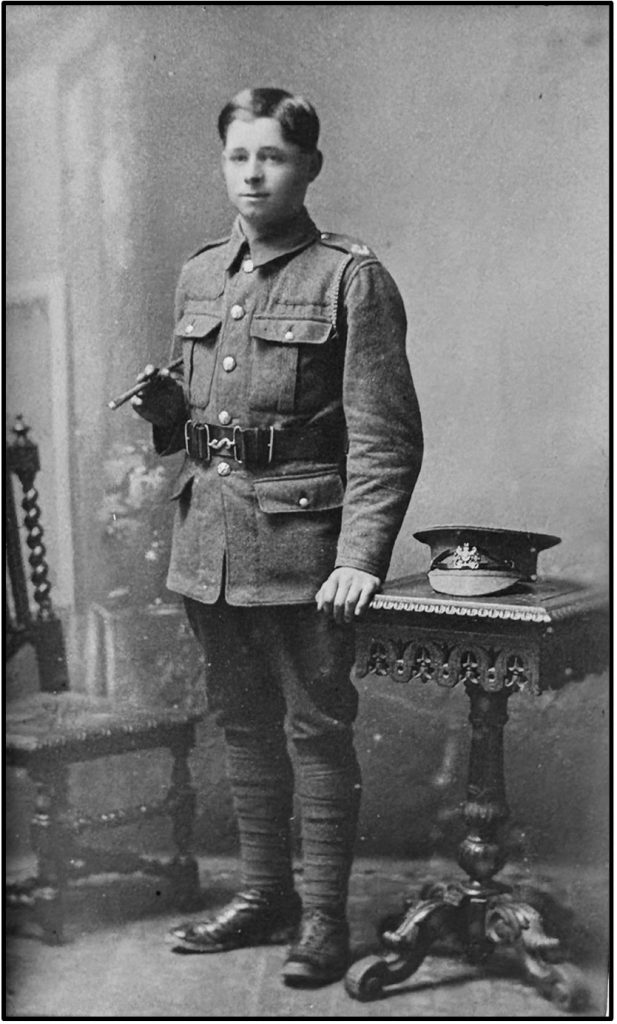
Sidney Thomas Chapman was the younger brother of Joseph Chapman and Frank Allgood. He was born in Kingston on 31 December 1899.
That date immediately raises questions. If Sidney was born at the very end of 1899, he could just about have served but only in the final months of the war, and only under particular conditions. In April 1918, because of the severe manpower crisis, the minimum age for overseas service was lowered to 18 years and 6 months, provided the man had already been in the Army for six months. Sidney would therefore technically have been old enough to serve overseas only from July 1918 onwards.
That is the tidy administrative answer. The human answer may be rather less tidy. Army administration was imperfect, and under-age enlistment was not rare. Young men who were determined to join could give a false age at attestation, and there was no systematic requirement to prove either age or identity. If a boy looked close enough, sounded confident enough, and stuck to his story, he might get through.
In the photograph Sidney looks very young though. One might wonder whether his enlistment, or attempted enlistment, was prompted by the death of his older brother Frank Allgood on 1 July 1916, the first day of the Battle of the Somme. If so, Sidney would have been only sixteen. It is impossible to prove motive, but the timing and family circumstances, and the visible youth of this picture, make the question hard to avoid.
The difficulty in researching Sidney has been that there were many men named Sidney Chapman, Sydney Chapman, or Sydney T. Chapman in First World War military records. Sidney Thomas Chapman of Kingston could not have used his true date of birth if he enlisted before he was legally old enough. That makes the search harder. A false age, an abbreviated name, a missing middle initial, or a later transfer to another unit can all make him vanish into the records.
The photograph provides some help, though not enough to settle the matter. Sidney’s cap badge does not appear to be that of a standard infantry regiment. Instead, it seems to be a version of the Royal Arms badge, which was used at different times by several Army organisations. For the First World War, three possibilities seem relevant.
The first is the Army Service Corps. The Army Service Corps was the Army’s vast logistics organisation. It handled supply, transport, food, forage, equipment, mechanical transport, horse transport and much else besides. A young or under-age soldier could plausibly have been kept in such a corps, especially in a home-service role, until he was old enough for other duties. If Sidney had served in the Army Service Corps, the key evidence would be his service number. ASC numbers often included prefixes showing whether a man worked in mechanical transport, horse transport, supply, remounts or another branch.
Unfortunately, no convincing record has yet been found for a Sidney Thomas Chapman, or a likely variant, enlisting in or near Cambridge from 1916 onwards. The absence of a military record is significant. Searches under Sidney Chapman, Sydney Chapman, Sidney T. Chapman, Sydney T. Chapman, Thomas Sidney Chapman, and even less likely combinations such as Frank Sidney or Sidney Frank have not produced a convincing match. Searches have also been narrowed to records with some geographical link to Cambridge, Bedford, Luton or nearby recruiting areas, and to enlistments from 1916 onwards. That restriction matters because Sidney would have been much too young to pass as eighteen in the earlier years of the war. Even allowing for a bold lie, there are limits to what a recruiting sergeant might overlook. So, it looks unlikely that Sidney served in France during the war.
The second possibility is the General Service Corps, or something close to it in function. This is more complicated. The General Service Corps was not a normal First World War unit in the way that the Suffolk Regiment or Army Service Corps was. The familiar Royal Arms cap badge was used by various holding, training and reserve arrangements before men were allocated to their final units, but the General Service Corps itself was not formally established until the Second World War. If Sidney was wearing this kind of badge during the First World War, it may suggest that he was still in training, or in some temporary non-regimental status. In that case his shoulder badges might have read “TR”, for Training Reserve, but the photograph is not clear enough to confirm this.
This leads to a cautious but possible conclusion. Sidney may have been one of those under-age boys who entered the Army, or tried to, but were held back in Britain until they were old enough for overseas service. During the war, there seems to have been a kind of informal compromise around such boys. If they were clearly far too young, they might be discharged. If they were close to military age, physically useful, and determined to serve, they might be retained in training units, reserve units, or support roles rather than sent immediately to the front. That could explain why Sidney appears in uniform, but why no firm medal record or overseas service record has been found.
The third option is perhaps the most plausible though. The Volunteer Training Corps (VTC) was a voluntary home defence militia which was the First World War equivalent of the Home Guard. When war was declared in August 1914, there was an immediate demand for a means of service for those men who were over military age or engaged in important occupations. Combined with the perceived risk of a German invasion, this resulted in the spontaneous formation of volunteer defence associations around the country. By September 1914, a central committee had been formed. It was renamed the Central Association of Volunteer Training Corps in November 1914 and recognised by the War Office. There is evidence of increasing support for VTCs in Cambridgeshire throughout 1915. A VTC was formed in Comberton which explicitly covered Toft, Kingston and Hardwick.
In August 1916, the War Office decided to take over the Volunteer Training Corps. In December, the Volunteer Act of 1916 was passed. Once the Volunteer Act came into force, men who were directed to join the VTC had to sign Army Form V.4010, in which they had to confirm:
- I do hereby agree that for the duration of the present war I will attend at least ten drills (or substitutes for drills) a month of such a character as may be directed from time to time by Volunteer Regulations, and, if I am not passed by such authority as the Army Council may prescribe, a further number of four such drills (or substitutes for drills) a month until I am so passed.
- I understand that I cannot be relieved of the obligation under this agreement, or, while this agreement is in force, quit my corps, except on the recommendation of my Commanding Officer and under the authority of the Army Council or such officer as may be deputed by them for the purpose.
- I understand that any failure on my part to comply with this agreement may be dealt with as an offence under military law in accordance with the Volunteer Act, 1916.
- I understand that, during the continuance of this agreement, I shall be subject to military law as a soldier while engaged in any drill, exercise or training, or while performing any military duty.
Nationally, by February 1918 there were 285,000 volunteers of whom 101,000 had been directed to the Corps by Tribunals as an alternative to full-time service (usually because they were in reserved occupations).
The Corps was disbanded at the end of the War. Unfortunately, no personal service records exist for the VTC, so the only information on men who joined these units comes from newspaper reports.
What is important for Sidney Chapman’s story is this though – the VTC would recruit boys from the age of 17. Also, their uniform, when it eventually arrived, used the cap badge of the Royal Crest, and had the name of the county on the epaulettes, with a V in the centre.
For the VTC conclusion, in the photo we have of Sidney, the cap badge is correct, and although the epaulette badge is too blurred to sharpen, it is credibly a long word, like Cambridgeshire, as opposed to a short set of initials like ASC (Army Service Corps), or TR (Training Reserve).
So, Sidney’s wartime service remains unresolved. The photograph strongly suggests military involvement. His age, the lack of a medal card, and the uncertain cap badge suggest that any service may have been home-based, under-age, or connected with Volunteer Training Corps in Comberton. It is likely that he never left Britain in uniform. It is also possible that he served late enough, or in such a way, that the usual surviving records do not readily identify him.
After the war, Sidney continued to live in Kingston with his family. In the 1921 Census he was working with his brother Joseph as a farm labourer at Impington. On 4 December 1926, he married Eva Kathleen Holland at St Paul’s Church in Cambridge. Their only child, Jean Margaret Chapman, was born in Chesterton in 1930.
By 1939, when the national register was compiled under Second World War regulations, Sidney was living at Whitwell Cottage in Coton. He was working as a horseman on a farm and was also serving in the Auxiliary Fire Service. The Auxiliary Fire Service had been founded in 1938 as part of Britain’s expanding civil defence preparations. If the First World War record leaves Sidney half-hidden, the Second World War register shows him clearly enough: still working with horses, still in the local area, and again attached to a form of voluntary national service.
Sidney seems to have remained at Whitwell Cottages in Coton for the rest of his life. He appears there in available trade directories through the 1930s and 1940s. He died in Cambridge in February 1990, aged 90.
Sidney’s daughter Jean later married Frank Harvey and had three children, two sons and a daughter. Their details are still withheld in online family history records, which usually indicates that they may still be living. Further searching produced a contact for Peter Harvey in Madingley, who was indeed Sidney’s grandson. Peter remembered his grandfather Sid, but he was only seven or eight when Sidney died and could not add anything more about Sidney’s First World War service.
Sidney Thomas Chapman’s story is therefore a story of uncertainty, but not of absence. We have a Kingston boy, born too late for straightforward wartime service, pictured in uniform, probably under-age, and belonging to a family already marked by the war. His older brother Frank Allgood had been killed on the Somme. His brother Joseph Chapman served with the 11th Suffolks, was wounded, and became a prisoner of war. Sidney may have tried to follow them. The records do not yet allow us to say exactly how far he got. But the photograph suggests that, in some form, he served.