
11th Battalion, Suffolk Regiment
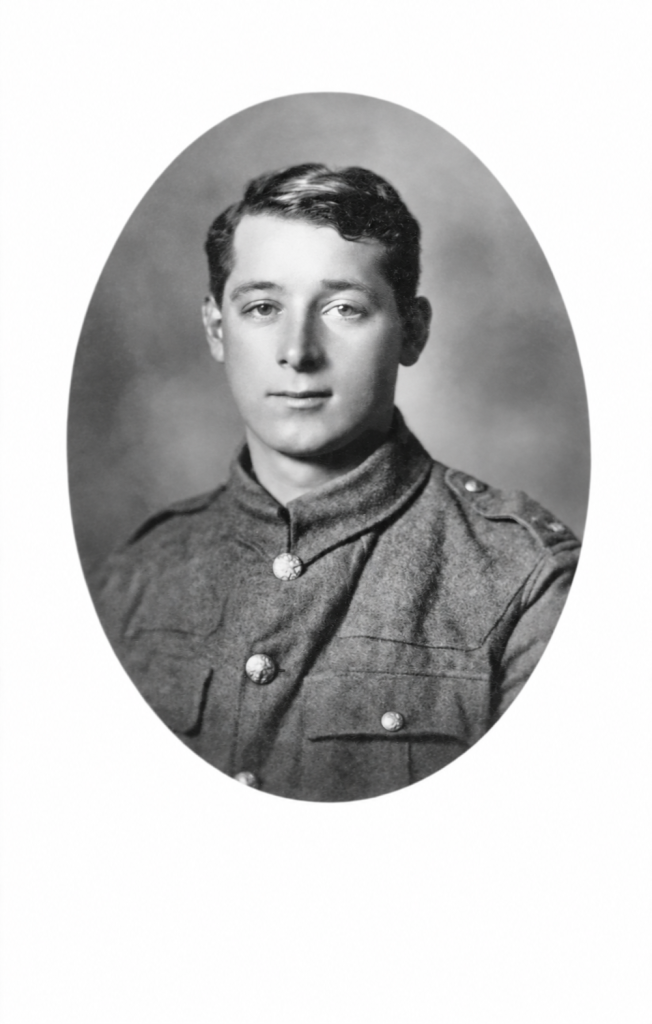
Joseph John Allgood Chapman was born in Kingston on 6 May 1895. His parents were Joseph and Sarah Chapman. In the 1911 Census, the family was living in a four-room house on Great Lane, which was probably the name then used for the main road through Kingston.
The household was a large one. As well as Joseph and his parents, it included his older half-brother Frank Allgood and four younger Chapman children: Sidney, Herbert, Hilda and Walter. Joseph Chapman senior was working as a stockman on a farm. Joseph junior, then still a teenager, was recorded as a labourer.
Joseph enlisted in Cambridge on 19 October 1914. He is one of the few Kingston men for whom a full service record survives, from attestation through to discharge. This is unusual because most First World War soldiers’ service records were destroyed or damaged during bombing raids in the Second World War.
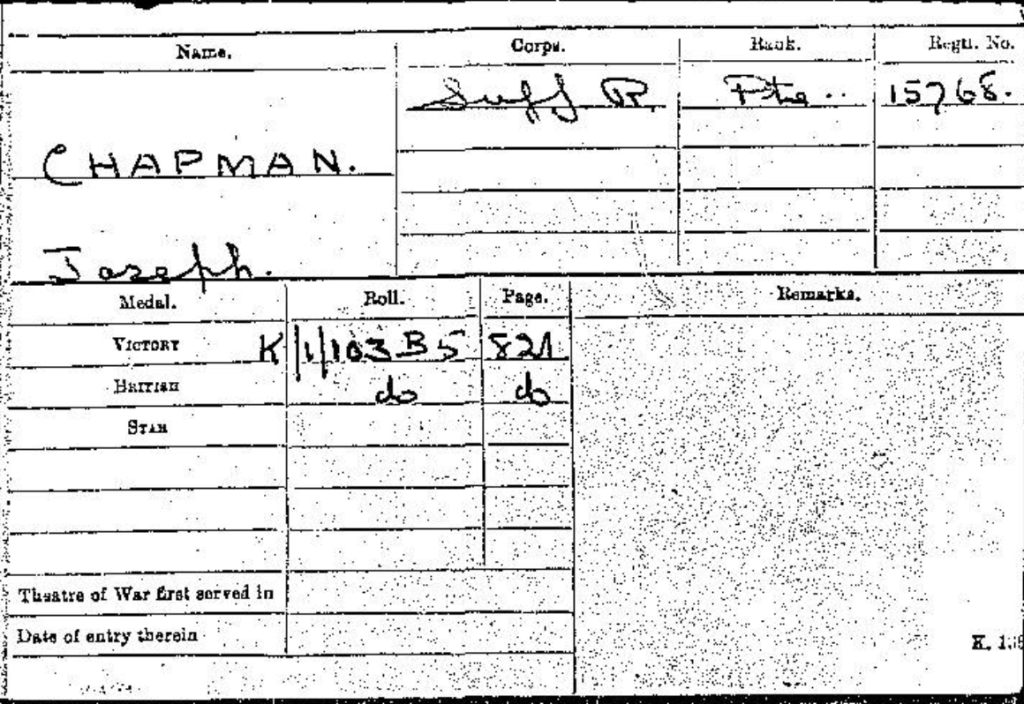
His medical examination at enlistment gives a clear physical snapshot of him as a young man. He was 19 years and 5 months old and working as a farm labourer. He was 5 feet 4¾ inches tall and weighed 138 pounds. His physical development was recorded as “Good”. He had been vaccinated in his left arm in infancy, his eyesight was 6/6, and he had no marks or defects that would prevent military service. His service number was 15768.
Like several other men from Kingston, Joseph joined the Suffolk Regiment and was posted to the 11th Battalion. He was sent to France on 9 January 1916. He was hospitalised a couple of times early on in his time in France, in January and March 1916 for scabies – an occupational hazard in the trenches.
Joseph’s half-brother Frank Allgood served in the same battalion. Frank was killed on 1 July 1916, the first day of the Battle of the Somme. Joseph survived that catastrophic day but the bare fact of survival can sometimes sound passive, in this context it was not. On 2 July 1916, Joseph was reported to have been wounded in the stomach and left wrist by a machine-gun bullet. This was the second day of the Somme, the day after his brother Frank had been killed.
Joseph was evacuated from France to a hospital in Chichester, apparently on the same day that he was wounded. From Chichester he was transferred on 18 August to another military hospital at Shoreham-by-Sea.
In early April 1917 Joseph created some trouble of his own by overstaying his leave pass. For this he was confined to Barracks for 6 days and fined 3 days’ pay. The punishment being more severe because he was deemed to be on active service even though, at the time, he was convalescing in Felixstowe.
He was discharged from hospital on 26 April 1917 after over 9 months of treatment and recuperation. He was then assessed as fit for continued service, and returned to France., rejoining the 11th on 19 May 1917.
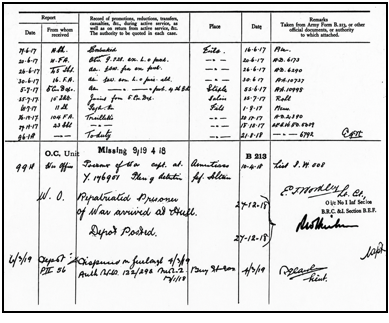
In 1917, the 11th Battalion was involved in the fighting around Arras, including the First and Second Battles of the Scarpe, the fighting at Arleux, and the fierce actions around the chemical works at Roeux. Joseph returned to the Battalion a few days after the action at Roeux.
Joseph seems to have been particularly easy to shoot! He was wounded again on 14 June 1917, shot in the arm and the foot. There was no named action at that point, but the frontline trenches were always dangerous, open to sniper and machine gun fire, as well as artillery bombardment and gas. He moved through the medical system before being treated at Etaples hospital. He was treated there and subsequently in Calais and rejoined the 11th Battalion on 6 September 1917 midway through the Battle of Ypres.
Then on 16 December 1917 he spent 6 weeks, including Christmas, in hospital with tonsillitis, returning to his unit in late January 1918.
Further ordeal followed. Joseph’s service record notes that on 9 April 1918 he went missing and was taken prisoner during the Battle of the Lys. This was part of the German spring offensives of 1918, when many British units were overwhelmed, forced back, or captured.
One battalion history describes the situation around Armentières and Bac St Maur:
“Shortly after sunset on April the 7th the Germans bombarded the town [Armentieres] with gas shells causing heavy casualties the 101st Brigade being now in core reserve the 8th who spent at La Rolanderie with the 12th Battalion close by it Fleurbaix. Before dawn on the 9th the enemy opened an intense bombardment south of the Lille railway but no attack developed along the 34th Division front at 10am the 101st Brigade’s core reserve was sent off to the south of Bac St Maur but when our later the Corps Commander came to Divisional Headquarters and hearing that the enemy had broken the Portuguese front and entered the battle zone of the 40th Division told Major General Nicholson to use the Brigade to cover his own flank.
Lieutenant-Colonel C. C. R. Murphy’s The History of the Suffolk Regiment, 1914–1927, pp. 280–281.
On approaching Bac St Maur and finding the village in possession of the Germans the 101st Brigade took up a position facing west and southwest near Fort Rompu when fighting immediately began. Thus, the first troops of the 34th Division to enter the general engagement with those who almost up to the very moment had formed the cause reserve. A rare tactical anomaly. Terrific fighting followed.
On the 10th the Battalion, having formed a defensive flank, beat off attack after attack twice the Germans broke through but on one occasion the breach was closed by Captain Rodwell and his Company and on the other by Captain Canning and his Company, assisted by Major Wright. At 3:20pm Lt Colonel Tucker received orders to withdraw behind the River Lys”
Joseph was probably captured in or around Bac St Maur on 9 April, when the German advance had unexpectedly overrun the village and forced British units into hurried defensive positions.
The War Office reported Joseph as missing in their Daily List No 5593 on 15 June 1918. Then on 8 October in the War Office Daily List No 5690 they give additional information Reported as Prisoner of War in lists received form the German Government. Apparently, he wrote a letter to his parents in May 1918, from the prison camp, but whenever it arrived, it seems likely his parents had a very long wait until they knew their son was alive.
He was given the prisoner number Y17695. He remained a prisoner of war for the rest of the conflict and was repatriated after the Armistice, returning to Britain by way of Hull.
Joseph was discharged from the Army on 1 April 1919. His discharge papers include a note indicating that he applied for a pension or award in relation to his stomach wound. The claim was rejected because the examining doctor found no continuing disability. That judgement should be read with some caution. A man might be found administratively “fit” or without pensionable disability while still carrying the memory, pain or consequences of what had happened to him. The pension system was not built to capture the whole human cost of service; it was built to decide eligibility.
After the war, Joseph continued to live in Kingston with his parents and his growing family of siblings.
By the time of the 1921 Census, the household included Joseph Chapman senior, Sarah, Joseph junior, Sidney, Herbert, Gertrude, Walter, Edith, William and Frederick. Joseph senior was then working as a tree feller for Apperley, Beard and Co., timber merchants at Toft. Joseph junior was again working as a farm labourer, this time for Robert Doyle and Co. Ltd at Impington. His younger brother Sidney was employed there too.
Joseph Chapman died in Cambridge in July 1972, aged 77.
Joseph’s war can be traced more closely than that of many Kingston men because his service papers survived. They show a young farm labourer who enlisted early, served with the 11th Suffolks, survived the Somme attack in which his stepbrother Frank Allgood was killed, but was himself seriously wounded and spent many months in hospital. The was wounded again in 1917, returned to service, and was then captured during the German offensive of April 1918. His record is therefore not one single episode but a sequence of endurance: enlistment, training, France, the Somme, Arras, wounding, hospital, return to the front, capture, imprisonment and repatriation. It is a long way from a house on Great Lane.
Research note
For future researchers, it is important to note that several men named Joseph Chapman served in the Suffolk Regiment at around the same time. The key link is Frank Allgood’s pension record. Joseph Chapman is listed there as Frank’s next of kin and as due a pension after Frank’s death. In that record, he is identified as 15768 Joseph Chapman, Suffolk Regiment, 11th Battalion. This connects the service number, the surviving service record and the Kingston family, and confirms that the records relate to this Joseph Chapman.